By CAP Liberté de Conscience Feb 2026
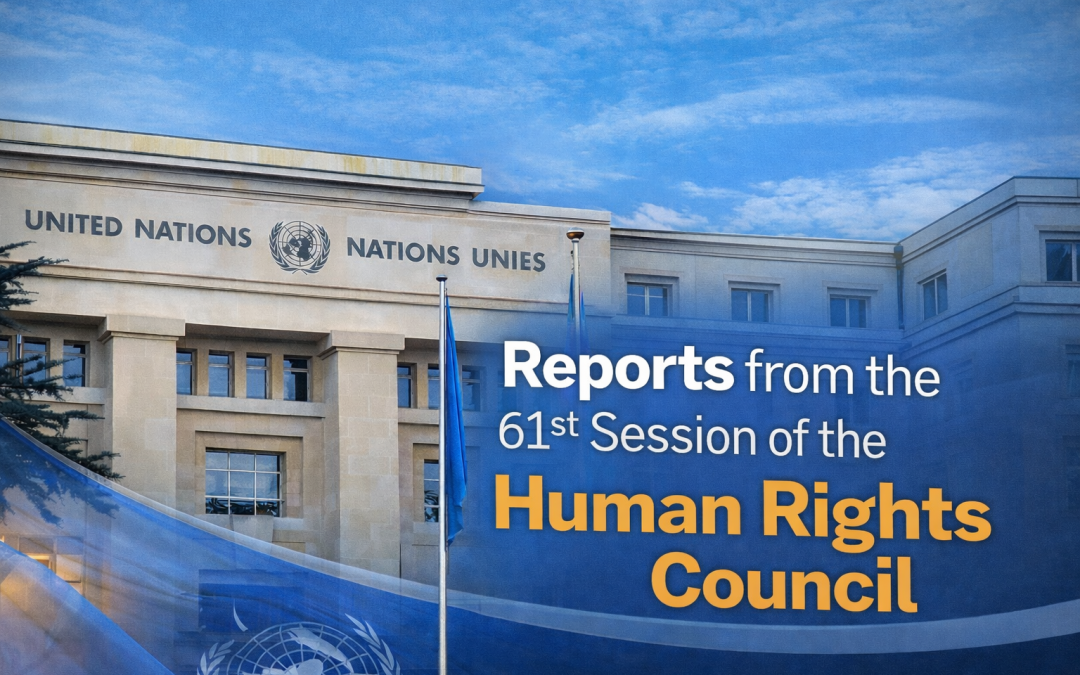
The report A/HRC/61/38, entitled “Annual Report of the Special Representative of the Secretary-General on Violence against Children,” was published on December 24, 2025, and submitted to the Human Rights Council for its 61st session, scheduled for February 23 to April 2, 2026. Prepared by Najat Maalla M’jid, Special Representative of the United Nations Secretary-General on Violence against Children, this document outlines the mandate established by General Assembly resolution 62/141.
Renewed for four years in December 2025, this independent global advocacy function serves the prevention and elimination of all forms of violence against children. Actions taken in 2025 by the Special Representative at the global, regional, and national levels to fulfill her mandate are detailed herein. These efforts are part of the follow-up to the recommendations of the United Nations study on violence against children and the implementation of the 2030 Agenda for Sustainable Development.
The year 2025 was marked by unprecedented multi-stakeholder mobilization, launched in 2024 and supported by the first Global Ministerial Conference on Ending Violence against Children, held in Bogotá in November 2024, and the launch of the Pathfinding Global Alliance to End Violence against Children. Emerging global challenges that increase children’s exposure and vulnerability to violence are identified, with a particular focus on growing concerns surrounding cyberbullying and its complexities.
The text also examines the ways in which rapidly evolving technologies, including artificial intelligence, amplify risks. To compile this analysis, the Special Representative sought contributions from 37 Member States, civil society organizations, and United Nations entities, as well as input from specialized partners and children. An unprecedented multi-stakeholder mobilization is documented, involving Member States, regional organizations, parliamentarians, national human rights institutions, the United Nations system, the private sector, civil society, faith-based organizations, and children.
During this period, the Special Representative visited 16 Member States, meeting with nine heads of state or government and 181 ministers and senior officials. At the time of finalizing the report, 48 Member States had joined the Pathfinding Global Alliance, with more than 400 specific commitments made at the Global Ministerial Conference. Significant progress in national actions is noted, including the adoption of whole-of-government approaches under the leadership of heads of state, development of costed national plans, strengthening of legal frameworks, assessment of the economic costs of violence, and increased allocation of resources for social protection and child welfare. States are developing integrated prevention and protection services accessible to all children, including one-stop shops for victims, alternatives to deprivation of liberty, and substantial investments in child-sensitive social protection.
With regard to cyberbullying, the report finds that it is a rapidly growing global threat. Cyberbullying refers to bullying between children carried out through digital technologies—social media, messaging apps, gaming platforms, and mobile phones—involving repeated actions intended to intimidate, embarrass, or harm the target. According to the WHO Survey on Health Behaviors Among School-Aged Children (2021/22), 15 to 16 percent of young people aged 11 to 15 in Europe, Central Asia, and Canada had been victims of cyberbullying in the previous months. Microsoft’s Global Online Safety Survey (2025) reports that 21 percent of children had been cyberbullied in the previous year, and 37 percent consider it their main concern regarding online safety. Several characteristics are identified that make cyberbullying particularly difficult to address: its cross-border and multi-platform nature, the anonymity of profiles, the difficulty of tracking it, and persistent underreporting. The most vulnerable children are those perceived as “different” or marginalized because of their physical appearance, race, ethnicity, gender, disability, religion, sexual orientation, health, weight, or socioeconomic status.
The risk peaks between the ages of 12 and 15 with the increase in social media use. Artificial intelligence is profoundly reshaping cyberbullying, increasing and accelerating its complexity. Generative AI technologies—creation of deepfakes, nudification tools, voice cloning—are increasingly being used as weapons to humiliate, harass, and coerce children. AI enables the fabrication of sexually explicit or compromising images from innocent photos, the dissemination of manipulated videos, and the online impersonation of victims, amplifying psychological damage and reputational harm. The report warns against the use of AI for profiling and predictive targeting, which can identify vulnerable children for targeted harassment or exploitation. The consequences of cyberbullying on children’s educational outcomes, long-term health, and well-being are well documented. Victims are more likely to miss school and perform poorly academically.
The WHO has linked cyberbullying to sleep disorders, eating disorders, addiction, and problematic use of social media and gaming. Victims have significantly higher rates of depression, anxiety, low self-esteem, self-harm, and suicide, with young adolescents being particularly vulnerable due to ongoing cognitive and emotional maturation. Several urgent recommendations are made for a comprehensive and coordinated response. Children’s rights must be integrated into the heart of digital governance through child safety and privacy by design, due diligence, and accountability frameworks. Given the role of AI in amplifying risks, the integration of child-centered principles into the development and deployment of AI systems is essential. Greater consistency and harmonization of regulations at the global level is recommended, particularly in the context of emerging technologies.
States should adopt national legislation and strategies specifically targeting cyberbullying, introduce amendments to criminal law to specifically address cyberbullying, cyberstalking, and related offenses, and impose obligations on technology platforms to assess the risks their services pose to children. Strengthening law enforcement and justice systems is recommended, including training law enforcement agencies on cyberbullying and reinforcing cross-border cooperation through regional cybercrime networks. Justice systems should prioritize restorative, educational, and supportive measures over punitive approaches in peer-to-peer cases, ensuring that victims and perpetrators receive counseling, protection, and pathways to rehabilitation. The establishment of child-sensitive counseling and reporting mechanisms is essential, including hotlines and helplines providing confidential access to assistance, legal advice, and referral to mental health and child protection services. School-based interventions should be reinforced by whole-school approaches, the integration of anti-bullying, digital literacy, and digital citizenship content into school curricula, and training for teachers to recognize the signs of cyberbullying.
The role of digital literacy education is crucial in preventing cyberbullying by empowering parents, caregivers, teachers, frontline professionals, and children with knowledge and skills. Increased investment in sustainable prevention is needed to reduce the incidence of cyberbullying.
Technology companies must develop prevention and response tools, including AI-powered moderation technologies for real-time detection of harmful content. Strong regulatory frameworks, mandatory child safety and privacy measures by design, and rigorous due diligence on children’s rights are needed to ensure that online products and services, including AI, meet the highest standards of safety, ethics, and privacy. Finally, children and young people must be empowered to shape solutions. Their experiences must be taken into account and they must be meaningfully involved in the design and implementation of responses to ensure that digital environments are established that truly protect and support them.
CAP Freedom of Conscience has been actively involved in monitoring children’s rights through UN mechanisms, producing several major contributions directly related to the issues addressed in this report. The organization submitted a contribution to the Committee on the Rights of the Child’s draft general comment No. 27 on children’s access to justice, highlighting the systemic barriers faced by children who are victims of domestic violence in France. CAP LC also responded to the call for contributions from the Special Representative of the Secretary-General on Violence against Women and Girls, analyzing the specific forms of institutional violence faced by mothers in contexts of domestic violence. In addition, the organization submitted a report to the Office of the United Nations High Commissioner for Human Rights on the experiences of victims and survivors of torture and other cruel, inhuman, or degrading treatment, documenting the systemic failures of French judicial and social institutions that lead to the revictimization of children and their protective mothers. These contributions are in line with the recommendations of this report, particularly with regard to effective access to justice for children, the prevention of secondary victimization, and the need for a coordinated institutional response focused on the rights of the child.
Related posts:
 UN Report on the Rights of the Child and Violations of Children’s Human Rights in Armed Conflicts: Findings and Recommendations – Human Rights Council 60th Session
 Submission on the Draft General Comment No. 27 on Children’s Access to Justice
 HRC 58 : Geneva Conference Highlights Religious Persecution and Education Crisis in Pakistan
 CAP Liberté de Conscience Responds to the Call on Children’s Right to Access to Justice and to an Effective Remedy