What is “Coordination des Associations et des Particuliers pour la Liberté de Conscience” (CAP Freedom of Conscience)?

CAP Freedom of Conscience is a secular European NGO with United Nations Consultative Status, created in 1995 and dedicated to protect the Right of Freedom of Religion and Belief.

CAP Freedom of Conscience combats all forms of discrimination based on religion or belief by alerting European and International bodies.

CAP Freedom of Conscience collects testimonies of discrimination and human rights violations affecting religious or belief communities in order to disseminate them to international bodies, and in order to raise awareness and inform them as well as to generate debate on the protection of Freedom of Religion and Belief.

CAP Freedom of Conscience also advocates for any religious or spiritual group facing discrimination to have their right to Freedom of Religion and Belief recognized.

CAP Freedom of Conscience is a member of the European Federation for Freedom of Belief (FOB), European Network Of Religion and Belief (ENORB) and participate to the Civil Society Platform of Fundamental Rights created by the EU Fundamental Rights Agency DAFOH Partners in Combating and Preventing Forced Organ Harvesting
European Parliament Resolution on Systemic Oppression in Iran: A Call for International Accountability

European Parliament Resolution on Systemic Oppression in Iran: A Call for International Accountability

On 12 February 2026, the European Parliament adopted Resolution P10_TA(2026)0046 addressing systemic oppression, inhumane conditions and arbitrary detentions by the Iranian regime. This text represents the institution’s continued engagement with human rights violations in Iran, building upon multiple prior parliamentary resolutions on the country. The resolution was adopted under emergency procedures (Rule 150(5) and 136(4)), underscoring the urgency with which the Parliament views the situation.

read more
European parliament raises urgent questions on antisemitism in Eu schools following UNESCO survey

European parliament raises urgent questions on antisemitism in Eu schools following UNESCO survey

On 30 January 2026, a cross-party group of eighteen European Parliament members submitted a written question to the European Commission regarding alarming findings in a UNESCO report on antisemitism in European Union educational institutions. The initiative, led by MEPs from multiple political groups—including the European Conservatives and Reformists, Renewists, and the Patriotic Europe faction—signals growing parliamentary concern over documented prevalence of antisemitic incidents within classrooms across the bloc.

read more
The United Nations High Commissioner for Human Rights Addresses Critical Violations in Sudan: Key Findings and International Recommendations

The United Nations High Commissioner for Human Rights Addresses Critical Violations in Sudan: Key Findings and International Recommendations

The Office of the United Nations High Commissioner for Human Rights (OHCHR) published a comprehensive report (A/HRC/61/24) on 13 January 2026, presenting an assessment of the human rights situation across Sudan. The document covers the period from 16 November 2024 to 15 November 2025 and was submitted to the Human Rights Council at its sixty-first session, responding to Council resolution 57/2.

read more
HRC 61 Written Statement Ensuring Justice in the Sudan: Extending Accountability for Crimes Against Humanity

HRC 61 Written Statement Ensuring Justice in the Sudan: Extending Accountability for Crimes Against Humanity

At the 61st session of the United Nations Human Rights Council, CAP Liberté de Conscience submitted a written statement highlighting the catastrophic human rights situation in Sudan and the urgent need for extended accountability. The submission documents heinous crimes committed by the Rapid Support Forces (RSF), including summary executions, sexual violence, and mass killings in areas like El Fasher and the Zamzam camp, while noting the RSF’s systematic attempts to destroy evidence. CAP LC emphasizes the necessity of extending the UN Security Council’s ICC referral beyond Darfur to cover all regions of Sudan, ensuring justice for crimes against humanity nationwide. Additionally, the statement exposes the critical role of foreign actors, particularly the United Arab Emirates, in supplying weapons that sustain the RSF’s operations. Consequently, CAP LC calls on Member States to cease arms transfers to the RSF, condemn the UAE’s involvement, impose sanctions on perpetrators and enablers, and support international mechanisms for evidence preservation and accountability.

read more
HRC 61 Written Statement Threatened Dissolution of Shincheonji and Other Religious Organizations in the Republic of Korea

HRC 61 Written Statement Threatened Dissolution of Shincheonji and Other Religious Organizations in the Republic of Korea

At the 61st session of the United Nations Human Rights Council, CAP Liberté de Conscience submitted a written statement raising serious concerns over the threatened dissolution of the Shincheonji Church and other minority religious organizations in the Republic of Korea. The document condemns efforts by President Lee Jae Myung to disband groups labeled as “pseudo-religions,” arguing that such state actions violate Article 18 of the ICCPR by allowing the government to act as a theological arbiter. CAP LC challenges the cited Japanese precedent, noting UN Special Rapporteurs’ criticism of dissolution orders based on vague concepts of “public welfare.” The statement further refutes claims of “enormous damage,” highlighting the Supreme Court’s acquittal of Shincheonji regarding COVID-19 allegations and the lack of coercive elements in its past evangelism methods. Consequently, CAP LC urges the Korean authorities to respect freedom of religion or belief and cease discriminatory campaigns driven by religious intolerance.

read more
Interactive dialogue on the oral update of the OHCHR on the human rights situation in and around El Fasher, in the context of the ongoing conflict in the Sudan

Interactive dialogue on the oral update of the OHCHR on the human rights situation in and around El Fasher, in the context of the ongoing conflict in the Sudan

Survivors of the attacks in El Fasher report mass atrocities and killings committed by the Rapid Support Forces after a year and a half of siege under horrific conditions, with no access to basic necessities. Civilians who fled describe widespread violence, including torture, kidnappings for ransom, sexual violence, disproportionately affecting women and girls, and summary executions as they attempted to escape. More than 1,000 days into the conflict, atrocities persist, and large-scale attacks are becoming a recurring pattern. Immediate and collective action is required to cease these crimes and prevent similar atrocities in other regions of Sudan.

read more

CAP Freedom of Conscience involvement UNITED NATIONS

LASTEST NEWS

Annual Report of the Special Representative of the United Nations Secretary-General on Violence against Children: Cyberbullying and Protection Issues

The report A/HRC/61/38, entitled “Annual Report of the Special Representative of the Secretary-General on Violence against Children,” was published on December 24, 2025, and submitted to the Human Rights Council for its 61st session, scheduled for February 23 to April 2, 2026. Prepared by Najat Maalla M’jid, Special Representative of the United Nations Secretary-General on Violence against Children, this document outlines the mandate established by General Assembly resolution 62/141.

Submission to UN Special Rapporteur Details Systemic Discrimination in German Public Procurement

In preparation for the upcoming official visit to Germany by the United Nations Special Rapporteur on the promotion and protection of the right to freedom of opinion and expression, the non-governmental organization CAP Liberté de Conscience (CAP LC) has submitted a comprehensive report addressing specific concerns regarding systemic discrimination. The Special Rapporteur’s visit, scheduled to take place from 26 January to 6 February 2026, aims to assess the situation of freedom of opinion and expression in the country. This assessment includes reviewing legal, institutional, and policy frameworks that protect or restrict these fundamental rights, as well as measures addressing intolerance, negative stereotyping, and stigmatization.

CAP Liberté de Conscience Submission to the UN Special Rapporteur on Violence Against Women and Girls

In response to the Call for Input issued by the United Nations Special Rapporteur on violence against women and girls for her report to the 62nd session of the Human Rights Council, CAP Liberté de Conscience has submitted a comprehensive analysis titled “CAP LC report of the Special Rapporteur on violence against women and girls.” The submission, accessible via the official call https://www.ohchr.org/en/calls-for-input/2026/call-input-report-special-rapporteur-violence-against-women-and-girls-62nd, examines specific forms of institutional violence faced by mothers in contexts of intrafamilial violence, with a focus on the French socio-judicial system.

Oral Statement – 39th Special Session of the UN Human Rights Council on Iran

CAP Liberté de Conscience is deeply concerned about the deteriorating human rights situation in Iran, particularly regarding religious freedom and the persecution of religious minorities.

CAP Liberté de Conscience Submits Report to UN Women CSW70 Addressing Barriers to Justice for Women and Girls

In August 2025, CAP Liberté de Conscience, in collaboration with a network of independent experts, submitted a communication to the Commission on the Status of Women (CSW) under the United Nations’ communications procedure for the seventieth session (CSW70) scheduled for March 2026. The report addresses systemic barriers to justice for women and girls and provides evidence-based documentation on institutional and societal discrimination. The initiative is part of CAP Liberté de Conscience’s ongoing advocacy to enhance the protection of human rights at the international level.

CAP Liberté de Conscience Submits Report to UN on Institutional Violence

The NGO CAP Liberté de Conscience has formally responded to the call for input issued by the Office of the UN High Commissioner for Human Rights (OHCHR) on the “Experiences and perspectives of victims and survivors of torture and other cruel, inhuman or degrading treatment or punishment”. The call, detailed here, seeks to gather information for a comprehensive report to be presented at the 61st session of the Human Rights Council in March 2026.

WG UPR 52nd Session CAP Liberté de Conscience Submits Report to UN WG UPR on Denmark’s Anti-Racism Efforts

CAP Liberté de Conscience (CAP LC), an international non-governmental organization with consultative status at the United Nations, has jointly submitted a report for the 52nd session of the Universal Periodic Review (UPR) Working Group, focusing on Denmark. This expert analysis was prepared in collaboration with Mr. Bashy Quraishy, Secretary General of the European Muslim Initiative for Social Cohesion (EMISCO), and Mr. Gregory Christensen, Leader of Youth for Human Rights – Denmark. Both experts are members of the Advisory Board of the Danish Institute for Human Rights and bring decades of experience in human rights, anti-discrimination, and minority integration work within Denmark and the European Union.

Submission on the Draft General Comment No. 27 on Children’s Access to Justice

A group of experts on children submitted a contribution on behalf of CAP Liberté de Conscience to the United Nations Committee on the Rights of the Child in response to its public call for contributions on draft general comment No. 27 (2025) on the right of children to access justice and effective remedy. The call for contributions is available on the OHCHR website.

CAP Liberté de Conscience Submits Written Statement on Human Rights Violations in Sudan at the 59th UN Human Rights Council Session

At the 59th session of the United Nations Human Rights Council, CAP Liberté de Conscience submitted a written statement detailing ongoing human rights violations in Sudan, emphasizing the urgent need for international attention and action. The statement highlights the severe impact of the conflict between the Rapid Support Forces (RSF) and other actors on civilians, including thousands killed or injured and nearly 12 million displaced persons, making it the world’s largest displacement crisis.

CAP Liberté de Conscience Responds to the Call on Children’s Right to Access to Justice and to an Effective Remedy

CAP Liberté de Conscience (CAP LC) has submitted a detailed report in response to the public consultation launched by the UN Committee on the Rights of the Child regarding the draft of General Comment No. 27 on children’s right to access to justice and to an effective remedy. The call for submissions, available at the OHCHR website, seeks perspectives on improving mechanisms to ensure that children can access justice effectively and receive appropriate remedies for violations of their rights. The contributors addresses systemic challenges in France and proposes concrete recommendations to safeguard children’s rights in judicial and social protection settings.

HRC 59 : The Ongoing Genocide in Sudan and The Intervention of International Actors

On Wednesday 18 June 2025, a side event on “The Ongoing Genocide in Sudan and The Intervention of International Actors” was hosted by the Coordination des Associations et des Particuliers pour la Liberté de Conscience (CAP Freedom of Conscience), and co-hosted by Global Human Rights Defence (GHRD), coinciding with the 59th session of the Human Rights Council.

HRC 59 Sudan Item 3: ID with the SR on extrajudicial, summary or arbitrary executions

I speak today on behalf of victims of violence committed by the Rapid Support Forces in Sudan and their foreign backers.

Since the outbreak of the conflict, thousands of civilians have been killed or injured with almost 12 million people who have fled their homes. The RSF has launched repeated attacks on displacement camps, forcing civilians to flee again.

Committee Against Torture Puts France’s Law Enforcement Practices and Detention Conditions under Scrutiny

During the 82nd session of the Committee Against Torture (CAT)[i], France’s record on police practices and detention conditions faced pointed scrutiny. Omnium des Libertés (ODL) recent report submitted to the Committee[ii] provided testimony-driven evidence highlighting abuses by French law enforcement and violations of detainees’ fundamental rights. In this context, the Committee used its platform to seek clarity and accountability from France, reinforcing the utility and urgency of independent civil society reporting.

82th CAT Session : France Under Scrutiny for Police Conduct

Key Findings from Human Rights Organization Report As France gets ready to respond to the Committee Against Torture (CAT) on its human rights record during the 82nd session, a report by an international human rights organization raises concerns about the activities of French police. The report notes severe violations of the fundamental rights of individuals during police raids and detention, with more emphasis on the treatment of spiritual minorities.

Freedom of Religion or Belief and the Plight of Migrants: A Call for Action

The United Nations Special Rapporteur on Freedom of Religion or Belief has called for contributions from  all over the world on the topic of religious freedom for migrants, internally displaced persons (IDPs)  and refugees. This initiative is aimed at the increasing problems faced by people and communities who have been forced  to leave their homes on account of religious persecution. The Special Rapporteur’s report provides a general  picture of systemic violations of religious freedom affecting primarily vulnerable populations such as asylum seekers and IDPs.

Religious Persecution and Human Rights: UN Report Examines Torture and Religious Freedom

In the  report “Freedom of Religion or Belief and the Prohibition of  Torture”, the UN Special  Rapporteur Nazila Ghanea looks at how religious persecution is linked with human  rights  violations. The study which was discussed at the 58th session of the Human Rights Council and later made  news by European Times News, focuses on how religious prejudice can lead to institutional violation.

 The focus of  the report is on the connection between coercion and religious freedom. According to European Times  News,  Ghanea said, “Not all forms of coercion reach the threshold of torture or ill-treatment,  but all forms of torture  committed on persons on the basis of their religion or belief constitute coercion.”

82th Session CAT : Domestic violence: a form of institutionalised torture?

The socio-judicial treatment of domestic violence in France is a cause for concern. At a time when our country, the self-proclaimed defender of human rights, is struggling to protect children and their protective parents from domestic violence, it is crucial to highlight the serious malfunctioning of our institutions. These practices, which I describe in a file submitted to the UN Committee against Torture as a form of institutionalised torture, expose the victims to a double penalty: that of the violence suffered and that of the procedures that condemn them to injustice and create new traumas.

Egypt’s Human Rights Landscape: Insights from the 48th Universal Periodic Review

The Coordination des Associations et des Particuliers pour la Liberté de Conscience (CAP Liberté de Conscience), a secular international organization, has actively contributed to the 48th session of the Universal Periodic Review (UPR) Working Group on Egypt. CAP Liberté de Conscience submitted a detailed report addressing critical issues related to freedom of religion and belief, particularly highlighting the persecution faced by the Ahmadi Religion of Peace and Light in Egypt. This article synthesizes the key points from the stakeholders’ submissions, the UPR summary report, and CAP’s recommendations to shed light on the ongoing challenges and proposed solutions.

UN OHCHR Syria: Children’s rights at the heart of the issues after the fall of the Assad regime

The fall of Bashar al-Assad’s regime on 8 December 2024 after fourteen years of civil war marks a major turning point for Syria. However, it also highlights the serious violations of children’s rights during the conflict. In the light of this particularly worrying information, based on data from international reports and first-hand accounts, I have submitted a dossier to the United Nations to draw attention to these injustices and make concrete recommendations.

Summary of stakeholders’ submissions on Ethiopia

Of particular alarm is the situation of the Amhara people. Joint Submission 3 (JS3) reported that the Amhara, Ethiopia’s largest ethnic group, have been subjected to targeted attacks, displacement, and grave human rights violations. These attacks appear to be intentionally aimed at eliminating Amharas from certain regions of the country.

France Under Scrutiny: UN Human Rights Committee Reveals Systemic Challenges in Religious Freedom, Policing

In a review of France’s human rights record, the United Nations Human Rights Committee has highlighted significant concerns regarding religious freedom, law enforcement practices. The 142nd session’s report (CCPR/C/FRA/CO/6) offers a critical examination of systemic challenges facing the French Republic.

UN OHCHR CAP LC Submits Report on Religious Persecution and Torture to UN Special Rapporteur

CAP Freedom of Conscience October 2024 CAP Liberté de Conscience has submitted a comprehensive...

Submission to the 49th session of the UPR Working group on Sweden

The submission highlights a concerning issue: the deportation of Ahmadi asylum seekers by Sweden to Pakistan, where they face a high risk of persecution. The submission argues that Sweden’s actions in this regard contravene international law, European legal frameworks, and established UN guidelines, which recognize the extreme vulnerability of Ahmadis in Pakistan.

CCPR – International Covenant on Civil and Political Rights 142 Session Pakistan

CAP Liberté de Conscience September 2024 Ahmadiyya Community in Pakistan Faces Alarming...

CCPR – International Covenant on Civil and Political Rights 142 Session FRANCE

The report by Human Rights Without Frontiers (HRWF) and CAP LC presented to the 142nd session of the UN Human Rights Committee paints a disturbing picture of the treatment of Romanian yoga practitioners by French authorities in the aftermath of wide-scale police raids in November 2023.

CAP Freedom of Conscience involvement in Europe

2024 WARSAW HUMAN DIMENSION CONFERENCE Session Germany Amhadiyya

We are deeply concerned about Germany’s refusal to grant asylum to Ahmadiyya Muslims and their forced return to Pakistan, where they face persecution and denial of rights. The Ahmadiyya Muslim Community in Pakistan is enduring an alarming rise in violence and systemic persecution, with a disturbing trend of targeted murders, desecration of mosques and graves, and the continued denial of basic civil rights. By sending back the Ahmadis to Pakistan, Germany contravene its obligation under:

2024 WARSAW HUMAN DIMENSION CONFERENCE Session 7 Freedom of religion or belief

We are very concerned about the systematic discrimination and exclusion of law-abiding citizens who follow the teachings of the Scientology religion in Germany.

In fact, there have been at least three thousand ninety-five cases in the last ten years in which German government agencies have included “faith-breaking” clauses in their invitations to bid, requiring bidders to renounce any association with Scientology.

2024 WARSAW HUMAN DIMENSION CONFERENCE – Independence of the judiciary – Right to a fair trial

2024 WARSAW HUMAN DIMENSION CONFERENCE Warsaw, 30 September to 11 October 2024 Plenary Session 6:...

2024 WARSAW HUMAN DIMENSION CONFERENCE France Institutional torture

Institutional torture can take many forms, and one particularly insidious manifestation is when control and ideology take precedence over  human dignity[i]. The case of the French police’s treatment of Romanian yoga practitioners is a stark example of this.

Faith and Freedom Summit 2024 HOW FAITH-BASED ORGANIZATIONS TACKLE ISSUE THAT ARE AFFECTING CITIZENS IN EUROPE

First of all I would like to thank Mrs Maxette Pirbakas MP and the organisers of this 3rd Faith and Freedom summit for inviting me to give you a presentation on the theme of “the social action of Faith-Based Organizations”. I would like to take you on a journey through time, exploring the profound impact of Faith-Based organisations in promoting peace and social equality from the 15th century to the present day.

OSCE ODIHR HATE CRIME REPORTING France

ODIHR recognizes France’s efforts to address hate crimes in a comprehensive manner, and improve its hate crime data collection. However, based on available information, it observes that France’s hate crime recording and statistics do not sufficiently distinguish hate crimes from other crimes. In addition, ODIHR observes that France would benefit from enhancing its efforts to build the capacity of prosecutors and judges to prosecute and sentence hate crimes.

Recognizing and recording bias motives essential to counter hate crime and restore victims’ trust, OSCE human rights office says

WARSAW, 16 November 2023 – Launching its annual Hate Crime Report on today’s International Day for Tolerance, the OSCE Office for Democratic Institutions and Human Rights (ODIHR) emphasized the importance of identifying the underlying bias motives of hate crimes in order to diminish the impact on victims and assist their recovery.

How the way a state treats religious minorities affects the way its citizens live together.

The French government has established a system of control over these minorities that is unique in Europe and that leads to serious violations by the State of the principles of freedom of religion or belief, equality of French citizens before the national institutions, and fraternity, by dividing citizens according to whether or not they belong to a recognized religious or belief minority, and by creating a climate of suspicion and sometimes even hatred towards non-traditional beliefs, leading to a deterioration in the quality of peaceful living together.

OSCE Warsaw Human Dimension 2023 discusses persecution of Ahmadi Religion members

Thank you, I’m Christine Mirre, From CAP Liberté de Conscience We have discovered that over one hundred members of the Ahmadi Religion of Peace and Light, a peaceful Muslim minority persecuted as heretics in several Muslim majority countries have been detained for over four months in Turkish immigration centers and are now being progressively released on the bases of a Turkish court decision.

CAP Freedom of Conscience Statement on France Plenary Session IV: Fundamental freedoms II

On behalf of UNITED SIKHS and CAP Liberté de Conscience, I address a critical issue affecting our Sikh community and the principles of religious freedom, values we all hold dear.

In recent years, France has become a focal point of concern due to its long-standing ban on Sikh turbans in state schools.

This ban, in place for two decades, violates the fundamental rights of Sikh students to express their faith by wearing turbans, under-turbans, and top-knot coverings, directly contradicting principles of human rights and religious freedom.

SUPPORT CAP Liberté de Conscience

IBAN BE61 9670 0987 0017

SWIFT / BIC TRWIBEB1XXX

Address
TransferWise Europe SA
Square de Meeûs 38 bte 40
Brussels
1000
Belgium

The Right to Return in International Law

The Right to Return in International Law

jointly organized by CAP Freedom of Conscience and the Western Azerbaijan Community, with media support from Bruxelles Media.

The program brings together experts, policymakers, and scholars for focused dialogue, including conceptual framing, panels on cultural heritage and property rights, a documentary screening, and structured opportunities for exchange.
read more
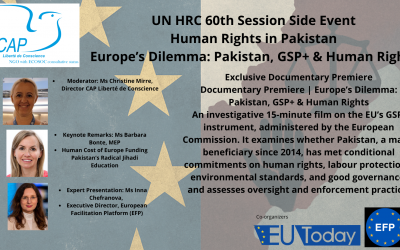
UN HRC 60th Session Side-event Human Rights In Pakistan

UN HRC 60th Session Side-event Human Rights In Pakistan

Documentary Premiere | Europe’s Dilemma: Pakistan, GSP+ & Human Rights
An investigative 15-minute film on the EU’s GSP+ instrument, administered by the European Commission. It examines whether Pakistan, a major beneficiary since 2014, has met conditional commitments on human rights, labour protections, environmental standards, and good governance, and assesses oversight and enforcement practice.

read more
HRC 59 Side-event Human Rights in Sudan

HRC 59 Side-event Human Rights in Sudan

Join us for this important side event, which will bring together legal and human rights experts,
victims, speakers with knowledge of the situation in Sudan to discuss the ongoing crisis and explore
potential ways to end the violations and hold those responsible to account.

read more
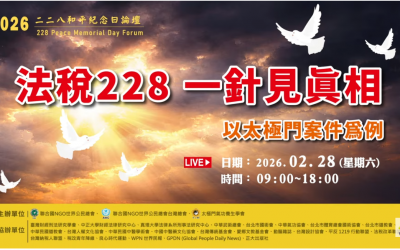
the 228 Incident Commemoration

the 228 Incident Commemoration

 The 228 Incident is not just a historical event; it is the representation of the fundamental human need for dignity, justice, and self-determination. When the peaceful protesters were killed, their spirit would have been killed as well, had they not rise up and fight for what they believed in. In this spirit of resistance, there are a number of similarities to the current struggle of the Tai Ji Men, a group that has for decades fought against systemic injustice and arbitrariness of the system.

read more
Human Rights Now And in the Future

Human Rights Now And in the Future

By Thierry Valle President CAP Liberté de Conscience 10/12/2024 Strengthening international solidarity to improve the Human Rights situation in the future Why It Is Crucial to Promote the Idea of International Solidarity in Human  Rights  It is a great pleasure to...

read more
Side event HRC 57 Arbitrary Detention in the UAE: Addressing the Crisis of Civil Society Suppression

Side event HRC 57 Arbitrary Detention in the UAE: Addressing the Crisis of Civil Society Suppression

On Tuesday 17 September 2024 at 1 p.m. in the Peace Palace (Room XXV) in Geneva, a side event will feature Joey Shea, Researcher at Human Rights Watch, Ahmed al-Nuaimi,  defendant in the UAE 94 trial, and Matthew Hedges, a British academic held in solitary confinement for nearly seven months. The panel will address serious concerns about arbitrary detention and the repression of civil society in the United Arab Emirates (UAE).

read more
Translate »
Share This