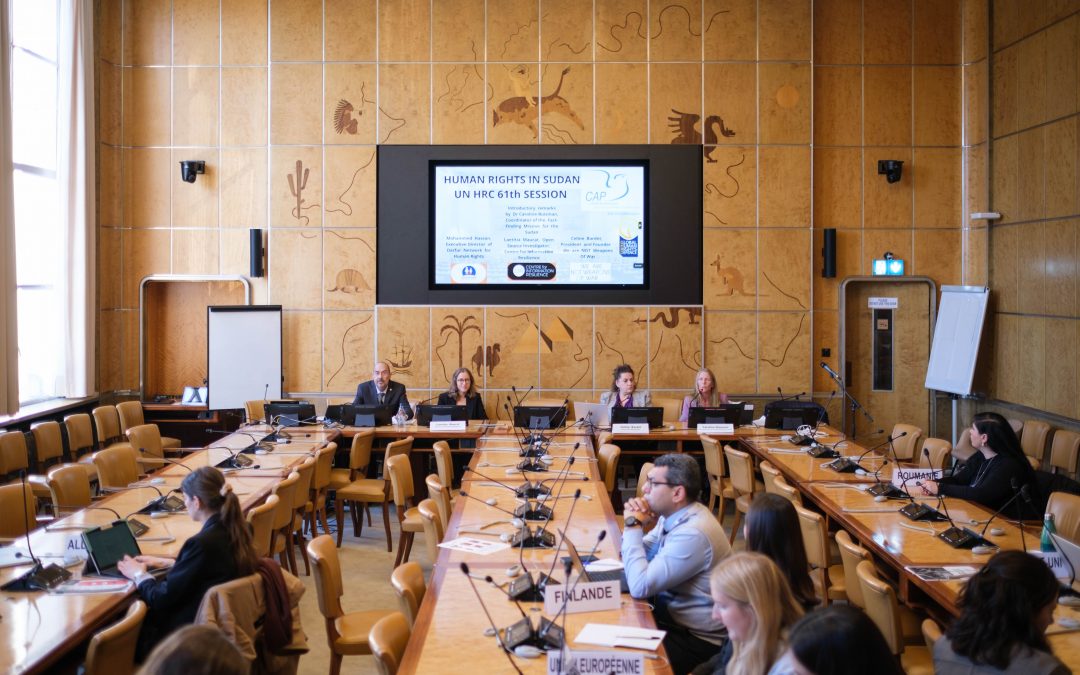
“1000 days of conflict. 1000 days of civilians suffering the first-hand consequences of the fighting”, opened Thierry Valle, President of CAP Freedom of Conscience, at the side event on Friday 27 February 2026, held at the UN Human Rights Council, as atrocities continue unabated.
Recent findings from UN representatives and bodies are deeply alarming. On Thursday 26 February 2026, during the Human Rights Council’s first session of the year, the UN High Commissioner for Human Rights reported “clear, ongoing patterns of violence, including killings, rape, and torture”.[1] Similarly, the UN Fact-Finding Mission revealed that in El Fasher last October, mass killings and related atrocities committed by the Rapid Support Forces were “indicators of a genocidal path”. In response, the UN Security Council imposed sanctions on four Rapid Support Forces ( “RSF”) commanders for atrocities committed during the October takeover.[2]
As emphasised in the opening remarks, international crimes continue, and new methods of warfare are emerging, including the use of drones to target civilian infrastructure. It is therefore crucial to press all parties to halt atrocities and to scrutinise any external involvement that facilitates them. Investigations by field teams and NGOs have reported external support, including from the United Arab Emirates (“UAE”), providing weapons and other resources that enabled the RSF to carry out attacks against civilians. Such backing allows large-scale hostilities to persist. The UAE has denied these allegations in its “Right of Reply” following the first session at the UN Human Rights Council.
The panel included Dr Caroline Buisman, Coordinator of the UN Fact-Finding Mission; Céline Bardet, President and Founder of We Are NOT Weapons of War; Mohammed Hassan, Executive Director of the Darfur Network for Human Rights and Laetitia Maurat, Open-Source Investigator at the Centre for Information Resilience. Delegations from Romania, the United Kingdom, Belgium, Tanzania, and Finland attended the event.
Dr Caroline Buisman highlighted to the audience that, in response to the human rights and humanitarian crisis in Sudan, the UN Human Rights Council adopted resolution A/HRC/RES/54/2 on 11 October 2023, establishing an independent international fact-finding mission. The mission is tasked with investigating the facts, circumstances, and root causes of all alleged human rights violations and abuses, including breaches of international humanitarian law, in the context of the armed conflict that began on 15 April 2023.
Dr Buisman emphasised that one of the mission’s key objectives is to preserve evidence “with a very protective database” and to “record the chain of custody, which is critical if you want to prepare for a trial”. Evidence is collected with the aim of being used in courts. She also explained that the findings of the mandate are based on “reasonable grounds to believe” standards, which require collaboration, credible evidence, and constitute “a sufficient base for indictment, for instance at the International Criminal Court”.
The UN Fact-Finding Mission works with any judicial mechanism willing to pursue cases, including both national and international courts. One of the mandate’s recommendations is the establishment of a new mechanism that “would work together with the ICC”, given that domestic jurisdiction in Sudan is currently insufficient, according to Dr Caroline Buisman.
Among the many challenges faced by the Fact-Finding Mission in carrying out its mandate, Dr Buisman pointed to restrictions on access: the Mission is not permitted to enter Sudan. Even if access were granted, it remains essential to conduct interviews in a safe and secure environment, without interference. Victims who have fled to neighbouring countries continue to “fear risks because the conflict is spilling over into those states”. Some survivors have reported seeing their perpetrators in the same refugee camps where they are staying, making “the security and safety of those people, and their conditions, incredibly important”.
Similarly to Dr Caroline Buisman, Céline Bardet emphasised the importance for investigators on the ground not only of having access to victims, but of being able to engage with them in a safe environment, particularly in cases of sexual violence. In her experience, victims are often unable or unwilling to speak to outsiders because of the depth of their trauma, as well as fear, stigma and shame. Many are located in hard-to-reach locations, frequently lack the means to travel, and face serious risks to their personal safety.
In Sudan, the UN and other organisations have reported widespread conflict-related sexual violence since the outbreak of fighting in April 2023. Interviews with survivors have documented extensive sexual and gender-based violence, including rape, gang rape, sexual exploitation and enforced prostitution, among other violations. Céline Bardet described the situation as an “unprecedented level of violence”. On several occasions, survivors have sought to draw attention to the scale of these crimes, including a group of victims who ultimately committed suicide after being raped in an attempt to escape further atrocities by the RSF.
On accountability, she underlined that collecting and preserving evidence while atrocities are still being perpetrated is essential. Supporting investigations on the ground, particularly through civil society organisations, is a critical step. Such evidence is necessary to initiate proceedings, including before domestic courts under the principle of universal jurisdiction which provides a means to pursue justice.
Regarding the role of Member States, she argued that they should continue to monitor the situation closely and maintain international attention on the alarming escalation of the conflict in Sudan. On the issue of sexual violence in armed conflicts, she cited the French Senate’s recent Colloquium “Violences sexuelles comme armes de guerre: l’exemple du Soudan et de l’Ukraine”, as an example of constructive engagement.[3] She also stressed that diplomatic channels must be used to bring the conflict to an end.
The audience then heard from Mohammed Hassan, Executive Director of the Darfur Network for Human Rights, who maintains direct contact with investigators on the ground. He highlighted the expansion of the conflict, particularly across the state of West Kordofan, which is currently under RSF control. He also reported an intensification of drone attacks, including one on Sudan’s Kordofan University, where buildings in the central campus were targeted, causing extensive damage. Hassan described this as part of an escalating pattern of attacks on civilian sites.
On accountability, he emphasised that legal avenues exist, including before the International Criminal Court in The Hague in relation to the situation in Darfur, making it crucial to collect and preserve evidence on the ground. He also stressed the importance of sanctioning individuals allegedly responsible for atrocities. The Darfur Network for Human Rights has previously stated that accountability must extend to the top of the command structure and that responsibility cannot stop at mid-level officers.[4]
In a powerful closing statement, he stressed that after 1,000 days of conflict, during which evidence of genocide has been collected, what is needed most is the political will to act on that evidence. He added that the work carried out by the Darfur Network for Human Rights is driven by the victims’ right to justice, emphasising that documentation alone cannot stop the killing: “We need the international community to act to ensure that justice is done”. He said: “I ask the Human Rights Council, I ask Member States, I ask all of you: will you fulfil your obligations?”.
Laetitia Maurat then shared her expertise with the audience, noting the “unprecedented amount of evidence” available on social media, with fighters filming themselves and witnesses recording what they see. Reflecting on how open-source evidence represents a powerful tool, she explained that “it is not just a technical method but a tool for justice to help collect what is already in the public domain”.
Commenting on a recent investigation in April 2024, she described how her team used images, videos, and satellite imagery to corroborate evidence. For instance, videos published by RSF members were analysed, distinctive elements were then identified, and satellite imagery confirmed the damage “consistent with the attack and the timeline”.
She emphasised that “technology becomes an instrument” in a context where the digital sphere is flooded with misinformation. Cross-checking and the use of satellite imagery allow for the collection of stronger evidence. Videos can be reposted out of context, and technical defects are an emerging risk. Verification therefore requires rigour, caution, and expertise, which is why her team places emphasis on ensuring content is verified.
Like her fellow panellists, Laetitia Maurat noted that evidence can support accountability mechanisms in domestic courts and at the ICC. She emphasised, however, that the credibility of this evidence is crucial: if it is later discredited, the consequences are not only legal but also moral, as it undermines victims, weakens cases, and reinforces denial. By contrast, when footage is rigorously verified, it becomes an extremely powerful tool for advancing justice.
Concluding, Laetitia Maurat stated that open-source investigations “have made it harder for perpetrators to hide. It has given civil society new tools. And it has strengthened the architecture of accountability. It has become, and it can become, a foundation for justice. It sends a message to victims and perpetrators alike that Sudan is not unseen, that violations are not unrecorded, and that accountability remains possible”.
Addressing questions from the audience, including on external support to the RSF, all speakers agreed that while documentation and investigations are essential steps towards accountability, states also have a crucial role to play. They welcomed the UN’s role as a platform for dialogue between states, but emphasised the urgent need for coordinated action to address the conflict, fully considering the role of external actors, especially where such support has facilitated atrocities.
[1] High Commissioner Türk on Sudan: Let aid in and keep weapons out, UN Media, 26 February 2026.
[2] A/HRC/61/77: Sudan: Hallmarks of Genocide in El-Fasher – Report of the independent international fact-finding mission for the Sudan (Advance unedited version), UN News, 19 February 2026.
[3] Violences sexuelles comme armes de guerre : l’exemple du Soudan et de l’Ukraine – Actes du colloque du 6 janvier 2026, Rapport information, Senat, 6 janvier 2026.
[4] DNHR Welcomes UN Genocide Determination and U.S. Sanctions for El-Fasher Atrocities, Press Release, 20 February 2026.
Related posts:
 HRC 59 : The Ongoing Genocide in Sudan and The Intervention of International Actors
 HRC 61 Side event : 1000 days of conflict. 1000 days of civilians suffering the first-hand consequences of the conflict
 Oral Statement – 39th Special Session of the UN Human Rights Council on Iran
 HRC 58 Written statement : Sudan Crisis