By CAP Liberté de Conscience Feb 2026
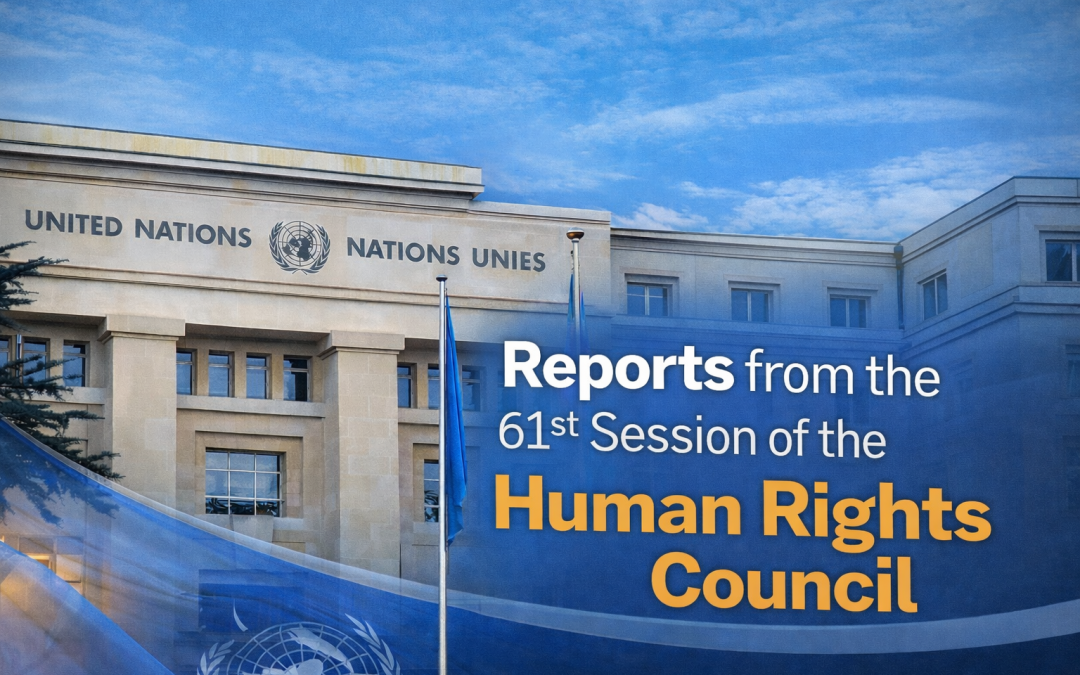
The Office of the United Nations High Commissioner for Human Rights (OHCHR) published a comprehensive report (A/HRC/61/24) on 13 January 2026, presenting an assessment of the human rights situation across Sudan. The document covers the period from 16 November 2024 to 15 November 2025 and was submitted to the Human Rights Council at its sixty-first session, responding to Council resolution 57/2.
This assessment emerges from extensive monitoring operations conducted despite severe security constraints. The OHCHR’s investigation drew on interviews with 778 sources—380 men, 382 women, and 16 children—alongside satellite imagery, video analysis, and cross-verification through multiple independent sources. The methodology employed a “reasonable grounds to believe” evidentiary standard, reflecting the rigorous approach necessary when documenting allegations of mass atrocities. Beyond direct field operations, the inquiry included monitoring missions to Chad, Uganda, and the Abyei Administrative Area, acknowledging how displacement has rendered the Sudan a regional humanitarian crisis affecting neighboring countries.
The conflict, now approaching its third year, has evolved into a fragmented, ethnically stratified struggle between the Sudanese Armed Forces and the Rapid Support Forces. During the reporting period alone, the OHCHR documented 5,359 civilian deaths resulting directly from hostilities, with the Darfur region accounting for 2,437 deaths and the Kordofan region recording 1,253. These figures underscore both the geographic expansion and intensification of violence.
The assessment identifies systematic violations spanning multiple categories. Regarding conduct during armed hostilities, parties deployed explosive weapons with indiscriminate effects in populated areas—barrel bombs, drone strikes, and artillery shelling frequently targeting residential neighborhoods without warning. Such practices contravene the principles of distinction and proportionality enshrined in international humanitarian law. Markets, schools, hospitals, and religious facilities experienced repeated attacks; notably, the Al-Safa Mosque in El Fasher came under drone strike on 19 September 2025, killing at least 67 civilians. Healthcare facilities proved especially vulnerable: the OHCHR documented 71 attacks on medical infrastructure, while the Saudi Hospital in El Fasher endured particularly devastating assaults, including a January 2025 drone strike that killed 67 individuals.
Beyond direct combat operations, the report chronicles 1,659 extrajudicial killings outside the scope of active hostilities—predominantly summary executions of civilians accused of collaboration with opposing forces. These killings escalated markedly during territorial transitions. Between January and June 2025, following the Sudanese Armed Forces’ recapture of Wad Madani, approximately 4,000 individuals faced arbitrary detention, with cholera outbreaks in overcrowded facilities reportedly claiming over 300 lives.
Sexual violence constitutes another grave finding. The OHCHR documented 337 incidents of conflict-related sexual violence involving 452 victims, with a particularly sharp increase following April 2025 operations targeting El Fasher. Survivors describe gang rape, sexual slavery, and abduction for forced labour. Women and girls, disproportionately from Zaghawa and other non-Arab communities, faced racially derogatory abuse alongside sexual assault. Twenty documented pregnancies resulted from rape, with some victims denied access to safe abortion services.
The recruitment and forced conscription of children proceeded systematically. In March 2025, OHCHR sources reported over 300 children, mostly under 16, undergoing military training in El Geneina under coercive conditions. In May, the Minister of Education announced exemptions from school fees for students fighting alongside armed forces, a policy signaling state endorsement of child participation in conflict.
The collapse of essential services has created a humanitarian catastrophe. Approximately 24.6 million people faced food insecurity at crisis level or worse, with famine conditions confirmed in multiple locations by November 2025. Over 17.3 million lack safe drinking water; infrastructure attacks severed supplies to entire regions, precipitating disease outbreaks. Cholera infections exceeded 122,000 since July 2024, claiming over 3,400 lives. Educational collapse has proven particularly severe: roughly 13 million children remained out of school by September 2025, with many losing two or more academic years.
The High Commissioner issued comprehensive recommendations targeting multiple stakeholders. Parties to the conflict are urged to cease hostilities immediately, uphold international humanitarian law, release arbitrarily detained individuals, halt attacks on civilians and infrastructure, and enable humanitarian passage. For the Sudanese authorities specifically, priorities include resuming essential services, ensuring accountability through fair trials, respecting due process rights, and refraining from restricting civic space through emergency decrees.
Addressing the international community, the High Commissioner recommends intensifying efforts toward a unified, inclusive peace process; supporting civil society protection and recovery programs; enforcing the existing arms embargo on Darfur and considering expansion to the entire country; and pressing the Security Council to refer Sudan’s situation to the International Criminal Court.
CAP LC actively engaged with the Human Rights Council’s examination of this situation. During the interactive dialogue on 9 February 2026 regarding the OHCHR’s oral update on El Fasher, CAP LC presented testimony documenting the mass atrocities perpetrated by the Rapid Support Forces against civilians, including torture, sexual violence disproportionately affecting women and girls, kidnappings for ransom, and summary executions. CAP LC further submitted a written statement to the sixty-first session of the Human Rights Council, urging Member States to pressure entities providing material and financial support to armed groups, impose sanctions on alleged perpetrators, and strengthen humanitarian assistance to displaced populations.