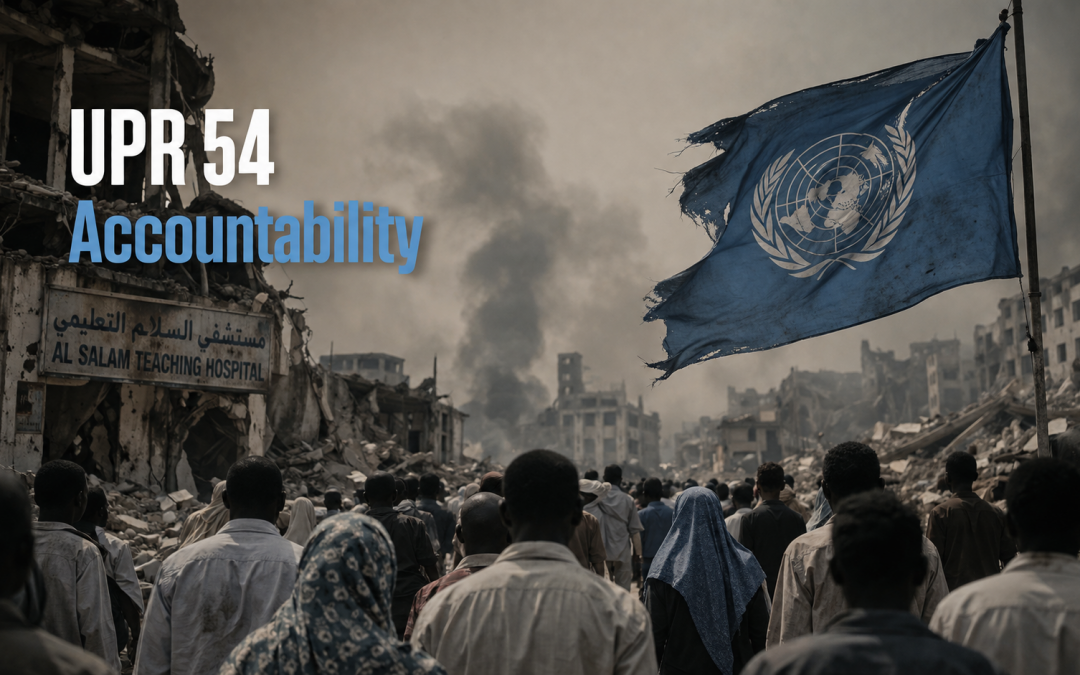
A Joint Submission to the 54th Session of the UPR Working Group
By the International Coalition of Human Rights Organizations (ICHR), Omnium des Libertés (ODL)
When the Universal Periodic Review Working Group convenes in January 2027 for its 54th session, Sudan will present its fourth national report against a backdrop of unimaginable human suffering. Since April 2023, the conflict between the Sudanese Armed Forces and the Rapid Support Forces has killed tens of thousands, displaced over ten million people, and triggered the world’s largest humanitarian crisis. Yet as the international community prepares to scrutinize Sudan’s human rights record, a troubling pattern threatens this peer-review mechanism: selective handling of violations, politicization of recommendations, and procedural bias that privileges diplomatic caution over civilian protection.
The UPR was designed as a cooperative process to assess every UN member state’s human rights record. In Sudan’s case, however, this framework risks becoming a shield for impunity. The 54th session must confront a fundamental question: can a mechanism built on state-to-state dialogue deliver accountability when the state itself is a primary perpetrator of atrocities?
Two non-governmental organizations — the International Coalition of Human Rights Organizations (ICHR), Omnium des Libertés (ODL) — have produced a comprehensive submission the international community cannot afford to ignore. Their report documents a near-total implementation gap since Sudan’s third review in February 2022, compounded by deliberate reversal of cooperation with international mechanisms and systematic restriction of access that has made comprehensive documentation impossible.
During its third review, Sudan received 283 recommendations, accepted 244, and merely ‘noted’ 39 — an acceptance rate of over 86%. On paper, this suggested commitment. In practice, many accepted recommendations addressed technical issues while core concerns — accountability for the 2019 Khartoum massacre, protection of religious minorities, security sector reform — were diluted. This reflects a broader procedural bias: states can cherry-pick recommendations, accepting those requiring minimal political cost while ‘noting’ substantive demands for institutional change.
The Coalition identifies the ‘root cause and principal driver’ of the crisis: not merely a military confrontation, but the ideological capture of the Sudanese Armed Forces by the Islamic Movement through formations including the Al-Baraa ibn Malik Brigade. This faction has deliberately prolonged the conflict, rejecting regional and international ceasefire initiatives by imposing unattainable preconditions. The same networks obstructed the 2019-2021 transition. No durable ceasefire can be expected while these formations retain veto power over military decisions.
The submission emphasizes ‘geographical selectivity’ in documenting violations. Limiting condemnation to El Obeid represents a fundamental failure of impartial justice and of the UPR itself, which requires assessment across the entire territory. The draft resolution overlooks atrocities in Darfur, Kordofan and Blue Nile. Recent deadly events in Kulbus, West Darfur, on 29 June 2026 killed numerous civilians including children. The siege of El Fasher and attacks on displacement camps in North Darfur remain outside the Council’s attention. Geographical selectivity distributes protection unevenly and creates de facto zones of impunity.
The Coalition highlights a serious procedural concern: the de facto military authorities in Port Sudan have been granted exclusive access to UN platforms, while the African Union has maintained Sudan’s suspension since October 2021 following the unconstitutional coup. Granting these authorities diplomatic legitimacy risks reinforcing intransigence and undermining peace efforts. The Coalition urges the Working Group to remain vigilant regarding the representativeness of any Sudan delegation, so the review is not instrumentalized to confer legitimacy upon authorities the African Union does not recognize.
The submission expresses grave concern over omissions from the Human Rights Council’s agenda, calling for urgent independent investigation into allegations of prohibited chemical weapons use by the Sudanese Armed Forces. It documents indiscriminate aerial bombardment of civilians, obstruction of humanitarian relief including World Food Programme convoys, and involvement of foreign armed groups including Seleka elements from the Central African Republic. These omissions carry measurable consequences: famine conditions in displacement camps, multiplied secondary victims from infrastructure destruction, and eroded normative barriers against prohibited weapons.
The Coalition’s nine recommendations are precise, actionable, and grounded in Sudan’s prior commitments. They demand unhindered access for OHCHR, the Independent Expert, the Fact-Finding Mission and special procedures; independent investigations into all violations since April 2023 including alleged chemical weapons use; cessation of indiscriminate attacks; safe humanitarian relief passage; unconditional engagement in ceasefire initiatives; a functioning national mechanism with civil society participation; restoration of civilian-led rule under the 2019 Constitutional Document; and full cooperation with the International Criminal Court. The Coalition further recommends that the Council ensure any resolution is comprehensive without geographical selectivity, and adopt a position consistent with African Union decisions by refusing recognition to post-coup military authorities.
Four years after its third review, Sudan’s record shows near-total non-implementation of supported recommendations, reversed cooperation with international mechanisms, and deliberate access restrictions preventing comprehensive documentation. The selective treatment of this crisis — geographical, institutional and procedural — compounds victims’ suffering and contradicts the universality, impartiality and equal treatment principles underpinning the UPR. The fourth review is a defining test: either the UPR becomes a formal exercise where commitments are recorded and forgotten, or it names, measures and redresses the gap between February 2022 promises and July 2026 reality. The Coalition urges all participating States to seize this opportunity. The full joint submission by ICHR, ODL and SWOP is available for download below.