What I saw at the Seoul detention center, and why a Korean war veteran’s speech changes the perspective
By Thierry Valle, President of CAP Liberté de Conscience
Ten Minutes Behind the Glass
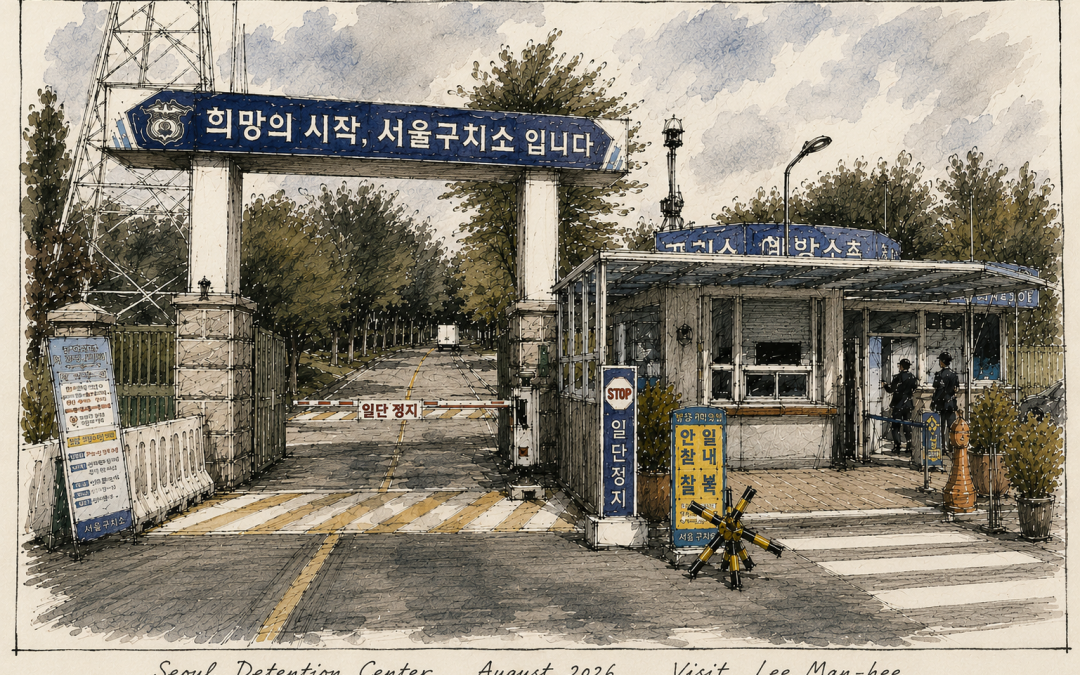
On August 6, alongside Massimo Introvigne (Bitter Winter)[1] and Hans Noot (HRWF)[2], I walked through the doors of the Seoul Detention Center.
Nothing truly prepares you for it. We first waited in a common room, crowded with people. Whole families, young visitors, elderly women. Tight faces, white-knuckled fingers gripping bag handles. Everyone was waiting, like us, to see someone they loved for ten minutes. Not a minute more.
We were led into a small room. In front of us stood a thick double pane of glass, reinforced by a metal grille. An intercom. And a timer set to the allotted time: ten minutes. A translator stood beside us, ready to carry our words to the other side of the glass.
Lee Man-hee entered the room. His voice was steady, yet the frailty of a ninety-five-year-old frame was unmistakable — the thin shoulders, the hands that trembled slightly as they rested on the table, a body that had already given everything it had to give.
At ninety-five, behind that glass, he spoke to us with a bearing that defied his age. He did not complain. Not once. He simply exchanged words with us, calmly, like a man who knows that time is a luxury being denied him. Our words traveled through the translator, then bounced off the glass, but his dignity crossed the bars effortlessly.
The Korean War had taught him to endure. When you have held your ground in a trench, when you have watched friends disappear beside you in the mud, you learn a word that books do not teach: hold. Hold on without a sound. Hold on while keeping hope alive even when nothing justifies believing anymore. That is what he was doing there, on the other side of the glass, under the guard’s silent watch, as the timer counted down the minutes he had left. He held on.
The Next Day
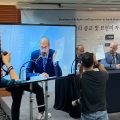
The following day, August 7, we were at the Seoul Foreign Correspondents’ Club. It was the European NGO Human Rights Without Frontiers — HRWF[3] — that had organized the press conference. CAP Liberté de Conscience, FOREF[4], CESNUR[5], and Bitter Winter[6] had been invited. HRWF had gathered the international press around a simple question: Is freedom of religion and expression in South Korea being respected?
The legal arguments were solid[7]. Each speaker came to add their stone to the wall.
Michael Langhans, of FOREF Germany, asked: Was pretrial detention truly necessary if indictment was already possible? And above all, had the investigation been conducted with neutrality, or through the prism of a narrative that presented Shincheonji as a “cult”?
Massimo Introvigne, for CESNUR and Bitter Winter, recalled the United Nations Mandela Rules: for a ninety-five-year-old defendant accused of non-violent offenses, house arrest should take precedence over prison.
Márk Nemes, of CESNUR, broadened the frame: what is at stake in Seoul goes beyond Korea. Articles 18 and 19 of the International Covenant protect Shincheonji believers worldwide.
Hans Noot, of HRWF, stated the principle: we are not defending a theology. We are defending the idea that fundamental rights apply to everyone. Even the unpopular.
And then there was this man: Ryu Jae-sik, head of the Seoul branch of the Association of Korean War Veterans. A man who was not there to speak about international law. He was there to speak about gratitude.
What the Paper Says
Before recounting what he said, one must understand who Lee Man-hee is in the eyes of the Korean state.
He is not merely the founder of the Shincheonji Church. He is an administrative designation, confirmed by the government itself. On March 4, 2020, at the height of the COVID-19 storm, the Ministry of Patriots and Veterans Affairs made an unexpected piece of information public[8]: Lee Man-hee had indeed served in the 7th Infantry Division of the South Korean army, from May 1952 to April 1953, with the rank of sergeant. He had been registered as a “Person of Distinguished Service to the State” — an official title — on January 12, 2015. Since then, he had received the honor pension reserved for former combatants.
Let me repeat: this is not propaganda. These are ministry files, relayed by the Yonhap news agency and the daily JoongAng Ilbo[9].
So what does it mean to be a “Person of Distinguished Service to the State” in South Korea?
It means the country has erected an entire ministry for you. That it spends billions of won every year on pensions and care. That you are entitled to a 90% reduction in public hospital fees. That on June 6, a national holiday, a siren sounds for you across the entire country at ten in the morning. That the president travels to the Seoul National Cemetery to bow before your dead. That the state officially declares: you risked your life for the nation. We do not forget you.
On paper, it is beautiful.
The Veteran’s Voice
Ryu Jae-sik stepped up to the podium[10] with a sheet of paper in his hands. He was not asking for impunity for Lee Man-hee. He said so himself: “I am not here to ask that someone’s faults be covered up.”
He was asking another question. One of consistency.
He recounted that the Shincheonji Church had cared for Korean War veterans, year after year[11], when few organizations still bothered. Hot meals served with kindness. Hands extended toward men who were cold and hungry. Compassion, gratitude for those who had saved the nation.
Then he came to the point. Lee Man-hee is ninety-five. He is a veteran. He has a fixed residence. He poses no flight risk. And his body, Ryu Jae-sik reminded those present, is failing him — a frailty that, in itself, should be enough to question whether detention is necessary for anyone of such an age. At his age, destroying evidence is almost a matter of quantum physics. So why pretrial detention?
“Even the strictest legal procedures cannot take precedence over human dignity and life.”
He spoke those words slowly. In the room.
When the Sirens of Recognition Fall Silent
For what Ryu Jae-sik placed on the table is a question of national dignity. Not merely of law.
How can a state that sounds the siren for its dead on June 6[12] lock one of its last survivors in a cell for alleged non-violent offenses? How can a country that pays pensions to its former combatants consider that one of them, at ninety-five, represents a sufficient threat to justify pretrial detention?
The Korean judiciary has confirmed the legality of this detention. I know this. I do not contest the formal legality. But legality is not the same as reasonableness. A ninety-five-year-old veteran, accused of non-violent acts, with a fixed residence and no flight risk, held in a detention cell — on any human ledger, the arithmetic defies common sense.
When No One Is Watching
I am not saying that South Korea has no right to investigate. It does. And it must do so when serious accusations weigh upon a citizen, regardless of age or past. Veteran status confers no immunity. I do not claim otherwise.
But there is a difference between legality and dignity. Between what the law permits and what a nation owes itself to be.
When we left the detention center on August 6, I thought back to Lee Man-hee’s face. To the way he held on. And I thought back to what Ryu Jae-sik had said: the Shincheonji Church had fed the veterans that no one visited anymore.
Today, it is a veteran asking the nation not to forget what gratitude means.
The true measure of a nation’s recognition of its veterans is not the sirens of the June 6 ceremonies. It is measured by how a country treats its last survivors when the sirens fall silent.
Thierry Valle is President of CAP Liberté de Conscience, a non-governmental organization accredited with the United Nations Economic and Social Council.
Notes
[1] Bitter Winter — A visit to the Seoul detention center: https://bitterwinter.org/a-visit-to-the-seoul-detention-center-and-the-difficult-path-of-religious-liberty-in-korea/
[2] HRWF — I visited Chairman Lee Man-hee in prison in Seoul: https://hrwf.eu/south-korea-i-visited-chairman-lee-man-hee-in-prison-in-seoul/
[3] HRWF — European rights groups raise alarm over freedom of religion and expression in South Korea: https://hrwf.eu/south-korea-%ed%95%9c%ea%b5%ad-european-rights-groups-raise-alarm-over-freedom-of-religion-and-expression/
[4] FOREF Europe: https://foref-europe.org/
[5] CESNUR: https://www.cesnur.org/
[6] Bitter Winter: https://bitterwinter.org/
[7] The Star (Kenya) — International rights groups raise alarm: https://www.the-star.co.ke/news/2026-08-07-international-rights-groups-raise-alarm-over-freedom-of-religion-and-expression-in-south-korea
[8] Yonhap — Gov’t confirms Shincheonji founder as Korean War veteran: https://en.yna.co.kr/view/AEN20200304004900325
[9] Daum — JoongAng Ilbo relay on Lee Man-hee veteran status: https://v.daum.net/v/j60PkX0XvW
[10] Traceinfos — Press conference coverage: https://traceinfos.com/coree-du-sud-des-organisations-internationales-alertent-sur-les-libertes-religieuses-et-la-liberte-dexpression/
[11] HiDomin — Shincheonji volunteers care for Korean War veterans: https://www.hidomin.com/news/articleView.html?idxno=548303
[12] Ministry of the Interior and Safety (South Korea) — Memorial Day ceremony: https://www.mois.go.kr/frt/bbs/type010/commonSelectBoardArticle.do?bbsId=BBSMSTR_000000000008&nttId=126671
Related posts:
 FRANCE: Qui est cette Église Shincheonji en France? 10 ans d’histoire (I)
 Press Conference – Freedom of Religion or Belief in the Republic of Korea
 FRANCE: Église Shincheonji : Comment on devient membre et comment on partage sa foi (II)
 L’image mondiale de la K-Pop masque-t-elle une crise de la liberté religieuse en Corée du Sud ?