
By Thierry Valle CAP Liberté de Conscience
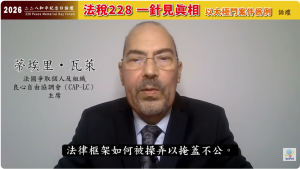 We come together today to remember the February 28 Incident of 1947, also known as the “228 Incident.” This tragedy marked the start of decades of repression known as the White Terror. On that day, state violence took the lives, freedom, and dignity of thousands. The lesson of 228 goes far beyond history. It serves as a stark reminder that when public power goes unchecked, when fear silences society, and when justice bows to authority, the foundations of peace begin to crumble.
Commemoration is not just an act of remembrance; it is also an act of responsibility. This conference encourages us to honestly ask whether today’s governance truly reflects the principles laid out in the Universal Declaration of Human Rights and the International Covenant on Civil and Political Rights. These principles include the rights to life, liberty, fair trial, and freedom of thought, conscience, and religion. These rights belong to everyone and should not be quietly stripped away for convenience or political gain.
The White Terror taught us how legal frameworks can be manipulated to hide injustice. Courts, prosecutors, and government agencies became tools for silencing dissent and stifling belief. We must stay alert not only to outright violence but also to the quiet acceptance of arbitrary power. This power often hides behind seemingly lawful procedures while undermining real justice and human dignity.
Dr. Hong offered a vital warning from the 228 Incident. When government bodies refuse to confront abuses of power, and when the judiciary cannot correct its mistakes, the tragedies of the past may resurface. This reflection directly relates to international human rights law. Article 2 of the ICCPR requires states to ensure meaningful remedies when rights are violated. A true democracy is defined not only by elections but also by its willingness and ability to hold itself accountable.
Dr. Hong reminded us that peace starts in the conscience. Honesty, repentance, and accountability are what genuine moral governance looks like. This applies to civil servants, judges, and political leaders alike. One administrative decision can either protect or destroy fundamental freedoms. Thus, conscience must guide institutions, not just individuals.
Through this lens, many observers have looked at the Tai Ji Men case. After Taiwan’s democratic transition, the country earned a strong reputation as a thriving democracy. Yet the ongoing tax measures applied to Tai Ji Men, even after courts found no tax evasion, continue to trouble scholars and civil society. The lingering administrative consequences affecting property show how unresolved cases can undermine confidence in the rule of law.
From a human rights perspective, several key principles are at risk. Legal certainty demands that all branches of government respect final judicial decisions. Freedom of religion or belief, protected under Article 18 of the ICCPR, includes the right for communities to manage their internal affairs without government interference. When administrative agencies continue actions that contradict court findings, the right to an effective remedy risks becoming a mere formality.
In this context, CAP Liberté de Conscience submitted a written statement to the 61st session of the United Nations Human Rights Council, currently held in Geneva. In our submission, we emphasized that genuine implementation of the ICCPR requires not just laws on paper but also faithful application in practice. Our involvement reflects our mission to raise concerns within the international community through constructive dialogue based on universal standards.
The memory of 228 urges us to stay vigilant, especially in situations like this one. Transitional justice does not end with acknowledging past horrors; it requires today’s governance to be transparent, proportionate, and accountable. When mistakes happen, there must be real ways to review, correct, and provide restitution. Justice stretched over decades risks turning into no justice at all.
Peace is not merely the absence of war. It is the presence of justice, trust, and accountability. It means that no individual or spiritual community will be targeted through the misuse of legal or fiscal tools because of their beliefs. It involves the assurance that institutions act with conscience and true respect for human dignity.
As we honor the victims of 228 and the White Terror, let us reaffirm a principle that holds everywhere: protecting freedom of religion or belief strengthens democratic societies. When institutions find the courage to correct their mistakes, and when conscience guides the exercise of power, history’s deepest wounds can begin to heal.