By CAP Liberté de Conscience (CAP LC) — 23 May 2026
The Pattern Before the Feast
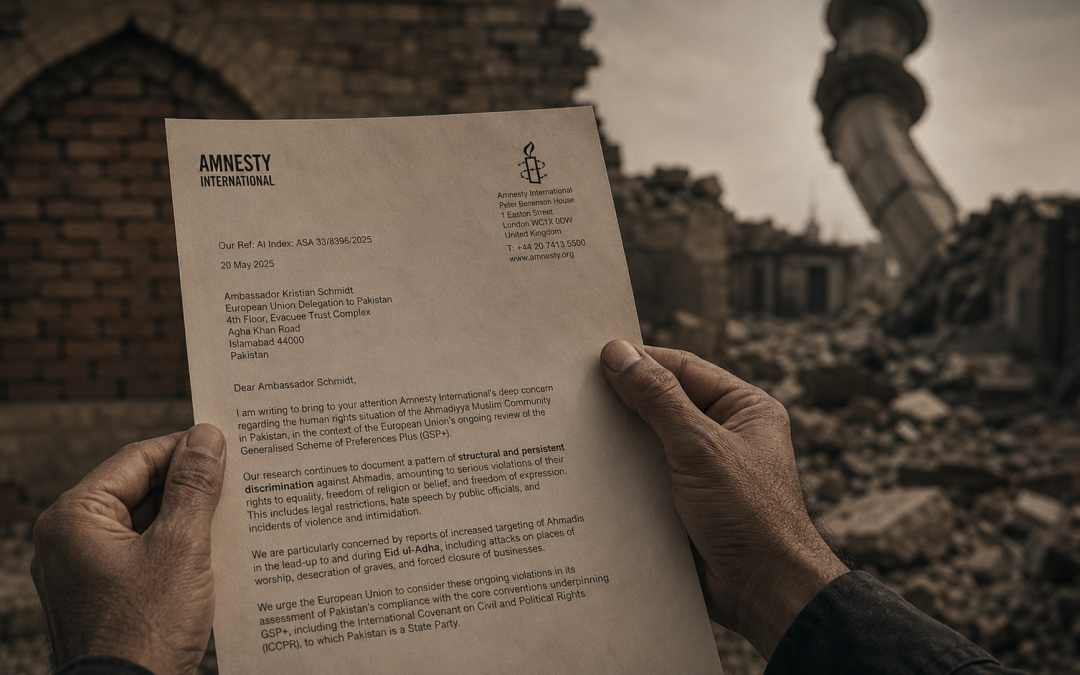
Religious holidays are supposed to be moments of communion. In Punjab province, they have become moments of coordinated assault. On 21 May 2026, Amnesty International sent a letter to Maryam Nawaz, Chief Minister of Punjab, warning of “structural and persistent discrimination, harassment and violence against the Ahmadiyya community” — violations that “routinely intensify in periods preceding and during major religious occasions, such as the upcoming Eid ul-Adha.”
The letter is not speculative. It documents what has already happened. During Eid ul-Fitr in March 2026, local administrative and police authorities across Punjab placed unlawful restrictions on Ahmadi religious practices. Congregations were explicitly prohibited in Gujranwala. Police intervened at six locations in Sialkot to stop all worship activities on Eid day. Worshippers were removed from a place of worship during prayers in Faisalabad. Multiple places of worship were sealed. The pattern is not new. In 2024, Amnesty documented 36 cases of arbitrary arrests and detention, plus dozens of police harassment incidents, in the lead-up to and during Eid ul-Azha. In 2025, local authorities forced individuals to sign affidavits undertaking that they would refrain from prayers and rituals on Eid.
Amnesty International’s letter puts the mechanism in plain terms: “These incidents reflect a recurring pattern that amounts to unlawful interference with the right to freedom of religion and belief.”
The Inventory of Violence
The letter goes beyond the cyclical harassment around Eid. It inventories the daily architecture of persecution that Ahmadis face in Punjab, where 86% of Pakistan’s Ahmadi population resides — 140,512 out of 162,684, according to the 2023 census.
Attacks on burial sites are frequent. The UN Special Rapporteur on Freedom of Religion or Belief noted in her 2026 report that “hundreds of Ahmadi graves have been desecrated in Punjab province and Ahmadi funeral rites are regularly interrupted by police.” In 2025, at least three Ahmadis were killed in targeted attacks, five survived assassination attempts. Two of the three killings occurred in Punjab. Members of the community — doctors, lawyers, teachers, public officials — are subject to smear campaigns, blasphemy accusations, and calls for violence or removal from their professions.
The administrative barriers extend even to the private sphere. Since 2024, Ahmadis have faced significant obstacles to marriage registration. Local authorities refuse to issue marriage and divorce certificates or accept certificates issued by the community’s designated authority — documentation that had been treated as valid legal documentation until an abrupt policy change in 2024. Since the Second Amendment to the Constitution in 1974, Ahmadi marriages have existed in a liminal space, no longer regulated by Muslim Personal Law. The community is, in Amnesty’s words, “at the mercy of arbitrary decisions by local administration.”
Jamalpur: The Mechanics of Complicity
The International Human Rights Committee (IHRC) has documented a concrete illustration of this system. On 14 May 2026, in Jamalpur, District Khairpur, opponents of the Ahmadiyya Muslim Community staged a protest, blocked a road, and demanded that the minarets and prayer niche of the local Ahmadi place of worship be demolished. Local authorities visited the site. The minarets were demolished. The prayer niche was covered from inside using bricks.
IHRC’s incident report, dated 23 May 2026, notes that this was not an isolated event. Prior to the incident, a hate campaign had targeted Ahmadi places of worship in the area. Local police had instructed Ahmadis to cover the minarets and prayer niche before 15 May. When the community complied by constructing a wall in front of the minarets, police inspected the work. The next day, under mob pressure, the authorities completed the destruction.
IHRC’s assessment is direct: “Instead of protecting a vulnerable religious minority, state authorities appear to have acted in response to mob demands.” The report also documents the physical assault of an Ahmadi individual in Karundi, and the subsequent disturbance created by the attackers after police intervened. IHRC calls for an impartial investigation, accountability for those who incited hatred, and protection for the Ahmadiyya community in Jamalpur and surrounding areas.
The Legal Frame
Amnesty International’s letter to the Chief Minister places these violations within Pakistan’s legal obligations. Article 20 of Pakistan’s Constitution guarantees the right to profess religion and to manage religious institutions. Article 18 of the International Covenant on Civil and Political Rights enshrines the right to freedom of thought, conscience and religion. The targeting of Ahmadis also violates their rights to liberty and security of person, freedom of expression, peaceful assembly, and non-discrimination. In many cases, these actions amount to unlawful and arbitrary interference with privacy, family and home.
Amnesty urges the Punjab government to repeal or amend discriminatory laws used against Ahmadis, particularly sections 295-A, 295-B, 295-C, 298-B and 298-C of the Pakistan Penal Code. It reminds the government that during Pakistan’s Universal Periodic Review in 2023, the UPR Working Group issued several recommendations to ensure the protection of the Ahmadiyya community, including calls to repeal these provisions. It also calls for the upholding of the 2022 Supreme Court judgment acknowledging Ahmadis’ right to practice their faith within their homes without interference.
The letter ends with a concrete demand: “thorough, independent, impartial, transparent and effective investigations into past incidents of violence, harassment and discrimination against Ahmadis during Eid celebrations” — and the creation of “an effective and accessible reporting and accountability mechanism” for the upcoming Eid ul-Adha.
The GSP+ Context
These documented violations occur in a country that has benefited from the EU’s GSP+ trade preferences since 2014 — preferences conditioned on the effective implementation of 27 international conventions, including the ICCPR. The Council of the European Union adopted a revised GSP regulation on 22 May 2026, expanding conditionality and requiring current beneficiaries to submit new applications within two years. Pakistan’s record on religious freedom, custodial abuse, and the persecution of the Ahmadiyya community should weigh heavily in the Commission’s evaluation of its reapplication.
CAP Liberté de Conscience and the International Human Rights Committee have worked together for decades to document the persecution of religious minorities in Pakistan. The organisations welcome Amnesty International’s letter as a timely and necessary intervention that adds institutional weight to a pattern they have long recorded. The convergence of documentation — from Amnesty’s field observations to IHRC and CAP LC’s UN submissions — creates a cumulative record that is increasingly difficult to dismiss.
The question is not whether the violations are occurring. The question is whether those with the power to stop them will act before the next Eid becomes the next occasion for systematic humiliation.
Related posts:
 The EU Reinforces Trade Preferences: Human Rights and the GSP+ Revision
 Pakistan: High Court Bar Condamnation Against the Ahmadiyya Community and Its Incompatibility with International Human Rights Law
 UN Human Rights Council Adopts Twin Resolutions on Freedom of Religion or Belief and Minority Rights at 61st Session