By CAP Liberté de Conscience March 2026
For years, CAP Liberté de Conscience (CAP LC) has documented and condemned discrimination and violence targeting the Ahmadiyya Muslim community, particularly in Pakistan. We have consistently raised these cases before the United Nations Human Rights Council, the OSCE and European institutions, often jointly with the International Human Rights Committee (IHRC), with whom we have cooperated on multiple reports and submissions. This long-standing engagement aims to ensure that acts of persecution, legal discrimination and incitement to hatred are brought to the attention of international mechanisms and that the standards of international human rights law are upheld.
The condemnation and its legal basis in Pakistani law
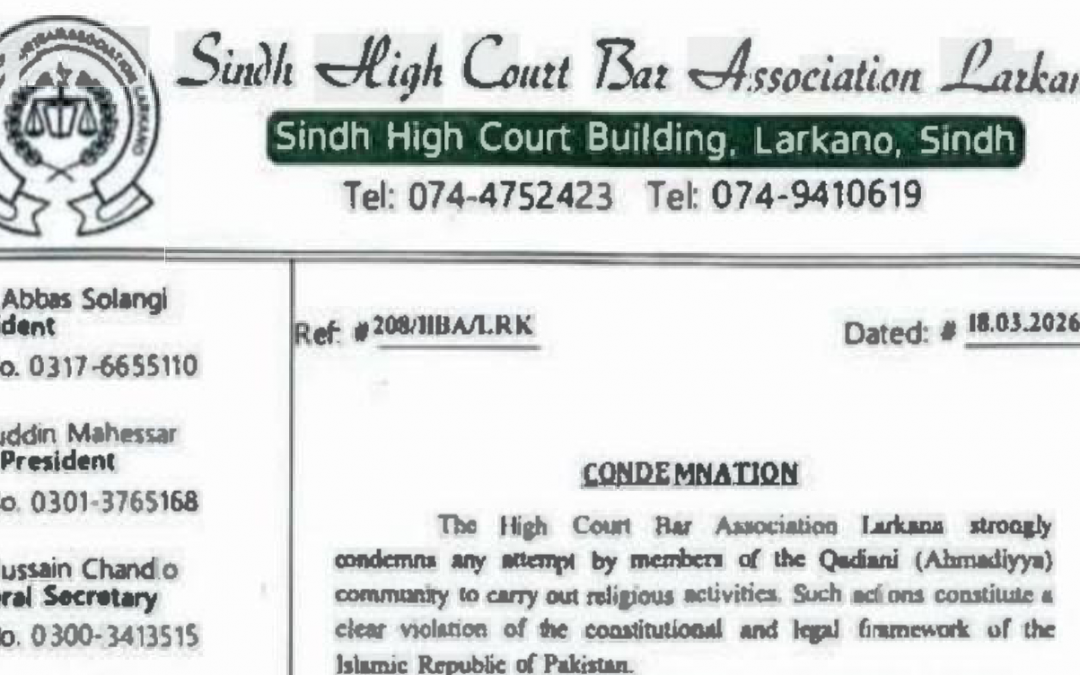
On 18 May 2026, the High Court Bar Association at Larkana, Sindh, issued a condemnation explicitly directed at the Ahmadiyya community. The text asserts that any attempt by members of the “Qadiani (Ahmadiyya) community” to carry out religious activities constitutes a violation of the constitutional and legal framework of Pakistan. It invokes Article 260(3)(b) of the Constitution of Pakistan, which declares Ahmadis non‑Muslims, and Ordinance XX of 1984 together with Sections 298‑B and 298‑C of the Pakistan Penal Code, which criminalise the use of Islamic titles, the performance of Islamic rituals and any act that could be perceived as presenting Ahmadis as Muslims. Specific practices mentioned as criminal offences include offering Eid prayers, performing animal sacrifices and organising public religious gatherings. The Bar Association calls on law enforcement agencies to take immediate action to prevent such activities, to enforce Sections 298‑B and 298‑C, to disperse “unlawful assemblies” and to prosecute under the relevant provisions. It also urges the judiciary to take suo motu notice and calls on federal and provincial authorities to issue clear directives to prevent any Qadiani‑led activities that could “mislead the public” or incite disorder.
Violations of the Universal Declaration of Human Rights
This condemnation and the legal framework it relies on are incompatible with several core provisions of the Universal Declaration of Human Rights (UDHR). Article 18 UDHR guarantees that “[e]veryone has the right to freedom of thought, conscience and religion,” including the freedom “either alone or in community with others and in public and private, to manifest [their] religion or belief in teaching, practice, worship and observance.” Criminalising Eid prayers, animal sacrifice and public religious gatherings solely because they are performed by Ahmadis directly contradicts the right to manifest one’s religion in community and in public. The condemnation also targets the very identity of the Ahmadiyya community by referring to constitutional provisions that declare them non‑Muslim, which amounts to State‑imposed doctrinal labelling. This is inconsistent with Article 2 UDHR, which states that everyone is entitled to the rights and freedoms set forth in the Declaration “without distinction of any kind, such as race, colour, sex, language, religion, political or other opinion, national or social origin, property, birth or other status.” By treating a specific religious community differently and depriving its members of rights enjoyed by others, the text enshrines discrimination in law and in official discourse.
Violations of the International Covenant on Civil and Political Rights
Pakistan is a State party to the International Covenant on Civil and Political Rights (ICCPR) and is therefore bound by its provisions. Article 18 ICCPR protects the right to freedom of thought, conscience and religion, including the freedom “to manifest [one’s] religion or belief in worship, observance, practice and teaching,” either individually or in community, in public or private. Any limitation on this right must meet strict conditions: it must be prescribed by law and necessary to protect public safety, order, health, morals, or the fundamental rights and freedoms of others. Blanket criminalisation of core religious practices performed by a specific community cannot be considered a necessary and proportionate limitation. It is, in essence, a denial of the right itself. The condemnation also violates Article 2(1) ICCPR, which obliges each State Party to respect and to ensure the rights recognized in the Covenant “to all individuals within its territory and subject to its jurisdiction, without distinction of any kind, such as… religion… or other status.” The call for strict enforcement of discriminatory provisions against Ahmadis, and for the dispersal of their assemblies and their prosecution, directly contradicts this obligation of non‑discrimination. Moreover, Article 26 ICCPR guarantees that all persons are equal before the law and are entitled without any discrimination to the equal protection of the law; it requires the law to prohibit any discrimination and guarantee equal and effective protection against discrimination on grounds such as religion. Legal provisions and authoritative interpretations that single out one religious community for punitive treatment solely on the basis of belief are clearly incompatible with this article.
The duty of States to respect international standards on freedom of religion
States that have ratified international human rights treaties are legally bound to give effect to their provisions in domestic law and practice. This includes revising or repealing constitutional provisions, ordinances and penal provisions that systematically discriminate against individuals on the ground of religion or that criminalise the peaceful manifestation of religion or belief. Authoritative bodies, including professional associations such as bar associations, have a particular responsibility to uphold the rule of law and international standards rather than to incite or justify discrimination. The condemnation issued by the High Court Bar Association at Larkana, and the legal framework it invokes, run counter to Pakistan’s international obligations under the UDHR and the ICCPR. They also undermine the independence and impartiality that the legal profession is expected to embody. It is incumbent on the State of Pakistan to ensure that its authorities, at all levels, refrain from any action that encourages or implements discriminatory measures and to take the necessary steps to bring its legislation and its practice into conformity with international human rights law.