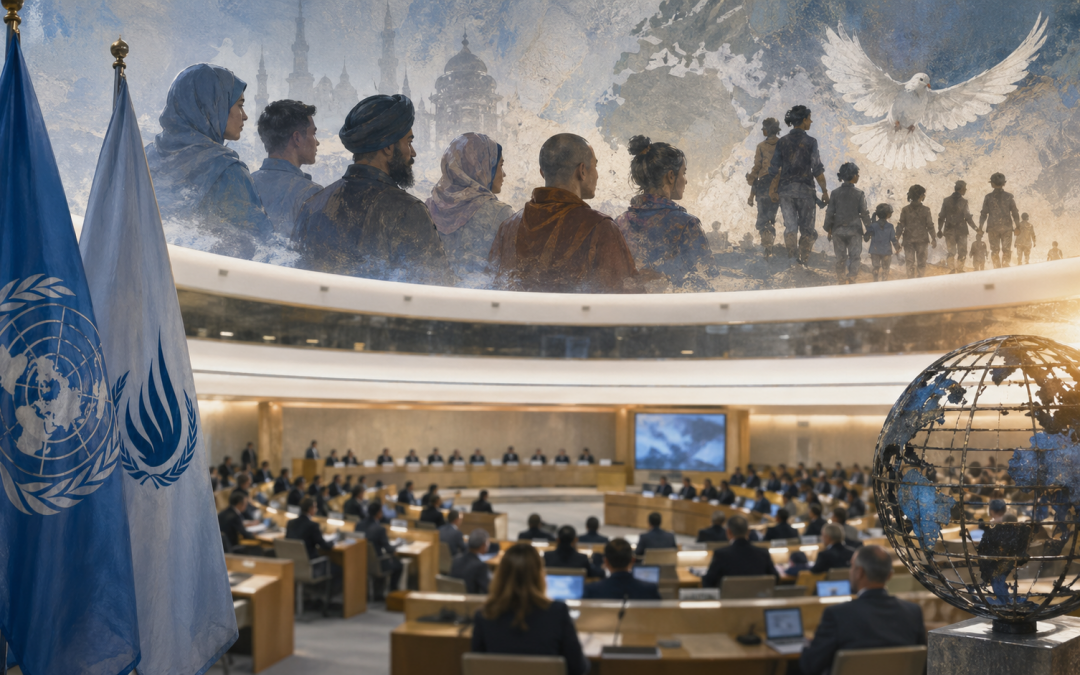
The 61st regular session of the United Nations Human Rights Council, held from 23 February to 31 March 2026, concluded with the adoption of 38 resolutions, among which three thematic texts directly addressed the protection of freedom of religion or belief and the rights of persons belonging to religious minorities. These instruments—document A/HRC/61/L.33 on Freedom of Religion or Belief, document A/HRC/61/L.20/Rev.1 on Rights of Persons Belonging to National or Ethnic, Religious and Linguistic Minorities: Mandate of the Special Rapporteur on Minority Issues, and document A/HRC/61/L.9 on Combating Intolerance, Negative Stereotyping and Stigmatization of, and Discrimination, Incitement to Violence and Violence against, Persons Based on Religion or Belief—were all adopted without a vote. Their simultaneous passage underscores the Council’s sustained attention to the intersection between individual freedom of conscience, collective minority rights, and the prevention of religiously motivated hatred and violence.
The first resolution, A/HRC/61/L.33, builds upon the 1981 Declaration on the Elimination of All Forms of Intolerance and of Discrimination Based on Religion or Belief, as well as article 18 of both the Universal Declaration of Human Rights and the International Covenant on Civil and Political Rights. Its preamble recalls the Rabat Plan of Action on the prohibition of advocacy of national, racial and religious hatred constituting incitement to discrimination, hostility or violence, adopted in 2012. The text reaffirms the universal, indivisible and interdependent character of all human rights, while stressing that States bear the primary responsibility for promoting and protecting the human rights of persons belonging to religious minorities. Fifty States, spanning Europe, the Americas and the Asia-Pacific, joined in sponsoring this draft, including several non-members of the Council
Operative paragraph 1 of A/HRC/61/L.33 restates that the right to freedom of thought, conscience and religion or belief encompasses the freedom to have, adopt or change a religion or belief, and to manifest that belief either individually or in community, in public or in private, through teaching, practice, worship and observance. Paragraph 2 underscores the interdependent and mutually reinforcing relationship between freedom of religion or belief and freedom of expression, noting the role these rights play in combating intolerance.
The resolution then catalogues, in paragraph 3, a series of emerging obstacles: the increasing number of violent acts directed against religious minorities; the rise of religious extremism; incidents of hatred manifested through derogatory stereotyping and negative profiling; constitutional and legislative systems that fail to provide adequate guarantees; and attacks on religious places, sites and shrines. Paragraph 4 condemns all forms of violence, intolerance and discrimination based on or in the name of religion or belief, as well as any advocacy of religious hatred constituting incitement to discrimination, hostility or violence, regardless of the medium used.
A notable provision appears in paragraph 6, which states that no religion should be equated with terrorism, given the adverse consequences such an equation may have for the enjoyment of freedom of religion or belief by all members of the community concerned. Paragraph 7 further emphasises that States must exercise due diligence to prevent, investigate and punish acts of violence against persons belonging to religious minorities, regardless of the perpetrator, and that failure to do so may constitute a human rights violation. The resolution contains an extensive list of measures that States are urged to adopt, ranging from ensuring constitutional and legislative guarantees and access to justice, to ending discrimination against women in the exercise of their right to freedom of religion or belief, reviewing registration practices, protecting the right to establish and maintain places of worship, and combating hatred and incitement both online and offline. Paragraph 9(l) specifically encourages States to promote mutual understanding and tolerance through education, including a wider knowledge of different religions, beliefs, and the history, traditions, languages and cultures of religious minorities.
The text concludes by taking note of the Special Rapporteur’s thematic report on how freedom of religion or belief relates to death and honouring the deceased, and by requesting the Secretary-General and the High Commissioner for Human Rights to provide the mandate holder with all necessary assistance.
The second resolution, A/HRC/61/L.20/Rev.1, addresses the rights of persons belonging to national or ethnic, religious and linguistic minorities and extends the mandate of the Special Rapporteur on Minority Issues for a further period of three years, under the same terms as provided for in Council resolution 25/5 of 27 March 2014. This text was sponsored by 39 States, including the State of Palestine, and draws upon a broad range of international instruments, including the 1992 Declaration on the Rights of Persons Belonging to National or Ethnic, Religious and Linguistic Minorities, article 27 of the International Covenant on Civil and Political Rights, and article 30 of the Convention on the Rights of the Child.
The preamble of A/HRC/61/L.20/Rev.1 reaffirms the 2030 Agenda for Sustainable Development and stresses the need for States to integrate its goals into national policies, using disaggregated data to ensure that no one is left behind, including persons belonging to minorities. It expresses concern about the increase of disinformation and misinformation, particularly through social media platforms and artificial intelligence, which may amplify hate speech and spread discrimination, racism, xenophobia and negative stereotyping.
The text also notes the particular vulnerability of minorities during humanitarian emergencies, armed conflicts and situations of occupation, as well as the prevalence of statelessness among minority populations. It recalls that a vast majority of stateless persons are persons belonging to national or ethnic, religious and linguistic minorities, and emphasises the need for birth registration and civil registration without discrimination on any grounds.
Operative paragraph 5 calls upon States to undertake initiatives to ensure that minorities are aware of and able to exercise their rights, and recommends that all measures be developed, designed, implemented and reviewed with the full, effective and equal participation of persons belonging to minorities.
Paragraph 6 contains a detailed set of recommended measures, including: ratification of relevant international and regional instruments; promotion of inclusion and meaningful participation; redoubled efforts to prevent and end statelessness; protection of the rights of minority children; investment in educational programmes and minority-language education; development of inclusive education systems and vocational training; adoption of legislation and policies to address discrimination against women and girls belonging to minorities; fostering of economic inclusion; ensuring full and equal participation in conflict prevention, resolution and peacebuilding; creation of a safe environment for civil society, journalists and human rights defenders; advancement of comprehensive anti-discrimination laws; condemnation of advocacy of national, racial or religious hatred constituting incitement to discrimination, hostility or violence; and enabling of open intercultural and interfaith dialogue.
Paragraph 14 formally extends the Special Rapporteur’s mandate, while paragraph 17 requests the Secretary-General and the High Commissioner to provide all necessary human, technical and financial assistance.
The preamble of A/HRC/61/L.9 reaffirms the obligation of States to prohibit discrimination on the basis of religion or belief and to implement measures guaranteeing equal and effective protection of the law. It recalls that terrorism, in all its forms and manifestations, cannot and should not be associated with any religion, nationality, civilization or ethnic group, and that violence can never be an acceptable response to acts of intolerance. The text expresses deep concern at continued serious instances of derogatory stereotyping, negative profiling and stigmatisation of persons on the basis of their religion or belief, including programmes and agendas pursued by extremist organisations aimed at creating and perpetuating negative stereotypes about religious groups, in particular when condoned by Governments.
Paragraph 7 of A/HRC/61/L.9 draws upon the call made by the Secretary-General of the Organisation of Islamic Cooperation at the fifteenth session of the Council, setting forth an eight-point action plan for States: encouraging collaborative networks to build mutual understanding; creating governmental mechanisms to identify and address potential areas of tension between religious communities; training officials in effective outreach strategies; encouraging community leaders to discuss the causes of discrimination and evolve counter-strategies; speaking out against intolerance; adopting measures to criminalise incitement to imminent violence on the basis of religion or belief; combating denigration and negative religious stereotyping through education and awareness-building; and recognising the positive role of open, constructive and respectful debate and interfaith dialogue.
Paragraph 8 calls upon all States to ensure that public functionaries do not discriminate on the basis of religion or belief; to foster religious freedom and pluralism; to encourage the representation and meaningful participation of individuals irrespective of religion; and to make strong efforts to counter religious profiling in law enforcement.
Paragraph 10 specifically calls upon States to adopt measures and policies to promote full respect for and protection of places of worship, religious sites, cemeteries and shrines, and to take measures where they are vulnerable to vandalism or destruction.
Paragraph 13 requests the High Commissioner to prepare a comprehensive follow-up report for the Council’s sixty-fourth session, based upon information provided by States on efforts and measures taken to implement the action plan.
All three resolutions were adopted without a vote, indicating a broad consensus among Council members and observers on the importance of these issues. The press release issued by the Office of the High Commissioner for Human Rights on 1 April 2026 confirms that the Council extended 19 country-specific and thematic mandates during the session, including those relating to freedom of religion or belief and minority issues.
For CAP Liberté de Conscience, these three resolutions carry direct operational significance. The emphasis placed by A/HRC/61/L.33 on the right to change one’s religion or belief, on the non-equation of religion with terrorism, and on due diligence in preventing violence against religious minorities aligns with the cases and testimonies we regularly document and transmit to UN mechanisms.
The focus of A/HRC/61/L.20/Rev.1 on statelessness, minority-language education, and the participation of minorities in peacebuilding reflects concerns we have raised in our parallel reports and oral statements to the Council. The annual renewal of A/HRC/61/L.9, with its detailed action plan and its specific call for the protection of places of worship, provides a continuous framework for monitoring state compliance and for engaging with the Istanbul Process and related interfaith initiatives. The extension of both Special Rapporteur mandates ensures the continuity of expert scrutiny that civil society organisations such as ours rely upon to channel information from the field to Geneva.
The 61st session took place against a backdrop of heightened geopolitical tensions, including armed conflict in the Middle East, which overshadowed part of the Council’s work. Yet the adoption of these three resolutions without a vote demonstrates that the protection of freedom of religion or belief and minority rights remains a shared priority, even in divided times. The texts do not introduce new normative standards; rather, they consolidate existing obligations and elaborate practical measures for implementation. Their value lies in the detailed guidance provided to States on legislative, administrative and educational steps, as well as in the reaffirmation of the Special Rapporteurs’ roles as independent watchdogs.
-
A/HRC/61/L.33: Freedom of religion or belief (24 March 2026)