Coordination des Associations et des Particuliers
pour la Liberté de Conscience
(CAP Freedom of Conscience)
 NGO with ECOSOC consultative status at the United Nations
Registration on EU Transparency Register 628479527756-78
Civil society platform of Fundamental Rights created by the EU FRA
French non-benefit association register : W751082307
Member : European Federation for Freedom Of Belief – FOB
Member : Conference of Non-Governmental Organizations in Consultative Relationship with the United Nations – ConGo
Advisory Board : International Council for Diplomacy and Dialogue
Advisory committee : New Generation Uniting Nations
2024 Friends of Falun Gong Human Rights Award
DAFOH Partners in Combating and Preventing Forced Organ Harvesting
Contact : contact@coordiap.com
phone : +336 70 66 04 42
CAP Liberté de Conscience – 117, rue de Charenton – 75012 – France
What is “Coordination des Associations et des Particuliers pour la Liberté de Conscience” (CAP Freedom of Conscience)?
CAP Freedom of Conscience is a secular European NGO with United Nations Consultative Status, created in 1995 and dedicated to protect the Right of Freedom of Religion and Belief.
CAP Freedom of Conscience combats all forms of discrimination based on religion or belief by alerting European and International bodies.
CAP Freedom of Conscience collects testimonies of discrimination and human rights violations affecting religious or belief communities in order to disseminate them to international bodies, and in order to raise awareness and inform them as well as to generate debate on the protection of Freedom of Religion and Belief.
CAP Freedom of Conscience also advocates for any religious or spiritual group facing discrimination to have their right to Freedom of Religion and Belief recognized.
CAP Freedom of Conscience is a member of the European Federation for Freedom of Belief (FOB), European Network Of Religion and Belief (ENORB) and participate to the Civil Society Platform of Fundamental Rights created by the EU Fundamental Rights Agency.
CAP LC General Assembly report 2021
CAP FREEDOM OF CONSCIENCE SUPPORT :
FoRB Roundtable Brussels-EU
https://www.forbroundtable.org/
The FoRB Roundtable Brussels-EU is an informal group of individuals from civil society who gather regularly to discuss FoRB issues on a non-attribution basis. It is simply a safe space where participants gather, speak freely in sharing ideas and information, and propose joint advocacy actions to address specific FoRB issues and problems globally.
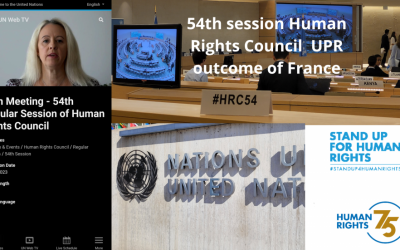
European nonprofit CAP Liberté de Conscience UNITED SIKHS make joint statement on France turban issue at UN Human Rights Council
Geneva, Sep 29 — The United Nations Human Rights Council Friday heard a joint statement by UNITED SIKHS and CAP Freedom of Conscience, a European nonprofit, regarding Sikh turban rights in France.
Both organisations collaborated on this significant endeavour as co-signatories to the oral statement presented by CAP Freedom of Conscience in Geneva, Switzerland.
The incorporation of the France turban issue in the joint statement, representing both UNITED SIKHS and CAP Freedom of Conscience, underscores the imperative nature of addressing this matter on the international stage.
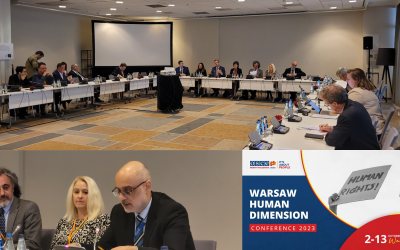
Side event OSCE 2023 Addressing Anti-Religious Hate Crime in the OSCE Area
Anti-religious intolerance and hate crimes continues to be a concern across the Organization for Security and Co-operation in Europe (OSCE) region. Such manifestations of intolerance threaten both the security of individuals and societal cohesion, as discrimination and intolerant discourse often escalate into violence and wider scale conflict. At the same time, a comprehensive security regime is also needed to fully respect, protect and fulfil freedom of religion or belief, which is specifically acknowledged as one of the fundamental principles guiding mutual relations among OSCE participating States and an integral aspect of the OSCE’s concept of security. Furthermore, participating States of the OSCE have agreed on a broad range of commitments to address racism, xenophobia, anti-Semitism, discrimination and intolerance, including intolerance against Christians, Muslims, Jews, and members of other religions.
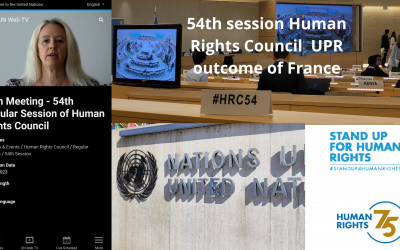
European nonprofit CAP Liberté de Conscience UNITED SIKHS make joint statement on France turban issue at UN Human Rights Council
The United Nations Human Rights Council Friday heard a joint statement by UNITED SIKHS and CAP Freedom of Conscience, a European nonprofit, regarding Sikh turban rights in France.
Both organisations collaborated on this significant endeavour as co-signatories to the oral statement presented by CAP Freedom of Conscience in Geneva, Switzerland.
The incorporation of the France turban issue in the joint statement, representing both UNITED SIKHS and CAP Freedom of Conscience, underscores the imperative nature of addressing this matter on the international stage.
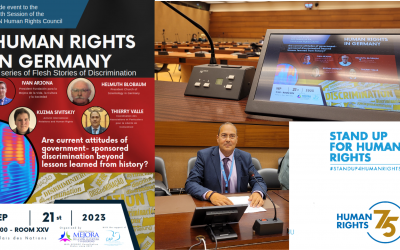
Ahmadi Muslims in Germany who’ve fled state persecution are being deported back to Pakistan and it’s putting their lives at risk
Thousands of Ahmadi Muslims in Germany who have fled severe religious persecution in Pakistan are awaiting a decision on their asylum applications. They belong to a religiously and politically persecuted minority – the Ahmadiyya Muslim Community. It is recognized around the world by human rights groups that Ahmadi Muslims are constantly, ruthlessly persecuted.
Algeria : Religious freedom to be on the agenda of a UN Special Rapporteur before his fact-finding mission
HRWF/ CAP (14.09.2023) – CAP/ Liberté de Conscience and Human Rights Without Frontiers, two NGOs active in Brussels, are deeply concerned about the situation of the members of the Ahmadi Religion of Peace and Light in Algeria and have addressed a report to the UN Special Rapporteur on the Rights of Peaceful Assembly and Association before his fact-finding mission in Algeria planned from 6 to 16 September.
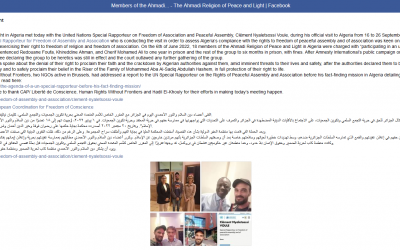
ALGERIA: Ahmadi Religion of Peace and Light people meet UN Special Rapporteur
Ahmadi Religion of Peace and Light (24.09.2023) – Members of the Ahmadi Religion of Peace and Light in Algeria met today with the United Nations Special Rapporteur on Freedom of Association and Peaceful Assembly, Clément Nyaletsossi Voule, during his official visit to Algeria from 16 to 26 September 2023.