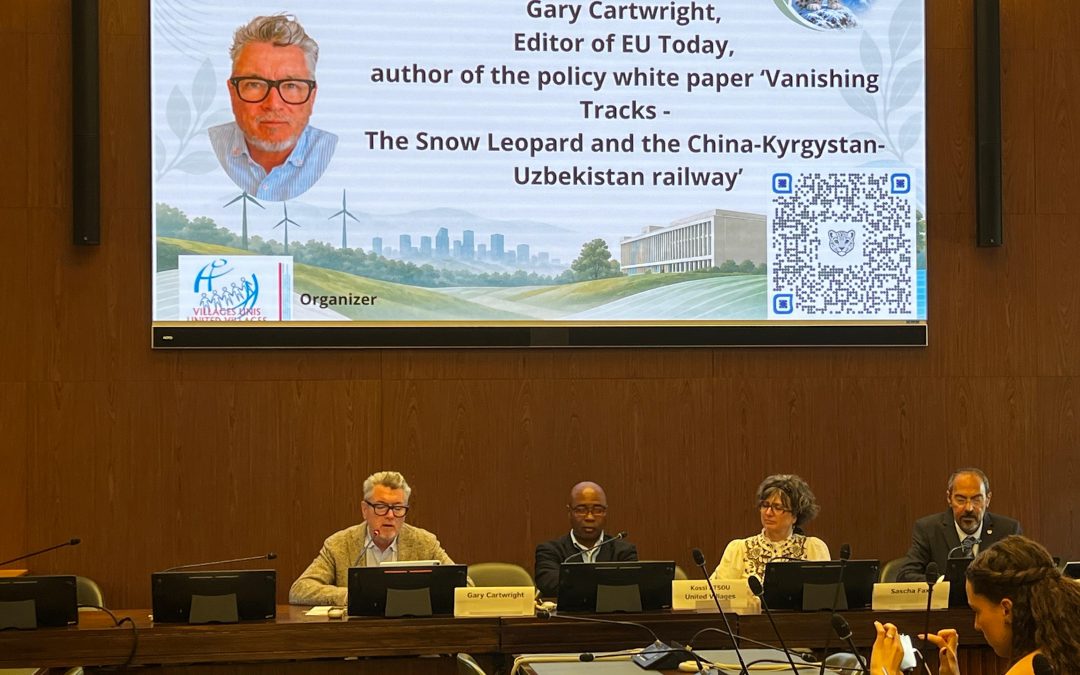
Geneva, 2 July 2026 — On the margins of the 62nd session of the United Nations Human Rights Council, a side event held at the Palais des Nations in Geneva placed the snow leopard at the centre of a wider debate on climate risk, high-mountain ecosystems, human rights, and the China–Kyrgyzstan–Uzbekistan (CKU) railway. Organized by United Village and Co-hosted by CAP Liberté de Conscience, Global Human Rights Defence,the conference brought together former parliamentarians, journalists, conservationists, and human rights advocates to argue that environmental protection is no longer merely an ecological issue — it is a human rights issue.
The event was moderated by Thierry Valle, President of CAP Liberté de Conscience, who opened by framing the snow leopard as a sacred guardian of the mountains for the peoples of Kyrgyzstan, Nepal, and the Himalayas, and a bridge between the spiritual and natural worlds. “This spiritual dimension reminds us that the protection of creation touches upon freedom of conscience and the respect for beliefs that give meaning to community life,” Valle said. “But today this guardian of the peaks is threatened.”
From Conservation to Human Rights
The shift in framing was deliberate. As Gary Cartwright, Editor of EU Today and author of the policy white paper Vanishing Tracks: The Snow Leopard and the China–Kyrgyzstan–Uzbekistan Railway, told the conference: “Twenty or thirty years ago, a conference about the welfare of snow leopards would have involved one conservationist talking to another. Today, we’re discussing the issue in the context of human rights.”
Cartwright explained that the snow leopard is not merely a beautiful animal but a “keystone species” and “umbrella species.” As the top predator across some of the world’s most spectacular mountain landscapes, it helps keep entire ecosystems in balance. Without snow leopards, prey populations such as Siberian ibex and argali can overgraze fragile mountain vegetation, accelerating soil erosion, destabilising slopes, and degrading watersheds that supply water to millions of people. The disappearance of the snow leopard would also affect Himalayan brown bears, Eurasian lynx, wolves, bearded vultures, and golden eagles — all endangered species that depend, directly or indirectly, on the predator’s presence.
“This is why some people refer to the snow leopard as an umbrella species,” Cartwright said. “Protect the snow leopard, and you’re protecting the ibex, argali, bears, wolves, birds of prey, alpine grasslands, rivers, people, investment.”
The CKU Railway: Development Without Due Diligence?
The immediate trigger for the conference was the proposed China–Kyrgyzstan–Uzbekistan railway, a major infrastructure project that would cut through the very mountain ecosystems the snow leopard inhabits. Cartwright stressed that the objective was not to oppose development. “Nobody doubts that Kyrgyzstan urgently needs investment. Nobody doubts the importance of improving transport links across Central Asia. The question isn’t whether the railway should exist. The question is whether it’s being built in a way that protects one of the world’s most valuable mountain ecosystems.”
A central concern raised by multiple speakers was the apparent absence of a comprehensive, publicly available Environmental Impact Assessment (EIA) for the Kyrgyz section of the railway. “If such an assessment exists, it has not been made readily accessible for independent scientific scrutiny or for meaningful public discussion,” Cartwright said. “It may be that the assessment is being hidden from public gaze. We can only speculate as to why that may be.”
Environmental impact assessments, he argued, are not simply paperwork. They are essential tools for asking difficult questions before irreversible damage occurs: How will wildlife move across the landscape? Will migration routes remain open? Can breeding populations stay connected? Will access roads increase poaching?
European Leverage and the GSP+ Scheme
Sascha Fass, former member of the Danish Parliament and the Parliamentary Assembly of the Council of Europe, brought a sharp political and legal perspective to the discussion. She noted that both Kyrgyzstan and Uzbekistan benefit from the EU’s GSP+ trade preference scheme, which grants duty-free access to the European market for up to two-thirds of their products in exchange for ratifying and effectively implementing 27 international conventions covering human rights, labour rights, environmental protection, and good governance.
“The CKU railway is clearly not living up to these standards,” Fass said. “The absence of environmental assessments is, from my perspective, deeply problematic. There’s no transparency or democratic participation in the process. The standards of good governance have been bypassed.”
Fass argued that the EU has “muscles to flex” and cannot afford, politically or ethically, to remain silent. “If we don’t act, it will not only be an indirect greenwashing of the railway. It will also be a signal that the requirements we set up in our trade agreements are not hard standards. If they can be bent on a big project like this, where will they be bent next?”
A Spiritual and Ecological Interdependence
The conference also explored the spiritual dimension of the issue. Valle and other speakers emphasised that for the peoples of Central Asia and the Himalayas, the snow leopard is not merely wildlife but a sacred being — a messenger of the gods in Germanic and Buddhist traditions, and a guardian of the peaks. This spiritual connection, they argued, reinforces the human rights dimension: the right to cultural and religious identity is inseparable from the right to protect the natural world that gives that identity meaning.
Frank Schwalba-Hoth, co-founder of the German Green Party and former Member of the European Parliament, delivered a video message from Brussels in which he recalled his work in the early 1990s on environmental awareness-raising in the former Soviet Union. “We are human beings, but on the other hand we are very close to other living beings, to animals. They have rights as well, and we, as technically more advanced species, have a responsibility.” He expressed hope that the international norms on environmental impact assessment would become a guiding principle for transport projects in Central Asia.
EU Today Coverage and Oral Statement
The side event attracted significant media attention. EU Today published a dedicated article on the conference, placing the snow leopard at the heart of Central Asia’s railway dilemma:
“A UN Human Rights Council side-event in Geneva placed the snow leopard at the centre of a wider debate on climate risk, high-mountain ecosystems, human rights and the China–Kyrgyzstan–Uzbekistan railway.”
Read the full article: https://eutoday.net/snow-leopard-puts-central-asias-railway-dilemma-before-un-human-rights-council/
In addition to the side event, Gary Cartwright delivered an oral statement directly to the UN Human Rights Council during the plenary session, calling for infrastructure projects in climate-sensitive mountain ecosystems to be subject to transparency, public participation, and independent ecological review. EU Today covered this intervention as well:
“Gary Cartwright told the UN Human Rights Council that infrastructure projects in climate-sensitive mountain ecosystems must be subject to transparency, public participation and independent ecological review.”
Read the coverage: https://eutoday.net/eu-today-raises-cku-railway-environmental-concerns-at-un-human-rights-council/
The Right to a Healthy Environment
The conference concluded with a clear message: the right to a clean, healthy, and sustainable environment, recognised by the UN General Assembly in 2022, must be applied in practice, not merely in principle. This means full publication of environmental impact assessments, disclosure of route-level documentation, independent ecological review, and meaningful participation by affected communities and civil society.
As Cartwright put it: “History won’t judge us by the roads we build or the railways we construct. It will judge us by whether we’re wise enough to build them responsibly. Protecting the snow leopard isn’t really about saving one beautiful animal. Ultimately, it’s about protecting ourselves.”
The full conference is available for viewing on the EU Today YouTube channel: https://www.youtube.com/watch?v=37OLoOs9aaw
Related posts:
 HRC 62 The Snow Leopard and Transboundary Linear Infrastructure in High-Mountain Ecosystems: Climate Risks, Ecological Connectivity and Human Rights
 HRC 62 Oral Statement: China–Kyrgyzstan–Uzbekistan Railway, Snow Leopard Habitat and the Right to a Healthy Environment
 HRC 62 : Ethiopia: The Amhara Cry at the United Nations — A Silence the Council Must Break
 The EU Reinforces Trade Preferences: Human Rights and the GSP+ Revision