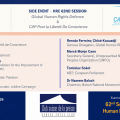
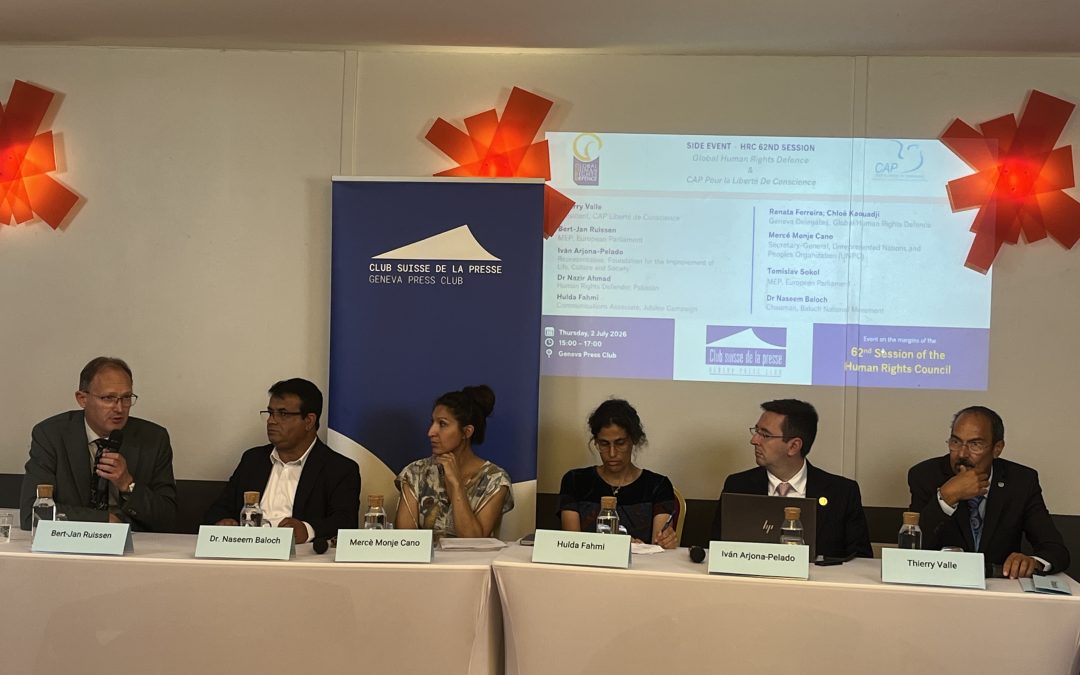
Geneva, 2 July 2026 — On the margins of the 62nd session of the United Nations Human Rights Council, CAP Liberté de Conscience and Global Human Rights Defence co-hosted a side event at the Geneva Press Club titled “Forced Conversions and Minority Women in Pakistan: A Human Rights Emergency.”* The conference brought together Members of the European Parliament, human rights defenders, representatives of minority communities, and civil society leaders to examine one of the most urgent freedom of religion or belief crises facing women and girls today.
The event was moderated by Thierry Valle, President of CAP Liberté de Conscience, and opened by Renata Ferreira of Global Human Rights Defence, who framed the discussion as an opportunity to “raise awareness, amplify the voices of those affected, and discuss ways to strengthen international action” against forced conversion and forced marriage.
A Crisis at the Intersection of Rights
The central issue before the conference was not abstract. Speakers documented a pattern in which young girls from Hindu, Christian, Sikh, and other minority communities in Pakistan are abducted, pressured into conversion to Islam, and married in circumstances that make free and informed consent impossible. According to figures cited during the event and confirmed by UN human rights experts, approximately 75 percent of recorded victims in 2025 were Hindu and 25 percent Christian, with nearly 80 percent of documented incidents occurring in Sindh province.
For participants, the violation goes beyond religious freedom. It touches child protection, women’s rights, family integrity, and the prohibition of torture and slavery-like conditions. As Hulda Fahmi of Jubilee Campaign noted, research examining 100 reported cases involving Christian girls between 2019 and 2022 found that 61 percent of victims were under 18. The age gaps between girls and their abductors were often extreme: in one case, a 40-year-old man abducted a nine-year-old girl; in another, a 37-year-old man took a 13-year-old.
European Parliament Pressure
Bert-Jan Ruissen, Dutch Member of the European Parliament and co-chair of the EP Intergroup on Freedom of Religion, Belief and Conscience, told participants he had raised two concerns directly with Pakistan’s ambassador in Brussels: the abduction and forced marriage of young girls, and Pakistan’s blasphemy laws. He warned that Pakistan’s access to the EU’s GSP+ trade preference scheme should not be separated from its human rights performance.
“Pakistan has to show serious progress,” Ruissen said, adding that the European Parliament was preparing to debate forced marriage in Pakistan, including the case of Maria Shahbaz, a Christian girl whose reported abduction, conversion, and marriage have drawn international attention. He cautioned that legal reform alone is insufficient if courts continue to disregard birth certificates or rely on statements made under duress.
MEP Tomislav Sokol, speaking by video, also tied the issue to EU policy. Earlier this year, he submitted a written question to the European Commission concerning false accusations of blasphemy in Pakistan. In his Geneva message, he urged the Commission to use GSP+ dialogue with Islamabad to seek “concrete progress before 2027.”
Beyond Individual Cases
Dr. Naseem Baloch, Chairman of the Baloch National Movement, widened the lens by drawing parallels between forced conversion and the coercion faced by Baloch women under state pressure. A former enforced disappearance and torture victim now living in exile, Baloch asked: “Can there be any freedom of religion when a child is afraid? Can there be any consent when a girl is under pressure?” He described how his own sister was forced to appear at a press conference against him, arguing that the same logic of manufactured consent underlies both practices.
Mercè Monje Cano, Secretary-General of the Unrepresented Nations and Peoples Organization, emphasized that child marriage and forced conversion are “two faces of the same crisis,” shaped not only by religion but by political exclusion, poverty, climate stress, and weak local accountability. She called for coalitions connecting freedom of religion or belief, women’s rights, minority representation, and climate vulnerability.
Education and Early Prevention
Victoria Walczyk of Global Human Rights Defence introduced the organization’s latest report, “Educating Intolerance,” which examines Pakistan’s education policies and school textbooks. She argued that discrimination begins in the classroom, where textbooks often present national identity through one dominant religious narrative while giving little space to minority history and contributions. The report calls for removal of discriminatory content, creation of an independent curriculum review commission with minority representation, and stronger human rights education.
Iván Arjona-Pelado, representing the Foundation for the Improvement of Life, Culture and Society, placed the discussion in the framework of Article 18 of the Universal Declaration of Human Rights. “No one else owns that conscience but yourself,” he said, emphasizing that freedom of conscience belongs equally to every child regardless of birth.
Looking Ahead
The Geneva conference made clear that participants are not seeking condemnation alone. They are asking for enforcement: police who register complaints promptly, courts that test evidence rigorously, shelters that protect victims, prosecutors who pursue perpetrators, and diplomats who treat freedom of religion or belief as a core human rights priority.
The event was covered by World Religion News in an article titled “Pakistan’s Minority Girls at the Crossroads”:
https://www.worldreligionnews.com/features_banner/pakistans-minority-girls-at-the-crossroads/
The event was covered by The Geneva Times news in article titled “A Geneva Conference Links Forced Conversion, Child Marriage, and EU Accountability” : https://www.thegenevatimes.news/2026/07/pakistans-minority-girls-crossroads-geneva-conference-forced-conversion-child-marriage-eu-accountability/
The full conference is available for viewing on the Geneva Press Club’s YouTube channel
Statement by Bert-Jan Ruissen . MEP European Parliament On the margins of the 62nd session of the UN Human Rights Council, Global Human Rights Defence and CAP Liberté de Conscience organised a side event at the Geneva Press Club addressing one of Pakistan’s most urgent and underreported human rights crises: the forced religious conversion and abduction of women and girls from minority communities.