By CAP Liberté de Conscience May 2026
The Mechanism of Erasure
Iran holds the highest death sentence rate per capita on the planet. This is not a statistic to be filed away; it is the baseline from which every other fact in the European Parliament’s resolution of 21 May 2026 must be read. The text, adopted under reference TA-10-2026-0185, addresses what the Parliament itself describes as “the largest mass murder of protesters in the country’s history” — a wave of repression numbering in the tens of thousands, including at least 236 minors, carried out through mass detentions, executions, torture, and what the resolution calls “daily terror.” The regime, the text adds, is using the ongoing war as cover to accelerate executions further.
This resolution is not a routine diplomatic gesture. It is a document of record, and its record is grim.
The Document and Its Mandate
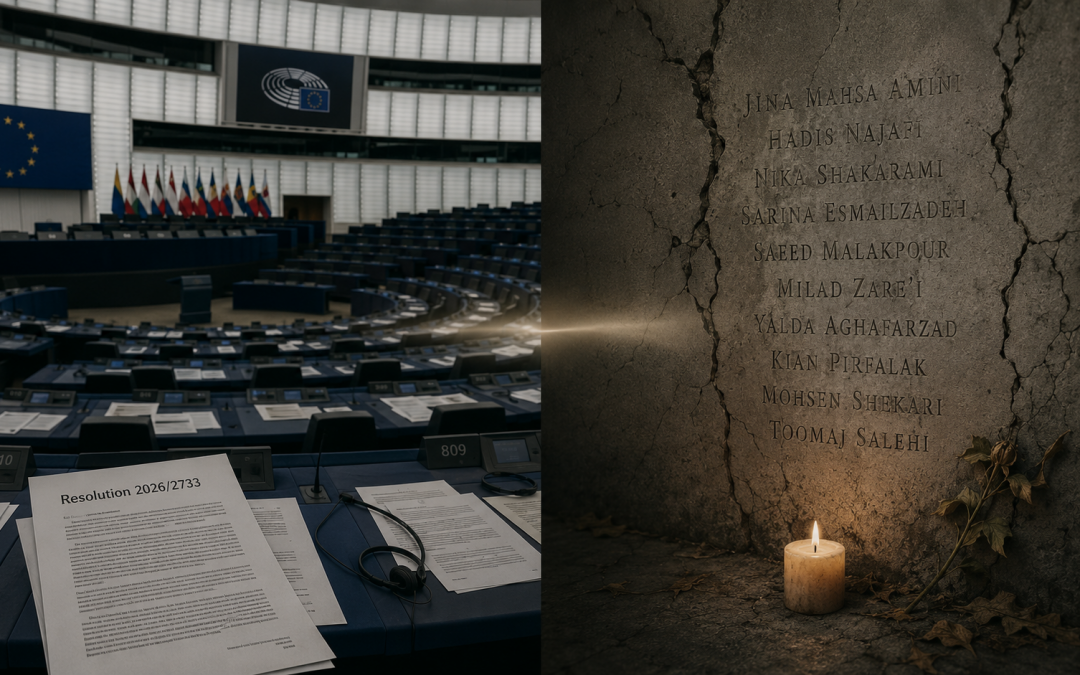
The European Parliament adopted resolution 2026/2733(RSP) on 21 May 2026, invoking Rules 150(5) and 136(4) of its Rules of Procedure. The text builds on a long sequence of prior resolutions on the Islamic Republic of Iran, but its urgency is sharpened by the events of the 2025–2026 uprising. The resolution’s mandate is straightforward: to condemn, to demand, and to call for structural accountability.
The Parliament grounds its intervention in the findings of the UN International Independent Fact-Finding Mission on Iran (FFM), which warned that the repression “may amount to crimes against humanity.” The FFM’s assessment is not hedged. It points to a pattern: sham prosecutions, confessions extracted through torture and sexual violence, broadcasted forced confessions, mock executions, and the systematic use of the death penalty as a tool of political deterrence. In March and April 2026, authorities began executing January protesters. The resolution pays tribute to the “remarkable bravery of those executed” — a phrase that, in the context of the document’s otherwise sober tone, carries the weight of witness.
The Anatomy of Repression
The resolution identifies the machinery of repression with precision. It names the judiciary, the prison administration, the Islamic Revolutionary Guard Corps (IRGC), and entities associated with the Supreme Leader as vectors of violence. It calls for the expansion of sanctions against officials responsible for repression, for the denial of entry into the EU, and for the freezing of IRGC assets and those of loyal family members. The text also urges Member States to close Iranian diplomatic missions associated with transnational repression — a signal that the Parliament views the regime’s reach as extending beyond its borders.
The document does not stop at state structures. It condemns the internet blackout imposed in Iran and calls on the EU and like-minded partners to provide Iranians with tools for secure internet access. It asks Member States to ensure the FFM receives adequate resources, to share information with it, and to establish a tribunal for Iran to pursue accountability and universal jurisdiction in European courts. The Vice-President of the Commission / High Representative (VP/HR), the Council, and Member States are urged to make human rights, the release of all political prisoners, an end to executions, and accountability for victims “core elements of any engagement to end the ongoing war.”
Religious Minorities: The Disproportionate Target
Point D of the resolution’s preamble states, without equivocation, that the regime “disproportionately targets religious and ethnic minorities.” The list is specific: Ahwazis, Afghans, Azeris, Bahá’ís, Baluchis, Christians, Jews, Kurds, Sunnis, and Zoroastrians. This is not a general allegation of discrimination. It is an inventory of communities under systematic assault.
The resolution highlights the arrests of Peyvand and Borna Naimi from the Bahá’í community as emblematic of the regime’s “brutal repression against minorities” and calls for their “immediate and unconditional release.” The reference is operational: it ties a general pattern to concrete names, making the abstract specific.
CAP Liberté de Conscience has documented this pattern before. At the 39th Special Session of the UN Human Rights Council on Iran, held on 23 January 2026, the organisation delivered an oral statement detailing the coordinated crackdown against religious minorities. The statement noted that the Ministry of Intelligence had arrested over 50 Christians on fabricated espionage charges, that eight Bahá’í women had received nearly 39 years’ imprisonment merely for promoting their faith, and that thirty-five Jewish citizens had been arrested for alleged ties to Israel based solely on decades-old travel or social media activity. CAP LC described this coordinated crackdown as constituting “crimes against humanity under international law” and urged the Council to establish accountability mechanisms and take concrete action. [^1]
The European Parliament’s resolution of 21 May 2026 echoes these findings and amplifies them within the EU institutional framework. The convergence between the UN special session and the Parliament’s text is not coincidental: it reflects a growing consensus among international monitoring bodies that the persecution of religious minorities in Iran is neither incidental nor secondary to the broader repression, but integral to it.
The Question of Accountability
The resolution’s most forceful demands centre on accountability. It calls for the immediate and unconditional release of all political prisoners and for accountability for violence committed in detention. It asks Member States to “duly consider the vulnerability of persecuted Iranians when processing cases under national legal frameworks” — a directive that speaks to the asylum and refugee systems of EU countries. It instructs the Parliament’s President to forward the resolution to the Council, the Commission, the VP/HR, the governments and parliaments of the Member States, and the authorities of the Islamic Republic of Iran.
The text also carries an implicit rebuke to those who would treat human rights as a bargaining chip. By making the release of prisoners, an end to executions, and accountability “core elements of any engagement to end the ongoing war,” the Parliament signals that these are not peripheral conditions but prerequisites for any legitimate diplomatic process.
CAP LC’s Position
CAP Liberté de Conscience welcomes the European Parliament’s resolution as a necessary, if belated, institutional response to a crisis that has been documented for years. The organisation’s mandate — to defend freedom of conscience and religion or belief, to alert European and international instances, and to support victims of discrimination — aligns directly with the resolution’s provisions on religious minorities and political prisoners.
The resolution’s call for expanded sanctions, for the closure of diplomatic missions linked to transnational repression, and for the establishment of a tribunal for Iran are measures that CAP LC has long advocated. The organisation will continue to monitor the implementation of these recommendations and to document cases of persecution that fall within the resolution’s scope.
Related posts:
 UN Human Rights Council Adopts Twin Resolutions on Freedom of Religion or Belief and Minority Rights at 61st Session
 European Parliament Resolution on Systemic Oppression in Iran: A Call for International Accountability
 Oral Statement – 39th Special Session of the UN Human Rights Council on Iran
 UN HRC 61 1000 days of conflict. 1000 days of civilians suffering the first-hand consequences of the fighting