A Question in Brussels, a Cry in Geneva
On 15 June 2026, while the 62nd session of the UN Human Rights Council opened in Geneva, a written question sat unanswered on the desk of the European Commission. MEP Nikolaos Anadiotis had asked the Vice-President of the Commission how she assessed the situation of Christian and other religious communities in Ethiopia, where churches are burned, believers displaced, and a policy of impunity appears to shield the perpetrators. He asked whether the EU would raise religious freedom in its political dialogue with Addis Ababa, and whether it would call for an independent investigation into attacks where state inaction or complicity is alleged.
The question was precise. It was also overdue.
That same week, in Strasbourg, MEPs Bert-Jan Ruissen and Tomislav Sokol hosted a conference at the European Parliament titled “The Silent Suffering of the Amhara.” The event examined the persecution of Christians in Ethiopia’s Amhara region, where members of the Ethiopian Orthodox Church live amid armed conflict, civilian killings, displacement, and the systematic destruction of places of worship. The keynote was delivered by Prince Asfa-Wossen Asserate of the Ethiopian Imperial family.
MEPs on the Front Line
 The site World Religion News reported that MEP Bert-Jan Ruissen, co-chair of the European Parliament Intergroup on Freedom of Religion, Belief and Conscience, was in Geneva on 2 July for a side event on forced conversions and minority women in Pakistan. Ruissen had raised two concerns directly with Pakistan’s ambassador in Brussels: the abduction and forced marriage of young girls, and Pakistan’s blasphemy laws. He warned that Pakistan’s access to the EU’s GSP+ trade scheme should not be separated from its human rights record. “New laws are not enough,” he said, “if courts continue to disregard birth certificates or rely on statements made under pressure.”
Speaking by video at the same event, MEP Tomislav Sokol tied the issue to EU policy, urging the European Commission to use GSP+ dialogue with Pakistan to seek “concrete progress before 2027.” Earlier this year, Sokol had submitted a written question to the Commission concerning false accusations of blasphemy in Pakistan.
CAP LC at the 62nd Session
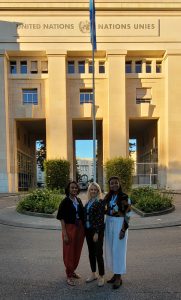
That afternoon, I was at the Palais des Nations in Geneva for the 62nd session of the Human Rights Council. CAP LC co-organised a conference on forced conversions and minority women in Pakistan with Global Human Rights Defence, and partnered on a side event on the snow leopard and transboundary infrastructure in Central Asia with United Villages and Global Human Rights Defence. The latter event, reported by EU Today, placed ecological connectivity and human rights in the same frame — a reminder that the Council’s mandate extends beyond single-issue advocacy.
But the information I carry back from Geneva is not limited to conference rooms.
The Broken Chair, Unbroken Voices
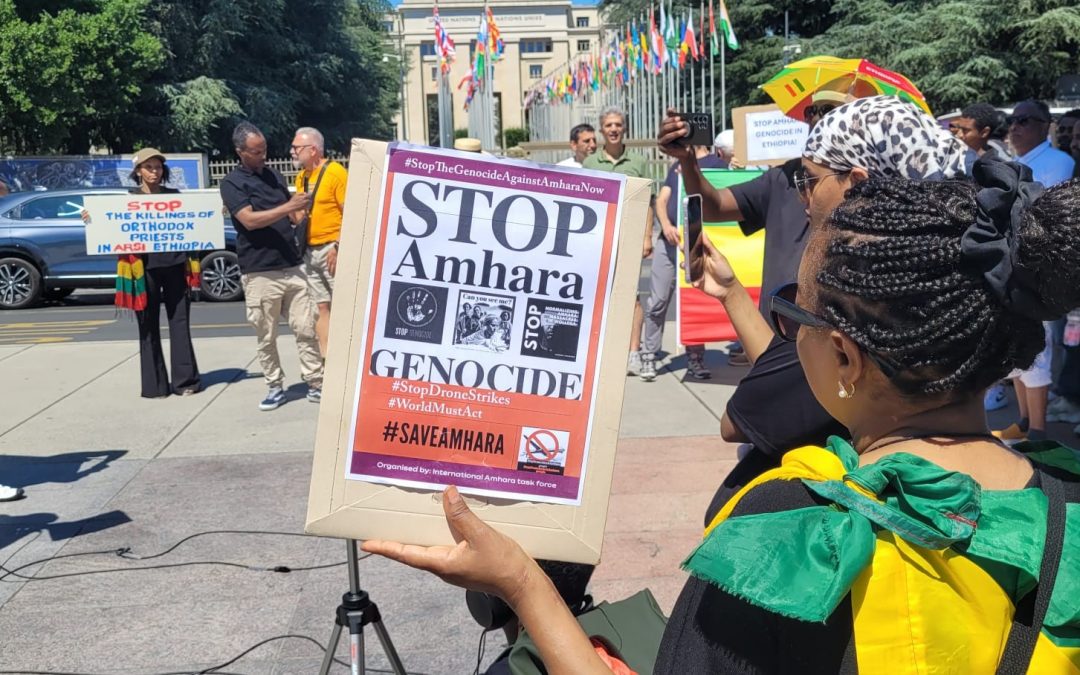
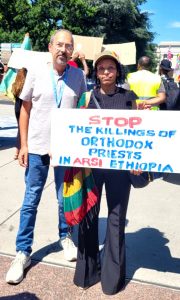
At the — the Broken Chair — a group of Amhara demonstrators had gathered under the July sun. They held signs that read “STOP Amhara GENOCIDE” and “STOP THE KILLINGS OF ORTHODOX PRIESTS IN ARSI ETHIOPIA.” Some carried the Ethiopian flag. Others held photographs of the dead. A line of red candles had been placed on the pavement.
 I spoke with one of the organisers, a woman who had travelled to Geneva to demand that the United Nations acknowledge what she described as years of extermination. She asked why the Council could act for Tigray but not for Amhara. Why drone strikes on churches and civilian gatherings were documented and filed, yet produced no investigation. Why the International Commission of Human Rights Experts on Ethiopia had been disbanded just when its mandate was most needed.
Her question was not rhetorical. It was a demand.
I gave her the only honest answer I had: that CAP LC had been raising these alarms since 2024, and that we would not stop.
A Track Record of Alarm
 In April 2024, Stop Amhara Genocide — an organisation with which CAP LC has collaborated for years at the Human Rights Council — released a report titled “The Escalating Attacks on Orthodox Christians in Ethiopia.” The document documented the systematic persecution of adherents of the Ethiopian Orthodox Tewahedo Church, one of the oldest Christian denominations in the world. It recorded the burning of churches, the killing of clergy and congregants, the kidnapping and murder of priests, and explicit statements by assailants that their goal was to destroy the Orthodox Church as a means of eradicating the Amhara people.
The Ethiopian Tribune reported on CAP LC’s advocacy in August 2023, noting that our representative to the United Nations, Christine Mirre, had repeatedly alerted the International Commission of Human Rights Experts on Ethiopia to massacres in East Wellega, the displacement of nearly one million Amhara civilians, and the mass arrest of Amhara youth. The article cited our oral intervention at the 52nd session of the Human Rights Council, where we detailed attacks carried out by government forces against women, children, and the elderly between November and December 2022.
CAP LC has also submitted written statements to the Council on the racial and ethnic-based violence against Ethiopia’s Amhara, on drone attacks and the escalating humanitarian crisis, and on the use of sexual violence as a weapon of war against Amhara women and girls. These submissions are not abstract exercises. They are based on testimony, documentation, and the growing realisation that the Amhara are being targeted not for what they have done, but for who they are.
The Cost of a Disbanded Commission
In 2023, the Ethiopian government succeeded in terminating the mandate of the International Commission of Human Rights Experts on Ethiopia. Human Rights Watch and Amnesty International had both called for its renewal. The Commission’s mandate was to investigate violations and identify perpetrators. Its closure left a vacuum that has since been filled with further violence.
The question the Amhara woman at the Broken Chair asked me is the same question I now put to the Council: how can we expect justice when the perpetrators are entrusted to investigate, prosecute, and judge their own crimes?
Over 100 drone attacks have been reported in the Amhara region in recent months, targeting civilians, churches, and gatherings. A state of emergency has been prolonged. The violence has escalated over the past eight months. Yet the Council’s response has been selective and, in the view of many observers, inadequate.
What Must Happen Now
It is time for the Human Rights Council to name a mission to investigate the crimes committed against the Amhara and to ensure that those responsible are brought to justice. The International Commission of Human Rights Experts on Ethiopia must be reconstituted with an expanded mandate to examine exactions against the Amhara from the beginning of the conflict to the present day.
The European Union must follow through on MEP Anadiotis’s questions. Religious freedom and cultural heritage must be raised in the EU-Ethiopia political dialogue. An independent investigation into attacks on Christian and other religious communities must be demanded, particularly where state inaction or complicity is alleged.
The Amhara who stood at the Broken Chair in Geneva did not come to plead for charity. They came to demand that the mechanisms of international law function as they were designed to function — without selectivity, without political calculation, and without the silence that has so far characterised the Council’s response to their suffering.
The broken chair is a monument to the victims of landmines. It is also a symbol of what remains unfinished in the architecture of human rights protection. The Amhara have placed their own broken lives before that monument. The Council must now decide whether to look away, or to act.
Never again is now.
Related posts:
 The EU Reinforces Trade Preferences: Human Rights and the GSP+ Revision
 UN Human Rights Council Adopts Twin Resolutions on Freedom of Religion or Belief and Minority Rights at 61st Session
 Serbia Condemned by the European Court of Human Rights for Banning Falun Gong Protests During Xi Jinping’s Visit