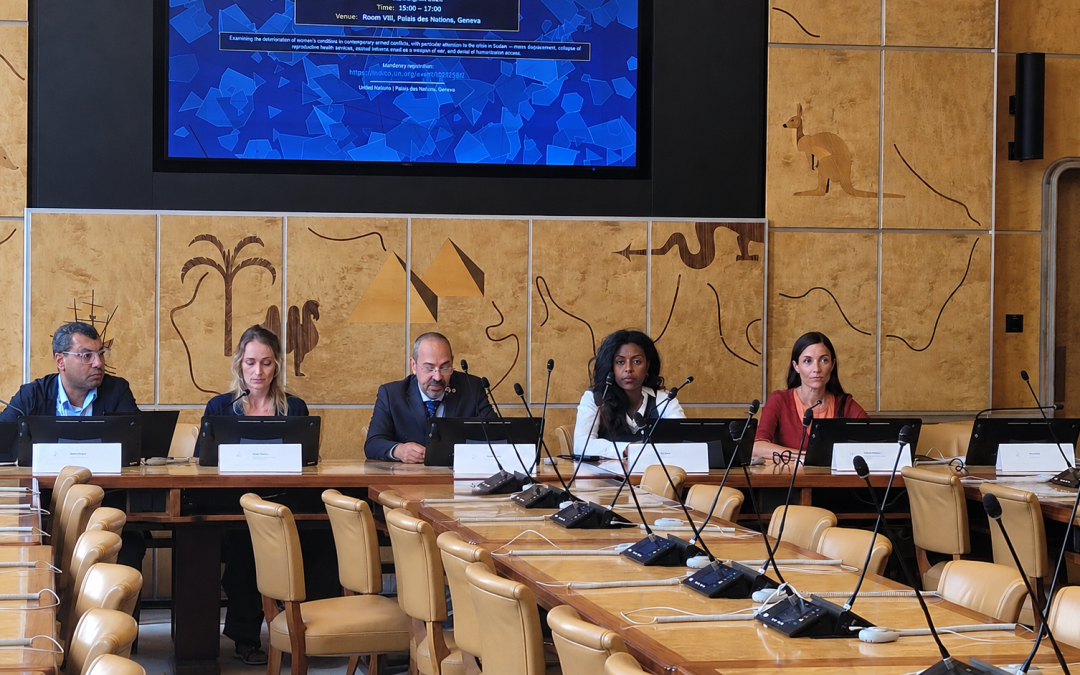
Geneva, 25 August 2026 — On 25 August 2026, in Room VIII of the Palais des Nations, CAP Liberté de Conscience (CAP LC) convened a side event on a subject that remains urgent and too often sidelined: the condition of women in wartime. Titled “Women’s Condition and Violence in Wartime,” the gathering brought together psychologists, human rights defenders, and humanitarian practitioners to give voice to women whose suffering is documented in files and reports, but whose stories rarely reach the chambers where decisions are made.
The conversation was rooted in the present catastrophe in Sudan, where the conflict between the Sudanese Armed Forces and the Rapid Support Forces has turned sexual violence into a tool of terror, destroyed the health system, and left millions of women without protection or care. Yet the speakers also drew the room’s attention to parallel horrors in Ethiopia and beyond, reminding those present that indifference is not neutrality, it is a choice that weighs on the conscience of the international community.
Sarah Thierrée, a psychologist and expert in torture and institutional violence, opened the panel by describing the invisible architecture of trauma that war erects inside the mind. She spoke of survivors who no longer sleep through the night, who carry the sound of footsteps as a permanent threat, and who face a void where mental health services should exist. Her testimony made clear that the violence does not end when the armed men leave the house; it continues in the silence of families who do not know how to help, and in health systems that have forgotten the meaning of care.
Lily David, Representative of the Association of Amharas in the Netherlands and co-founder of Stop Ahmara Genocide, then turned the room’s attention to Ethiopia. She spoke with precision and pain about Amhara women and girls who have been subjected to gang rape, torture, and coerced sterilisation by multiple armed actors, including Tigrayan forces, federal troops, and the OLA. She stressed that their bodies have been turned into battlegrounds for ethnic revenge, and that the collapse of health facilities across Amhara mirrors the destruction witnessed in Sudan, leaving pregnant women without clinics and survivors without treatment. Two points from her presentation stood out: first, the documentation, gathered with CAP LC, of systematic sexual violence against Amhara civilians as part of a broader campaign of ethnic cleansing; and second, the direct parallel she drew between the drones that burn women in Ethiopia and the blockades that starve women in Sudan, captured in the protest sign held by Amhara mothers in London: “Your drones. Our dead.”
Ahmed Mefreh, President of the Committee for Justice (CFJ), brought the focus back to Sudan with a sober account of his organisation’s documentation on the ground. He reported on the abduction of women and girls for ransom, the deterioration of humanitarian conditions inside detention facilities, and the targeting of journalists and activists by both warring parties. His intervention was a reminder that accountability is not an abstract principle, it is a debt owed to those who have been robbed of every other form of justice.
Andrea Widmer, representing the Association Sudan-Switzerland Humanitarian Projects, spoke of the practical work of keeping people alive across borders. She described how Swiss-based networks are trying to channel medicine and funding into Sudan, and why the international community must stop bypassing the local midwives, emergency room volunteers, and women-led groups who have become the true backbone of the humanitarian response. Her message was clear: without direct funding to those who know the terrain, aid remains a promise that never arrives.
Fana Belay, a human rights activist, closed the panel with a summons rather than a speech. She refused to let the room see Sudanese women only as victims of atrocity, insisting instead on their role as organisers, peacebuilders, and the quiet leaders holding their communities together. Two points defined her intervention: first, the affirmation that Sudanese women are not asking for pity, but for a seat at the table where the future of their country is decided; and second, the three demands that have become a rallying cry on the ground “Protect Her, by stopping the flow of weapons and enforcing accountability; Fund Her, by sending resources directly to local responders without bureaucratic obstruction; and Stand with the Sudanese People, by ending the culture of impunity that allows rapists to walk free”.
Following the presentations, participants engaged in a constructive exchange on how to translate testimony into action. The discussion touched on the legal barriers to documenting rape in collapsed states, the risks faced by local volunteers who accept international funding, and the moral failure of a world that knows the scale of these crimes yet continues to debate procedure while women bleed.
The conference concluded with a set of recommendations addressed to the United Nations, member states, and the humanitarian community. The protection of women in Sudan cannot be separated from the protection of women in Ethiopia, Syria, or any other zone where war is waged on civilian bodies. The international community must ensure unimpeded humanitarian access, including sexual and reproductive health supplies; it must channel funding directly to local women-led organizations; and it must support independent investigations capable of naming perpetrators and paving the way for justice. Words of concern have been spoken too many times. What is needed now is the political will to act.
Related posts:
 EU Parliament and Council Take Firm Stand on Sudan Crisis as Accountability Efforts Widen
 HRC 62 : Ethiopia: The Amhara Cry at the United Nations — A Silence the Council Must Break
 The United Nations High Commissioner for Human Rights Addresses Critical Violations in Sudan: Key Findings and International Recommendations