CAP Liberté de Conscience – Sept 2026 63rd session of the Human Rights Council
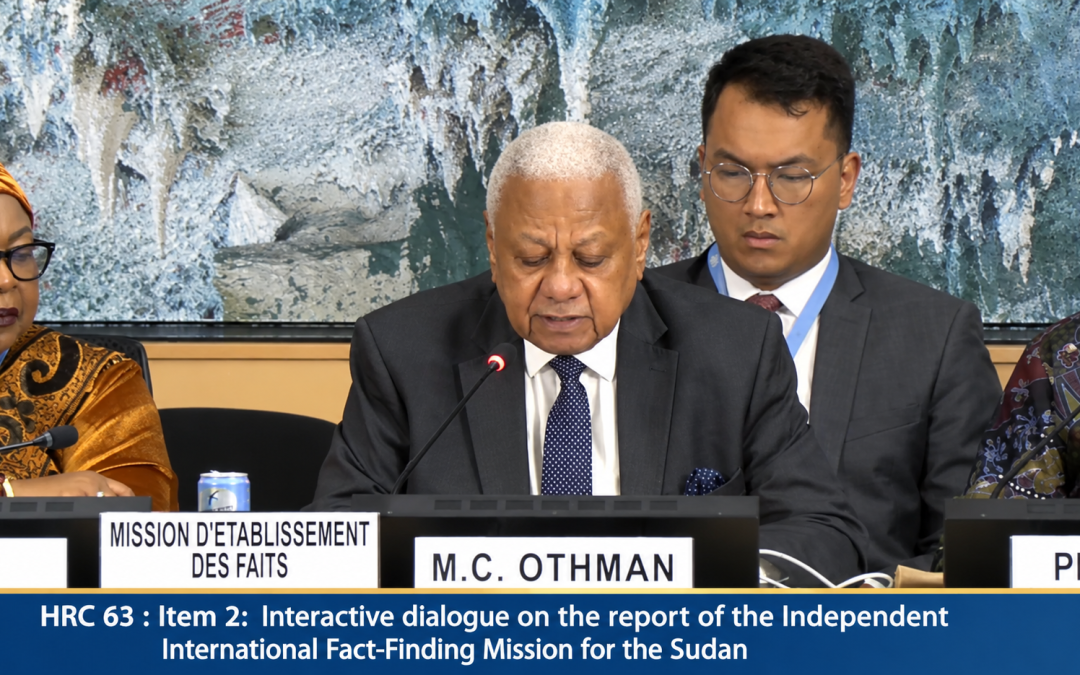
More than 1,000 civilians were killed by drone strikes in Sudan between January and May 2026 alone. That figure, documented by the Office of the UN High Commissioner for Human Rights and cited in the latest report of the Independent International Fact-Finding Mission for the Sudan, framed the interactive dialogue held at the Human Rights Council’s 63rd session in Geneva. The subject was not only who is killing civilians, but who, and what, makes the killing possible.
The report
The document under examination is “Fuelling Sudan’s conflict: weapons, fighters and external support networks” (A/HRC/63/23), the advance unedited version of which was issued on 1 September 2026 as an agenda item 2 report of the Council’s 63rd session (7 September to 9 October 2026). The report was submitted to conference services after the deadline, deliberately, so that the most recent information could be included; an unusual procedural choice that signals the urgency the Mission attached to its findings.
Its authors are the three members of the Independent International Fact-Finding Mission for the Sudan, established by Human Rights Council resolution 54/22 and renewed by resolution 60/3 of 6 October 2025: Mohamed Chande Othman (Chair), Joy Ngozi Ezelo and Mona Rishmawi. The Mission operates under a “reasonable grounds to believe” standard of proof and works in parallel, and increasingly in coordination, with the African Commission on Human and Peoples’ Rights’ own fact-finding mission, with which it issued a Joint Declaration in Banjul in May 2026.
Mandate and scope
The report pursues two connected lines of inquiry. The first is technological: how long-range drones have redefined the battlefield, allowing both the Sudanese Armed Forces (SAF) and the Rapid Support Forces (RSF) to strike hundreds of kilometres beyond front lines, into hospitals, schools, markets, weddings, funerals and displacement camps. The second is structural: the external networks of weapons, money, logistics, training and personnel that sustain those capabilities.
This dual focus responds directly to the Council’s Urgent Debate of 6 July 2026, which requested an urgent inquiry into the situation in and around El Obeid, North Kordofan. That inquiry remains ongoing.
The human cost recorded is specific rather than abstract. In Kalogi, South Kordofan, successive RSF drone strikes hit the Nabaa al-Hanan Kindergarten, then the responders, then the rural hospital receiving the wounded. One hundred and fourteen people were killed, including some 60 children. The hospital ceased operating for approximately 45 days. In Ad-Da’ein, East Darfur, SAF drone strikes rendered the teaching hospital non-functional on the first day of Eid al-Fitr, killing at least 70 people and depriving more than two million people of referral care. In El Obeid, repeated strikes on electricity and fuel infrastructure cascaded into water, dialysis and emergency surgery. The Mission found reasonable grounds to believe that both parties committed serious violations of international humanitarian law, which may amount to war crimes, and reminded the Council of its earlier documentation of conduct displaying hallmarks of genocide in El Fasher.
The external vector
The report’s analytical weight, however, lies in its fifth chapter: the networks behind the weapons. Here the Mission names mechanisms rather than merely outcomes.
It finds reasonable grounds to believe that a transnational network linked individuals and entities in the United Arab Emirates, Chad, southeastern Libya and Puntland (Somalia) through air, land and sea routes supplying the RSF with artillery, including NORINCO AH-4 howitzers and FK-2000 air-defence systems, as well as CH-95/FH-95 drones, electronic warfare equipment, logistics and personnel. Nyala Airport appears in the evidence as a principal entry point, complete with drone command-and-control stations later targeted by SAF missiles.
The most fully documented channel is the recruitment of former Colombian military personnel. Estimates of their number range from 350 to 2,000. The Mission identified key recruiting entities registered in Colombia and the UAE, including one founded by Colonel Álvaro Andrés Quijano Becerra, based in Abu Dhabi, and coordinated from Colombia by his wife, Claudia Viviana Oliveros Forero. Both were sanctioned by the UN Security Council Committee on 28 April 2026. Contractors reportedly transited through Ghayathi in the UAE for training, then through Bosaso, Benghazi, Kufra or Chad into Darfur, operating and maintaining drone systems without transferring them to RSF ranks. Drone controllers were recovered in El Fasher’s Al-Thawra neighbourhood from a building identified as a Colombian-operated launch site.
Support to the SAF receives shorter, explicitly preliminary treatment. Verified imagery of Bayraktar Akıncı combat drones and Yiha III loitering munitions, systems not manufactured in Sudan, indicates foreign-supplied equipment in strikes such as Yabus market, which the Mission assesses may amount to war crimes. The investigation into that supply chain has only begun.
The section on state responses is itself revealing. Chad and Colombia engaged substantively and cooperated; both dispute or downplay their territory’s role while acknowledging the allegations. Ethiopia, Libya, South Sudan and Somalia provided no substantive response. The UAE rejected all allegations as unfounded, attributed them to a “false media campaign” led by Sudanese authorities, and pointed to its own regulatory framework. The Mission, weighing the totality of the evidence, found that individuals and entities linked to the UAE “played a significant role” in the networks and called on Abu Dhabi to investigate and take enforcement action. Notably, the Mission documents that in April 2026 the UAE itself initiated domestic proceedings concerning alleged military transfers linked to Sudan, concerning support to the SAF rather than the RSF, which the Mission cites as evidence that comparable mechanisms exist.
The debate: two grammars of responsibility
The interactive dialogue that followed revealed, with unusual clarity, two competing frames through which states read the same evidence.
The first frame, dominant among Western delegations, treated external support as the report’s central finding. Sweden, for the Nordic-Baltic group, called for “an immediate end to external financing and support.” The United Kingdom, twice speaking (once for the Coalition for Atrocity Prevention and Justice for Sudan), stated that those providing support “bear direct responsibility for sustaining the conflict” and urged states to “cease support to the warring parties.” The European Union, Ireland, Liechtenstein, Luxembourg, Belgium, the Netherlands, Germany, Switzerland and Australia echoed this, with several explicitly endorsing extension of the arms embargo to all of Sudan and of the ICC’s jurisdiction. The Netherlands drew the principle into a formula: accountability must reach “not only those that are direct perpetrators but also those that are enablers.” North Macedonia cited the 1,000-plus drone deaths; Germany, the 33 million people in need of assistance.
The second frame, articulated by Sudan, Egypt, Turkey, Eritrea, Algeria, Kuwait, Qatar, Saudi Arabia, Somalia and several African Group members, subordinated the external-support question to state sovereignty and asymmetric blame. Sudan’s representative, chairing the government’s own national investigation commission, named the UAE as “the main reason for the ongoing conflict” and demanded immediate measures against it, while presenting domestic figures: 153,000 complaints registered, 22,000 criminal investigations opened, and a conviction in the murder of the governor of West Darfur. Egypt and Turkey argued the SAF’s arms procurement is legitimate self-defence that cannot be equated with the RSF’s illicit supply. Eritrea rejected “unconsented” mandates outright. The African Group, speaking through Kenya, stressed sovereignty, complementarity and the consent of the concerned country, condemning “any interference” without naming a sponsor.
Colombia occupied a singular position: neither accuser nor accused, but a state whose nationals stand documented inside the supply network. Its representative condemned mercenarism, announced stiffer controls on military service companies and accession to the 1989 Mercenaries Convention, and stated plainly that Colombia “does not support, promote or condone the participation of its nationals in armed conflicts.”
The UAE’s intervention was categorical: it “rejects any allegations of wrongdoing,” has provided no arms since April 2023, and called, as one of the first states to do so, for the arms embargo to be expanded to the whole of Sudan and for an end to “all forms of external military support to the warring parties without exception.” Whether read as rebuttal or repositioning, it placed Abu Dhabi inside the frame it disputes: the debate about external actors had become, itself, a battlefield of narratives.
Civil society: sharper edges
Non-governmental interventions pressed where states demurred. The Committee for Justice documented fresh strikes on 27 and 28 August and called for tracing the networks “across the full chain of responsibility.” Legal Action Worldwide recalled filing, in June 2026, the first-ever war crimes and crimes against humanity complaints against RSF members in Kenya, adding a pointed sentence: “What has been lacking is the will.” Lawyers for Lawyers, with the International Bar Association’s Human Rights Institute and Lawyers’ Rights Watch Canada, counted at least 16 lawyers killed and 31 suspended or disbarred by bodies “lacking a recognized legal mandate” since April 2023; the dismantling of the justice system as a parallel atrocity.
Two interventions probed the report’s own limits. The African Centre for Democracy and Human Rights Studies, while supporting the Mission’s mandate, called the external-support chapter “patchy,” noted that the role of some of Sudan’s neighbours “is yet to be documented and disclosed,” and demanded that all external supporters of both parties be treated “with the same sense of urgency and vigor.” This was a direct challenge to the asymmetry between the detailed RSF section and the preliminary SAF one. Midline for Human Rights urged scrutiny of mounting evidence concerning UAE support, insisting that “silence is not neutrality when civilians are being killed.”
In their closing remarks, the Mission’s members held both truths: external support “cannot be separated from the conduct of those receiving it,” and denial “is not enough. Action is needed.” Mona Rishwawi added, in Arabic, that the ICC’s jurisdiction must cover all of Sudan, not only Darfur.
The measure of the next vote
This session’s debate showed the Council converging on ends while diverging on causes. Virtually every delegation condemned the drone strikes, demanded humanitarian access, and invoked accountability. But when the Mission’s evidence pointed outward, toward the UAE, Chad, Libya’s southeast, Puntland, Colombian recruiters and Turkish-manufactured airframes over Darfur, the room split between those who saw the supply chain as the story, and those who saw it as a threat to sovereignty, or to one side in the war.
The report’s central insight survives that split. A drone over Kalogi kindergarten is not a weather event. It was financed, shipped, assembled, maintained and launched, sometimes by foreign hands, through decisions taken in offices far from the battlefield. Naming those decisions, and the people who take them, is not taking a side. It is the minimum condition for any peace that does not begin again the day after it is signed.
The Council will soon vote on the Mission’s renewal. The credibility of that vote will be measured by a simple test: whether accountability is extended across the full chain of responsibility, or whether it stops, conveniently, at the border.
The civilians of El Obeid, who cannot drink safely because a substation was hit, are waiting for the answer.
Related posts:
 EU Parliament and Council Take Firm Stand on Sudan Crisis as Accountability Efforts Widen
 Silencing dissent: mass trials in the United Arab Emirates Press Club Geneva
 UN HRC 61 1000 days of conflict. 1000 days of civilians suffering the first-hand consequences of the fighting
 HRC 63 : Sudan: CAP LC Written Statement to the UN Human Rights Council Denounces Chemical Weapons, Human Shields, and External Support