A written statement submitted by CAP LC to the United Nations Human Rights Council calls for an independent international investigation into violations in Sudan, including the alleged roles of Saudi Arabia, Egypt, and Türkiye.
by CAP Freedom of Conscience | Sep 11, 2026
<break>
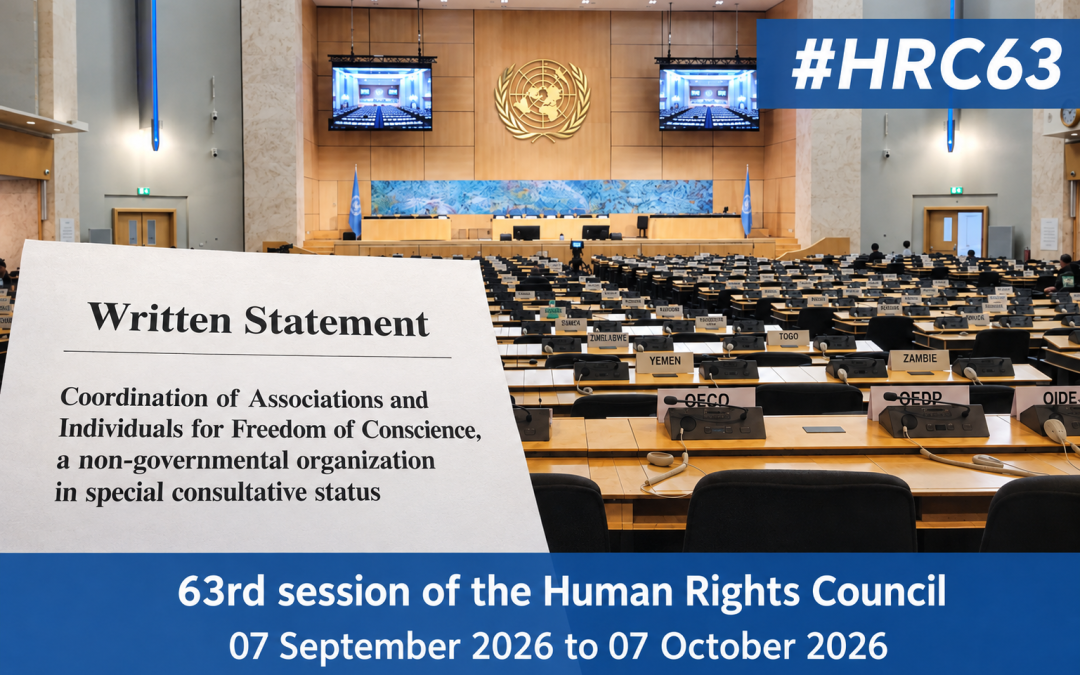
A written statement, submitted on 5 August 2026 by the Coordination des Associations et des Particuliers pour la Liberté de Conscience (CAP LC), an NGO in consultative status with ECOSOC, has been circulated by the United Nations Human Rights Council in Geneva during its sixty-third session. The document draws attention to grave and systematic violations of international human rights law and international humanitarian law committed in the context of the conflict in Sudan.
<break>
CAP LC focuses on five interrelated issues. First, credible allegations implicating the Sudanese Armed Forces (SAF) in the use of prohibited chemical agents. Second, violations against civilians in El Obeid, including obstruction of civilian movement and the possible use of civilians as human shields. Third, fourth, and fifth, the role of external support networks linked to Saudi Arabia, Egypt, and Türkiye.
<break>
On chemical weapons, the statement recalls that the United States announced in May 2025 that it would impose sanctions on Sudan after determining that the Sudanese government had used chemical weapons in 2024 during the conflict, calling on Khartoum to comply with its obligations under the Chemical Weapons Convention. CAP LC notes that a France 24 investigation traced at least part of the chlorine supply chain used in suspected attacks: shipments originating in India, transiting through Saudi Arabia, and then reaching Port Sudan via a Sudanese company linked by investigators to SAF supply structures. Human Rights Watch stated that these findings provided the first public elements corroborating earlier U.S. allegations, noting that the use of chlorine as a weapon would violate the Chemical Weapons Convention and amount to a war crime.
<break>
The statement therefore calls for an independent international investigation into all allegations of chemical weapons use, including chain-of-custody preservation, forensic examination, witness protection, and scrutiny of the procurement and transport networks that may have enabled the diversion of dual-use chemicals into unlawful military use.
<break>
The situation in El Obeid demands urgent and specific attention. CAP LC reports escalating risks to civilians, including attacks affecting populated areas, restricted movement, and severe constraints on humanitarian access. A July 2026 Amnesty International statement urged states to act with urgency to protect civilians. More troubling still, reports indicate that the SAF are refusing to establish safe corridors and are using residents as “human shields” to generate international sympathy. Separate reporting has stated that preventing civilians from fleeing a besieged city may amount to the war crime of using civilians as human shields.
<break>
The role of outside powers must also be examined where it may contribute to violations. Reuters reported that Egypt and Saudi Arabia have shown support for the Sudanese military. Saudi Arabia in particular presents itself as a mediator and humanitarian actor: this dual posture makes rigorous due diligence essential, as mediation efforts cannot shield any state from scrutiny where its relationships, logistical channels, or financial backing may contribute to serious abuses. The France 24 investigation is especially relevant here, as the chlorine canisters transited Saudi territory. As for Egypt, there are allegations that its territory has been used to facilitate SAF military operations and even that it has directly participated in operations causing civilian harm.
The statement finally examines the role of Türkiye, in light of emerging reporting regarding the transfer of military equipment, including unmanned aerial vehicles, to SAF-aligned forces. Open-source intelligence has indicated the presence of Turkish-manufactured drones in SAF operations, raising concerns about their potential use in strikes affecting civilian areas and critical infrastructure.
<break>
In conclusion, CAP LC calls on the Human Rights Council to: establish or strengthen an independent investigative mechanism covering chemical weapons allegations and related supply chains; demand immediate civilian protection measures in El Obeid, including safe passage and humanitarian access; call on all third states to suspend any military, logistical, or financial support that could contribute to violations in Sudan; and press all states with influence over the SAF, including Saudi Arabia and Egypt, to cooperate fully with international inquiries. The statement recalls that the democratic aspirations of the Sudanese people, expressed through the removal of the Bashir regime in 2019, must not be sacrificed to the security demands of Sudan’s immediate neighbors.
<break>
Related posts:
 EU Parliament and Council Take Firm Stand on Sudan Crisis as Accountability Efforts Widen
 UN UPR 54th Session: On Procedural Bias and the Selective Handling of Human Rights Violations in Sudan
 UN HRC 61 1000 days of conflict. 1000 days of civilians suffering the first-hand consequences of the fighting
 The United Nations High Commissioner for Human Rights Addresses Critical Violations in Sudan: Key Findings and International Recommendations