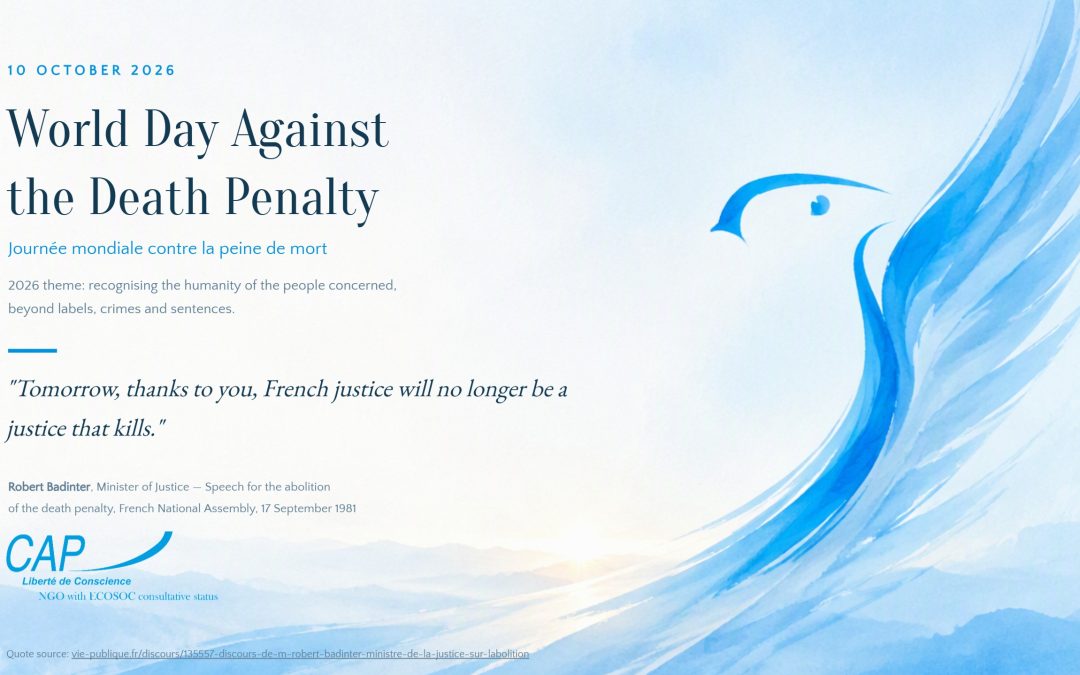
On 10 October, the World Day Against the Death Penalty, United Nations human rights experts renewed their call for the complete abolition of capital punishment. Their message this year is simple: look beyond labels, crimes and sentences, and recognize the humanity of those affected. The death penalty is not an abstract concept. It is imposed on people with families, life stories, aspirations and inherent dignity.
A record year for executions
The figures are alarming. In 2025, at least 2,707 people were executed worldwide, the highest number recorded since 1981 and a 78 per cent increase over the previous year. Some 25,508 people were living on death row, and nearly half of all known executions were reportedly carried out for drug related offences. Yet 145 States have now abolished the death penalty in law or in practice, confirming a steady movement towards universal abolition.
Convicted without justice
Many people on death row were convicted in proceedings marked by serious violations of fair trial guarantees: allegations of torture, coerced confessions, denial of legal representation and politically influenced trials. Over the past five years, the UN Working Group on Arbitrary Detention found the detention of at least 16 individuals sentenced to death or executed to be arbitrary. The experts also warn that capital punishment is still imposed for offences that fall outside the international standard of the most serious crimes, understood as intentional killing, including political offences and blasphemy. Human lives must never be instrumentalized to suppress political or religious dissent.
No one should die for their beliefs
This is where the struggle becomes inseparable from freedom of conscience. CAP Liberté de Conscience pays particular attention to cases where the death penalty is imposed for blasphemy or apostasy, in which the punished act consists of words, opinions or peaceful expression about religion. Among the cases cited by the UN experts is that of Yahaya Sharif Aminu, whose detention was found arbitrary. Punishing a person with death for alleged blasphemy is not justice; it is the criminalization of thought itself.
What the experts demand
The UN experts call on retentionist States to establish an immediate moratorium on executions, in line with General Assembly resolution 79/179; to guarantee fair trial standards; to prohibit the death penalty for crimes that do not involve intentional killing; and to ratify the Second Optional Protocol to the International Covenant on Civil and Political Rights.
The voice of Robert Badinter
The World Day falls each year on 9 October, the anniversary of the promulgation of the French abolition law in 1981. Its author, Robert Badinter, entered the Panthéon on 9 October 2025, exactly forty four years after his law entered into force.
His words to the National Assembly on 17 September 1981 remain the finest summary of why this fight continues:
« Aussi terribles, aussi odieux que soient leurs actes, il n’est point d’hommes en cette terre dont la culpabilité soit totale et dont il faille pour toujours désespérer totalement. Aussi prudente que soit la justice, aussi mesurés et angoissés que soient les femmes et les hommes qui jugent, la justice demeure humaine, donc faillible. »
Whatever the acts, there is no human being whose guilt is total; justice remains human, and therefore fallible.
Related posts:
 Oral statement on the situation of Chairman Lee Man-hee in pretrial detention in the Republic of Korea — General Debate under Item 3, 63rd session of the Human Rights Council
 La chaîne n’a pas disparu, elle a changé de nom Dialogue sur la servitude 2.0
 Iran: The European Parliament Denounces a Machinery of Death
 The Quietest Violation: The Working Group on Arbitrary Detention at HRC 63