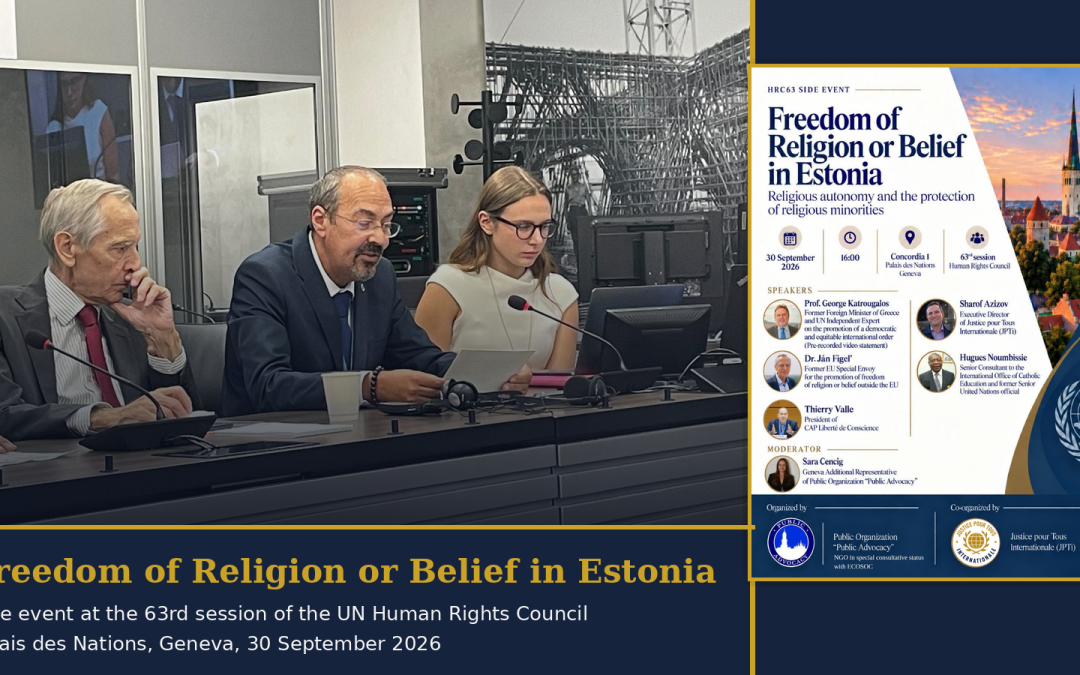
A side event during the 63rd session of the Human Rights Council
On 30 September 2026, during the 63rd session of the United Nations Human Rights Council, the Public Organization “Public Advocacy”, an NGO in special consultative status with the United Nations Economic and Social Council, convened the side event “Freedom of Religion or Belief in Estonia: Religious Autonomy and the Protection of Religious Minorities” in Concordia 1 at the Palais des Nations in Geneva, with Justice pour Tous Internationale (JPTi) as co organizer. Moderated by Sara Cencig, Geneva Additional Representative of Public Advocacy, the discussion brought together Professor George Katrougalos, United Nations Independent Expert on the promotion of a democratic and equitable international order and former Foreign Minister of Greece, who contributed by video; Dr Ján Figeľ, First Special Envoy for the promotion of freedom of religion or belief outside the European Union and President of the Forum for Religious Freedom Europe; Thierry Valle, President of CAP Liberté de Conscience; Hugues Noumbissie, International Consultant and former senior United Nations official; and Sharof Azizov, Executive Director of JPTi. The event followed the adoption of Estonia’s Universal Periodic Review outcome by the Council on 25 September 2026 and focused on the implementation of the recommendations Estonia has supported.
Religious autonomy at the heart of the debate
The discussion centered on the situation of the Estonian Christian Orthodox Church and of the Pühtitsa Convent. The canonical head of the Church, Metropolitan Evgenii, remains excluded from Estonia following a 2024 residence permit decision, while the Churches and Congregations Act, in force since 27 June 2026, now automatically bars him from clerical functions, with a transition period for specified institutional requirements ending on 28 December 2026. The speakers recalled that, under Article 18(3) of the International Covenant on Civil and Political Rights, national security is not an independent ground for restricting the manifestation of religion or belief, and they noted that the Supreme Court judgment of 8 June 2026 itself requires a real rather than abstract threat, excludes confessional and doctrinal affiliation from the prohibition, and treats compulsory dissolution as a last resort, six of the seventeen participating justices having dissented on legal clarity. They also stressed the precedent set by the European Court of Human Rights, which has held that a State may not push a religious community under a leadership it has not chosen, and questioned the consistency between Estonia’s international advocacy, including its support for the freedom of Tibetan Buddhists to choose the Dalai Lama’s successor without State interference, and its domestic practice.
An open letter to the Estonian authorities
On 2 October 2026, JPTi transmitted an open letter to the Estonian authorities, endorsed by Dr Ján Figeľ, Thierry Valle and Hugues Noumbissie. Addressed to Igor Taro, Minister of the Interior; Margo Palloson, Director General of the Estonian Internal Security Service; Egert Belitšev, Director General of the Police and Border Guard Board; Ülle Madise, Chancellor of Justice and President elect of the Republic; and Olari Koppel, Deputy Chancellor of Justice Adviser and Director of the Office of the Chancellor of Justice, the letter calls for a fair, individualised reassessment of the immigration obstacles and of the restrictions on clergy eligibility, and for the administrative or legislative measures necessary to enable Metropolitan Evgenii’s dignified and lawful return. It recalls that any change of canonical jurisdiction must remain a free decision of the religious community concerned, invites the Chancellor of Justice to assess the case under international human rights standards and to publish findings and recommendations, and requests a substantive written response, preferably within 21 days of receipt. Here follows the statement delivered by Thierry Valle at the side event.
Source : https://www.jpti.ch/#top
Statement by Thierry Valle, President of CAP Liberté de Conscience, 30 September 2026
Madam Moderator, Excellencies, dear colleagues,
For thirty years, CAP Liberté de Conscience has defended freedom of religion or belief for everyone, and especially for minorities that are stigmatized, marginalized or placed under suspicion. We have spoken for Ahmadis in Pakistan, Jehovah’s Witnesses in Sweden, members of the Unification Church in Japan. Our position does not change with geography or with the political sympathy a community inspires. Today we speak within one framework only: international law, and in particular Article 18 of the Universal Declaration and of the Covenant.
Let me be clear. Estonia faces real security challenges, and we do not question its right to protect itself. Our question is narrower: do the measures taken respect the limits that the Covenant sets?
Our experience shows a recurring pattern: believers pay for acts attributed to authorities they do not control.
In Sweden, the State withdrew public support from the Jehovah’s Witnesses as a whole, based on general assessments of the organisation’s teachings. The situation of each local congregation was not examined. In Japan, the dissolution of the Family Federation, based on conduct attributed to parts of its structure, takes places of worship away from tens of thousands of believers who were never individually accused. In both cases, CAP Liberté de Conscience raised the same objection: responsibility in a democracy is individual, not collective.
In Estonia, the Supreme Court itself held on 8 June that confessional and doctrinal affiliation falls outside the prohibition and that the threat must be real, not abstract. Canonical confirmation of a Primate who is proposed and elected in Estonia, by an Estonian assembly, is not administrative or economic control. The Estonian Christian Orthodox Church must be judged on its own statutes, conduct and circumstances, not on statements made elsewhere.
Yet the Church’s canonical head remains excluded. Today a 2024 residence-permit decision, whose grounds were never publicly individualized, automatically bars him from clerical functions. The practical consequences fall on ordinary believers: no episcopal ministry, no ordinations, no pastoral visits, and uncertainty over canonical continuity. Parishes are deprived of spiritual leadership through no act of their own.
Article 18(2) of the Covenant states that no one shall be subject to coercion that impairs the freedom to have or adopt a religion. A change of jurisdiction is an act of conscience only if refusing it carries no penalty. When the alternative is a deadline of 28 December, possible court dissolution and the loss of a historic cathedral, the choice is no longer free.
Strasbourg has already said this. In Supreme Holy Council of the Muslim Community v. Bulgaria and Holy Synod of the Bulgarian Orthodox Church v. Bulgaria, the Court held that a State may not push a religious community under a leadership it has not chosen. In Metropolitan Church of Bessarabia v. Moldova, it held that a community’s choice of canonical belonging belongs to the community alone.
This applies with particular force to the Pühtitsa Convent. For a community of nuns, canonical belonging is not an administrative label. It is the substance of their monastic vows. The Ministry acknowledged on 28 July that it cannot compel the Church to elect a metropolitan. That principle must also hold in practice.
Estonia has supported UPR recommendations to keep national security measures consistent with freedom of religion or belief, and to protect the religious freedom of minorities. In July 2025, Estonia also affirmed that communities must choose their leaders without State interference. CAP Liberté de Conscience therefore recommends that Estonia refrain from any coercive restructuring of religious communities and from any dissolution that is not based on a court’s finding of a concrete and individualised threat, used only as a last resort. It also recommends that every restriction affecting clergy be subject to individual, effective and independent review, replacing automatic exclusions. Estonia should take concrete steps towards the lawful return of Metropolitan Evgenii, beginning with a transparent re-examination of the 2024 decision. It should guarantee that the Pühtitsa Convent and every parish remain free to keep their canonical affiliation without penalty.
Freedom of religion cannot depend on which community is in favour. If it is not for everyone, it is for no one.
Thank you.
Related posts:
 HRC63 Side Event: Freedom of Religion or Belief in Estonia
 UN Human Rights Council Adopts Twin Resolutions on Freedom of Religion or Belief and Minority Rights at 61st Session
 Pakistan: A Two Week Escalation Against the Ahmadiyya Muslim Community
 La chaîne n’a pas disparu, elle a changé de nom Dialogue sur la servitude 2.0