CAP Liberté de Conscience — Session coverage, 63rd session of the Human Rights Council
“Arbitrary detention is the quietest of violations. There is no explosion, no headline. A door simply closes and a person disappears from their work, from their family, from public life.”
The Vice-Chair of the Working Group on Arbitrary Detention opened her presentation to the Human Rights Council with those words, then gave the room a number worth pausing on. In 2025, 115 of those doors opened. One hundred and fifteen arbitrarily detained people went home, the highest figure ever recorded in a single reporting period and an increase of roughly 156 per cent over the previous year. She asked the delegates to hear the statistics differently: not as a scoreboard, but as people. It is a request that framed the entire debate.
The document and its authors
The report under discussion is “Arbitrary detention” (A/HRC/63/33), distributed on 5 August 2026 under agenda item 3 of the Council’s 63rd session, covering the Working Group’s activities from January to December 2025. The mandate itself dates back to Commission on Human Rights resolution 1991/42 and was extended for three years by Human Rights Council resolution 60/8 of 6 October 2025.
The Working Group’s five members come from Ecuador, New Zealand, Malaysia (replaced in August 2025 by Ethan Hee-Seok Shin of the Republic of Korea following Priya Gopalan’s resignation), Zambia and Ukraine. Its Chair-Rapporteur, Ganna Yudkivska, presented the report in Geneva.
The year 2025 produced 78 opinions concerning 210 individuals, among them 28 women and four children, across 38 countries. The Working Group also joined 23 urgent appeals and transmitted 148 allegation letters touching at least 608 people. Its thematic study, the analytical heart of the document, examines arbitrary detention and transnational repression. A country chapter draws on a visit to Australia conducted from 1 to 12 December 2025.
A record year, a strained mandate
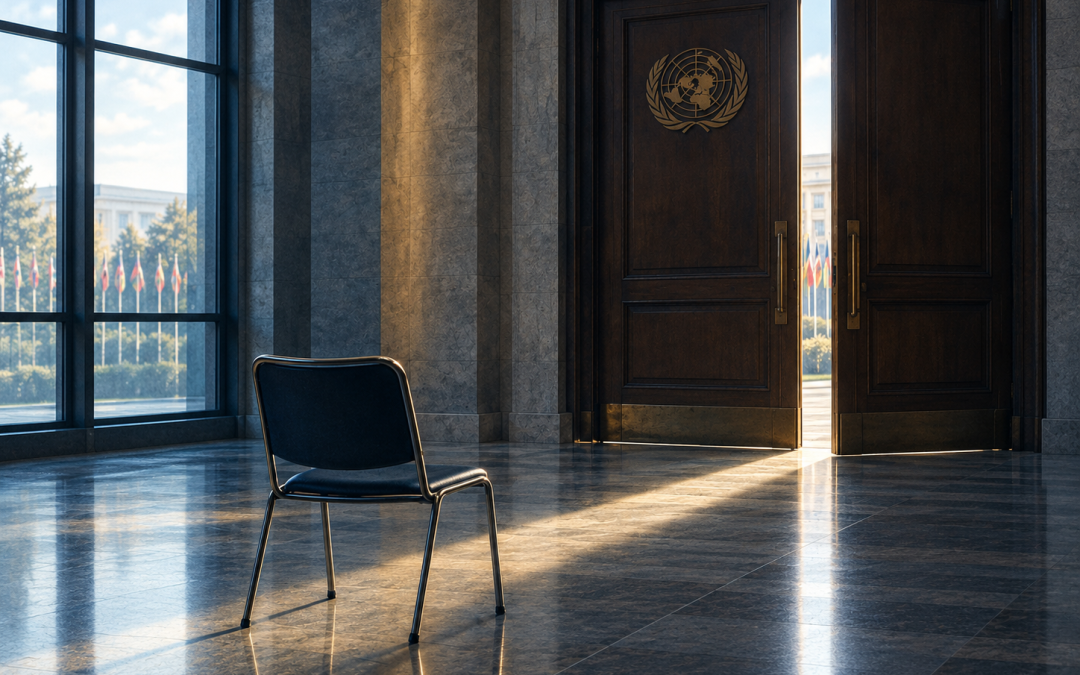
The good news comes with an asterisk, and the Working Group did not hide it. States replied on time in only 46 per cent of cases in which an opinion was adopted. Follow-up information arrived from governments in 26 per cent of cases, compared with 85 per cent from sources. As the Vice-Chair put it with deliberate plainness: silence is also an answer, but never a defense. Where no one comes, the account before the experts stays unrebutted, and where it is credible, they act upon it. That, she stressed, is not a presumption against the state. It is the ordinary consequence of an empty chair.
Money is the other constraint. The liquidity crisis gripping the United Nations has direct consequences for people in cells. In 2025 the Working Group could not finance two country visits it had planned; one state that had extended an invitation was told there was simply no money to come. A backlog, the Vice-Chair reminded delegates in her closing remarks, is not an abstraction. A backlog is a person in a cell waiting longer.
Transnational repression
The thematic study describes a practice that has learned to travel. For those who flee repression, exile was once an escape. Increasingly it is just a change of address. The Working Group identifies three modalities. The physical one: abductions, renditions and forcible returns carried out without a judge ever seeing the file. The legal one, today the fastest growing: trials in absentia, extradition requests and Interpol Red Notices converted into instruments of pursuit, alongside deprivation of nationality and the criminalization of peaceful activity abroad. The digital one: spyware, hacking and coordinated harassment, now amplified by artificial intelligence.
One practice, the Vice-Chair said, must be named plainly. When a state cannot reach the critic, it reaches the family. Relatives are arrested at home for what someone abroad has said. Those relatives are hostages held for the conduct of another, and no legal system can accommodate that.
The report’s legal architecture rests on a distinction delegates were invited to retain: extradition is an instrument of justice, but the moment it is used to retrieve a critic rather than a suspect, it becomes an instrument of repression, and the state that executes it becomes a partner in arbitrariness. Hence four safeguards. A judge always, because a transfer without judicial oversight is not extradition but rendition. A genuine test of motive. An effective remedy before removal, not afterwards from abroad. And serious vetting of Red Notices against Article 3 of the Interpol Constitution, with unconditional respect for non-refoulement. The report also notes a sharp phenomenon: cases involving the detention of humanitarian and UN personnel rose more than fivefold in a single year. Detaining those who bring relief, the Vice-Chair said, is always arbitrary.
The Australia chapter models the Working Group’s method. It records real strengths, among them safeguards in police custody, judicial oversight of extended detention, an innovative legal hotline in most jurisdictions and specialist Indigenous sentencing courts deserving of stable funding. It then names the deficits: the absence of a federal human rights act, rising pretrial detention driven by restrictive bail laws that cage the poor more often than the dangerous, the continued overrepresentation of First Nations peoples, and a migration detention regime, including of children, that cannot meet the test of necessity, proportionality and last resort.
The debate: praise and pushback
The European Union led the endorsements, welcoming the fourth consecutive year of rising releases while pressing states to answer communications and report on implementation. France, recalling that the Working Group has brought 65,000 cases to the attention of states since 1980, joined the appeal for replies and visits. The Nordic-Baltic states, speaking through Lithuania, framed transnational repression as a component of hybrid warfare and asked how system-wide UN coordination on monitoring could be strengthened. The Benelux countries warned specifically about the legal modality: Red Notices, in absentia trials and the new reach of AI. Germany reported that it has made combating transnational repression a national priority, with criminal legislation that entered into force in April 2026 and published guidance for victims. Switzerland, Ireland, Spain, Poland and Czechia aligned with this chorus, several of them pressing Russia over arbitrary detention in occupied Ukraine; Czechia and Poland, whose own histories under totalitarianism informed their interventions, tied memorialization of the missing to accountability for the living.
The Lublin Triangle spoke of civilians detained incommunicado behind Russian lines and prisoners of war denied access to independent monitors. Armenia raised the fate of nineteen Armenians still held in Baku. Iraq defended its detention of Robert Pether as lawful, while quietly conceding the case’s continued examination.
The critics were numerous and predictable in their grammar. China regretted that most communications concerned developing countries and read this as proof of double standards in international human rights governance. India invoked universality, impartiality and non-selectivity, insisting that national security allegations do not by themselves establish arbitrariness. Egypt complained of fabricated submissions and asked the Working Group to verify before it publishes. Tunisia and Cuba warned against politicized use of the mandate, and Venezuela rejected any portrayal of its judiciary’s acts as arbitrary. Peru offered a jurist’s caveat: the Working Group’s opinions are not binding jurisdictional decisions, while affirming its timely cooperation. Tanzania categorically rejected the findings concerning opposition figure Tundu Lissu, whose case, it insisted, is before a competent court with full guarantees. Cambodia sought clarity on a cross-border case it says was never its decision. Russia used its time to accuse Moldova of arbitrary detention of passengers arriving from Russia.
Seoul opens its door
One response stood apart. The Republic of Korea welcomed the Working Group’s upcoming country visit, confirmed for 23 November to 4 December 2026, and pledged full support for its success. It also recalled the Working Group’s November 2024 opinion on the arbitrary detention by the DPRK of three South Korean missionaries, urging their immediate release.
The symbolism is not lost on observers. The Vice-Chair addressed it directly in her closing remarks, speaking to Australia but clearly beyond it: the state that invites scrutiny is not a state with more to answer for. It is a state more confident in its capacity to improve. A country visit, she added, is not a verdict. It is also the format in which the Working Group can see what works and say so.
The names behind the files
Civil society interventions supplied what statistics cannot: faces, ages, dates.
The most resonant name was Jimmy Lai’s. The United Kingdom recalled that the Working Group found the 78-year-old publisher arbitrarily detained and that he has now spent more than 2,000 days in prison, sentenced in February to twenty years. PEN International described an elderly man in fast-declining health who will likely die in prison for practicing journalism, and called on the Working Group to reiterate its demand for his release. A counter-voice followed: a representative of the United Nations Association of China, speaking by video, reminded the Council that an opinion is not a verdict and detailed a 156-day open trial with thousands of exhibits. The exchange captured, in miniature, the standing tension between the mandate and the states it examines.
Other cases carried their own weight. The International Commission of Jurists detailed Egyptian practice, including the so-called case rotation whereby release is ordered but never effected and fresh identical charges extend pretrial detention indefinitely; given the volume of cases, the ICJ said, an investigation into possible crimes against humanity is warranted. The Helsinki Foundation for Human Rights described a Tibetan monk detained in May 2021 whose family learned only in February 2026, after nearly five years of enforced disappearance, that he is serving a six-year sentence. The Institute for Human Rights reported hundreds of political prisoners in Azerbaijan and asked European leaders to attach a condition to the European Political Community summit Baku is preparing to host. Freedom Now recalled Victoire Ingabire, still imprisoned in Rwanda despite an opinion finding her detention unlawful. The World Organization Against Torture counted 60 newly detained human rights defenders across fourteen countries in 2025 alone, and decried the extradition of a Vietnamese defender from Thailand despite a real risk of torture. The Ukrainian Parliament Commissioner for Human Rights put a figure on a national wound: almost 1,900 Ukrainian civilians confirmed unlawfully detained by Russia. One delegation, the Shanghai Patriotic Volunteer Association, proposed expanding the very definition of transnational repression to cover cross-border abductions of foreign leaders by powerful states, urging the Working Group to take up the question at a future session.
The three asks
The Vice-Chair closed by grouping everything into three requests, addressed to every delegation regardless of its comfort with the mandate’s findings. Answer the letters. Implement the opinions. Let us in. Guilt, she reminded the room, is a matter for national courts. Arbitrariness is a matter for the Working Group. And the difference between a person walking out and a person remaining behind bars is sometimes as small as a reply that never came, or one that arrived too late.
The 115 releases of 2025 prove the mechanism can work when states engage. The empty chairs in the record, the unfunded visits and the rising backlog prove how rarely they do. The Working Group leaves this session with its mandate renewed in substance and its resource crisis unresolved; the people in the cells, as ever, wait on both.
Related posts:
 HRC 62 : Ethiopia: The Amhara Cry at the United Nations — A Silence the Council Must Break
 Eighty Incidents in Eighteen Months: IHRC Launches Its Report on the Persecution of Ahmadis in Pakistan at Jalsa Salana UK
 Silencing dissent: mass trials in the United Arab Emirates Press Club Geneva
 Iran: The European Parliament Denounces a Machinery of Death