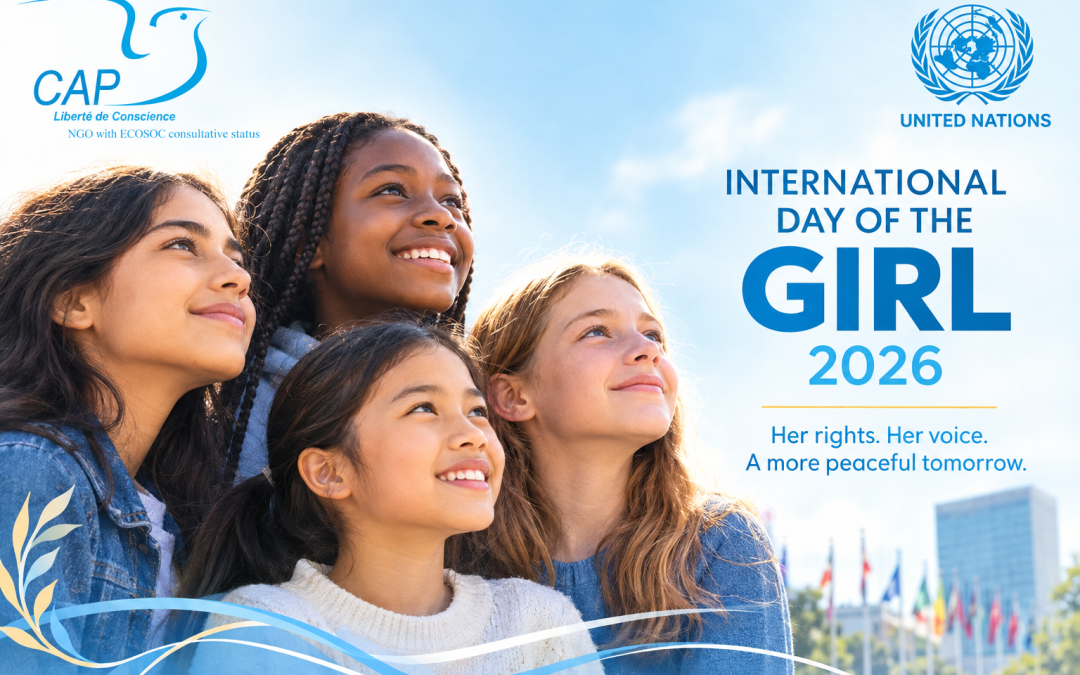
Every year on 11 October, the world marks the International Day of the Girl Child. In 2026, the observance carries a theme chosen with unusual clarity: end child marriage and invest in girls’ rights. For CAP Liberté de Conscience, the day is not only a celebration. It is a reminder of the girls whose rights are violated in the name of tradition, extremism or institutional failure, from Pakistan to France.
From a Campaign to a United Nations Observance
The International Day of the Girl Child began as an initiative of Plan International, the children’s development organisation, within its Because I Am a Girl campaign, which highlighted the importance of nurturing girls, particularly in developing countries. Plan International representatives in Canada approached the Canadian government, which formally proposed the observance at the United Nations General Assembly. On 19 December 2011, the General Assembly adopted resolution 66/170, declaring 11 October 2012 as the inaugural International Day of the Girl Child.
The resolution recognised that the empowerment of and investment in girls are critical for economic growth and for the meaningful participation of girls in decisions that affect them. It framed girls’ empowerment as key to breaking the cycle of discrimination and violence and to promoting the full enjoyment of their human rights.
The purpose of the day is to raise awareness of the gender inequality faced by girls worldwide, including in access to education, nutrition, legal rights, medical care and protection from discrimination, violence and forced child marriage. It also builds on a longer trajectory: the 1995 Beijing Declaration and Platform for Action, adopted unanimously at the Fourth World Conference on Women, was the first international blueprint to specifically call out the rights of girls.
The 2026 United Nations Message: End Child Marriage and Invest in Girls’ Rights
For 2026, the theme was developed through consultations with girls, girls’ organisations and networks led by girls, together with civil society organisations and United Nations partners. Their call is urgent: end child marriage and invest in girls’ rights.
The facts justify the urgency. According to the United Nations, more than 12 million girls, roughly one every three seconds, are married before reaching adulthood each year, with the highest prevalence in Africa south of the Sahara, where 31 per cent of young women were married in childhood. Child marriage denies girls the chance to stay in school, protect their health, live free from violence and fulfil their potential. Its consequences for physical and mental health are severe and lasting, at a time when self harm remains one of the leading causes of death among adolescent girls aged 15 to 19 worldwide.
The United Nations also insists that this is not inevitable. Thanks to investment in girls’ education, legal reform and social protection, an estimated 68 million child marriages have been averted over the past 25 years. The solutions are known: keep girls in school, expand access to health, protection and social services, work with families and communities to challenge harmful norms, and invest in girls’ rights and leadership. The 2026 message closes with a simple appeal: stand with girls.
UN Women: Turning Commitments into Action
In its statement for the 2026 International Day of the Girl, UN Women recalls that globally one in five girls is married before the age of 18, and that every year more than 12 million girls are married in childhood. Behind every statistic, the statement notes, is a girl whose education, health, safety, choices and future are put at risk.
UN Women calls on governments, partners, civil society, communities and the private sector to turn commitments into action: enforce laws that protect girls, keep girls in school, expand access to essential services, challenge harmful norms, fund organisations led by girls and women, and ensure that solutions reach the girls most at risk, including those affected by poverty, conflict, displacement, disability and crisis.
This mandate matters. Created in 2010 to accelerate progress on gender equality, UN Women coordinates the work of the United Nations system on women’s and girls’ rights, supports Member States in policy and law reform, and serves as the secretariat of the Commission on the Status of Women. Its seventieth session, held in March 2026 under the theme of ensuring access to justice for all women and girls, placed the enforcement of rights, not their mere proclamation, at the centre of the international agenda. Girls do not need more promises. They need functioning courts, enforced laws and funded services. That is the work UN Women exists to drive.
By the Numbers: What Official United Nations Data Tells Us
Including official figures in this article is not optional; it is the point. The Girl Goals report, published in March 2025 by UNICEF, Plan International and UN Women on the thirtieth anniversary of the Beijing Platform for Action, documents both progress and persistent gaps:
-
122 million girls are out of school today, despite a 39 per cent decrease over the past 20 years.
-
Nearly four in ten adolescent girls and young women do not complete upper secondary school.
-
Nearly one in four ever married or partnered adolescent girls aged 15 to 19 has experienced intimate partner violence.
-
An estimated 650 million women alive today were married or in union before the age of 18.
-
In East Asia and the Pacific alone, an estimated 93 million women were married as children, one in 13 young women in the region.
UNESCO data adds a structural insight: countries that legally guarantee at least nine years of compulsory education and twelve years of free primary and secondary education have substantially lower levels of child marriage. Legal protection of education and legal protection from child marriage reinforce one another.
And in Afghanistan, UNICEF reported in September 2025 that by the end of that year more than 2.2 million adolescent girls would have been excluded from education since the Taliban barred girls from attending school beyond grade 6. The denial of education to girls, the Executive Director of UNICEF stated, is one of the defining injustices of our time.
Pakistan: Forced Conversion and Child Marriage as a Human Rights Emergency
The 2026 theme speaks directly to the situation CAP Liberté de Conscience has documented in Pakistan. On 2 July 2026, on the margins of the 62nd session of the United Nations Human Rights Council, CAP Liberté de Conscience and Global Human Rights Defence co organised a side event at the Geneva Press Club titled “Forced Conversions and Minority Women in Pakistan: A Human Rights Emergency.” Speakers documented a pattern in which girls from Hindu, Christian, Sikh and other minority communities are abducted, pressured into conversion and married in circumstances that make free and informed consent impossible.
Figures cited at the event and confirmed by United Nations human rights experts indicate that in 2025 approximately 75 per cent of recorded victims were Hindu and 25 per cent Christian, with nearly 80 per cent of documented incidents occurring in Sindh province. Research presented by Jubilee Campaign, examining 100 reported cases involving Christian girls between 2019 and 2022, found that 61 per cent of victims were under 18. In one case, a 40 year old man abducted a nine year old girl; in another, a 37 year old man abducted a 13 year old.
The emblematic case is Maria Shahbaz, a Christian girl from Lahore abducted at thirteen, presented as a convert and married to her abductor. In March 2026, Pakistan’s Federal Constitutional Court upheld her conversion and marriage and ordered her to remain with her abductor. On 9 July 2026, the European Parliament adopted a resolution that opens with her case and treats it as a symbol of a pattern Pakistani institutions have proven unable or unwilling to stop. The resolution demands transparent investigations, the safe return of abducted girls, the repeal of blasphemy laws and the protection of religious minorities, and it recalls that failure to implement human rights commitments, including on women’s and children’s rights, should result in the withdrawal of Pakistan’s GSP+ trade preferences.
This pressure has been building for years. In an earlier resolution, the European Parliament already documented that abduction, forced conversion to Islam, rape and forced marriage remained an imminent threat for religious minority women and children in Pakistan, particularly Hindus and Christians, and called for a review of Pakistan’s GSP+ eligibility. CAP Liberté de Conscience has contributed to this documentation through its side events in Geneva and its submissions to the United Nations Committee Against Torture on Pakistan’s compliance with the Convention.
India and the Indo Mediterranean: Women and Children Are Extremism’s First Victims
At the 60th session of the Human Rights Council, CAP Liberté de Conscience also co organised a side event on the Indo Mediterranean region, where speakers argued that women and children are the first victims of extremism. The warning carried a direct relevance for India. As Vas Shenoy, President of Glocal Cities, told participants: “It is the same terrorist organisations that fundraise in Europe, radicalise youth and plan terrorist attacks in India.” Himanshu Gulati, a member of Norway’s Storting, added that terrorism from Pakistan, Bangladesh, Syria and Yemen does not only affect its own regions but echoes back in the rights and future of vulnerable groups, especially women and children.
The event also addressed the mirror phenomenon inside Europe, where young girls and adolescents are forced by their families to live in what Anna Maria Cisint, Member of the European Parliament, called “Islamic cages,” and where authorities have too often looked away out of fear of being called discriminatory. The message from Geneva was that protecting girls is a moral test that neither Asia nor Europe can afford to fail.
France: When Institutions Themselves Fail the Child
The journey ends in France, because violations of girls’ rights are not only a feature of conflict zones. At the 82nd session of the United Nations Committee Against Torture in 2025, a report submitted by Sarah Thierrée in collaboration with CAP Liberté de Conscience documented persistent institutional violence against children, particularly in the handling of incest allegations. The Committee’s conclusions, in recommendations 32 and 33, directly echoed the report’s core alerts: children victims of incestuous sexual abuse are sometimes placed in the custody of their alleged abuser while the protective mother is accused of parental alienation, prosecuted and even convicted; reporting, investigation and prosecution rates for incest remain far too low; and statutes of limitation for sexual abuse of minors should be abolished.
The figures behind these findings are stark. In 2023, internal security services recorded 271,000 victims of domestic violence in France, 85 per cent of them women. Nearly 76 per cent of complaints of sexual violence against minors are dismissed, often without thorough investigation. CAP Liberté de Conscience has carried this documentation further, submitting in August 2025 a communication to the Commission on the Status of Women for its seventieth session on systemic barriers to justice for women and girls, and, in response to the call for input of the United Nations Special Rapporteur on violence against women and girls for her report to the 62nd Human Rights Council, a comprehensive analysis of institutional violence against mothers who report intrafamilial violence in the French socio judicial system.
CAP Liberté de Conscience Stands With Girls
The International Day of the Girl Child is a celebration of what girls can achieve when they are safe, educated and free. It is also an accounting. Twelve million child marriages every year. 122 million girls out of school. Girls abducted and converted in Pakistan, girls targeted by extremist networks reaching from South Asia into Europe, Uyghur girls denied their identity, and in France, girls whose disclosures of abuse are disbelieved by the very institutions meant to protect them.
CAP Liberté de Conscience observes this day the way it works every day: at the United Nations, in Geneva and New York, side by side with its partners, documenting violations, submitting reports, organising side events, and pressing courts, governments and international bodies to move from law to enforcement. Every girl deserves a childhood. Every girl deserves the freedom to choose her own future. That is the message of 11 October 2026, and it is our commitment.
Related posts:
 Maria Shahbaz and the Girls Pakistan’s Courts Refuse to Protect
 HRC 62 side event : Forced Conversions and Minority Women in Pakistan: A Human Rights Emergency
 CAP Liberté de Conscience Submission to the UN Special Rapporteur on Violence Against Women and Girls
 CAP Liberté de Conscience Submits Report to UN Women CSW70 Addressing Barriers to Justice for Women and Girls