By CAP Liberté de Conscience March 2026
During the 61st session of the UN Human Rights Council in Geneva, CAP Liberté de Conscience (CAP LC) raised an urgent alarm about media-fueled hatred against religious minorities. We delivered two statements. The first focused on the specific abuses faced by the Christian Gospel Mission (CGM), while the second demanded that the UN hold sensationalist media coverage accountable for inciting violence.
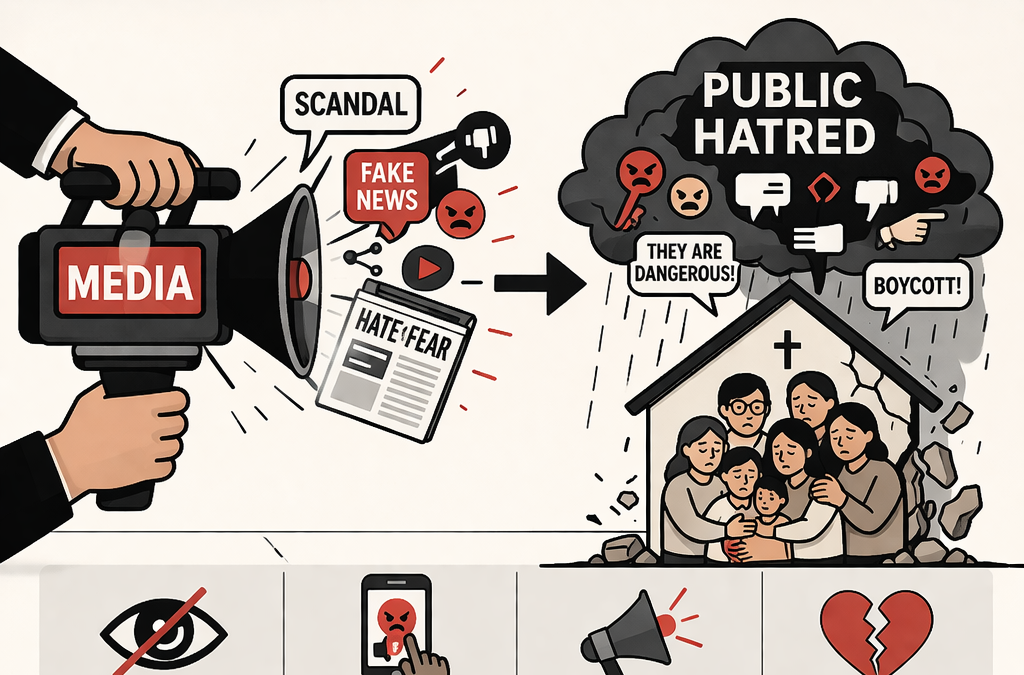
To understand the gravity of this phenomenon, we must look beyond traditional legal frameworks and adopt the Public Health Approach to Violence Prevention, as championed by the World Health Organization (WHO) in its 2022-2026 strategy. This approach treats violence not merely as a legal transgression, but as a preventable disease with identifiable risk factors. Just as a virus spreads through physical contact, hatred spreads through information channels. The WHO framework establishes that the stigmatization of minorities by the media—whether ethnic or religious—is a scientifically recognized precursor to violence. When media outlets portray specific religious groups as dangerous, deviant, or nefarious, they are effectively releasing a pathogen into society that contaminates public perception and facilitates aggression.
The evidence of this “contamination” is visible across the globe. In Europe, we observe how public broadcasters can inadvertently foster this climate of intolerance. The recent France Télévisions documentary on Scientology, alongside sensationalist series on Netflix and HBO targeting groups such as Jehovah’s Witnesses, often relies on shock value rather than nuance. As critically noted by Human Rights Without Frontiers (HRWF), such productions often rely on activists without any professional expertise who claim to be authorities. This lack of rigor in vetting sources results in biased narratives that fuel prejudice rather than informing the public.
The urgency of addressing these media distortions was further underscored during a recent conference focused on the persecution of the Ahmadiyya community, featuring the renowned journalist Marco Respinti. As reported by Bitter Winter in an article titled “Between Law and Reality: Media and Religious Discrimination,” the discussion highlighted the dangerous disconnect between legal protections for religious minorities and the harsh reality they face due to media bias. During the conference, Mr. Respinti delivered a observation on the mechanics of this persecution: “The media often acts as an echo chamber for prejudice, transforming baseless accusations into accepted facts. This creates a parallel reality where minorities are tried and convicted in the court of public opinion long before any legal process occurs.” This insight perfectly encapsulates the threat we identified at the UN: media narratives are bypassing the rule of law to incite social and physical violence.
The situation in East Asia demonstrates how quickly this verbal violence can escalate into physical brutality. In our statement under Item 4, CAP LC documented the systematic persecution of the Christian Gospel Mission (CGM) in South Korea and Taiwan. Following the release of commercial documentaries, CGM members have faced a massive “digital witch-hunt.” This is not merely online harassment; it is a structured campaign of exclusion. Members have been forced to wear a “digital scarlet letter,” subjected to coordinated review-bombing that destroys their livelihoods, and targeted by sexualized defamation.
Tragically, this stigmatization recently turned lethal in Taiwan. As reported by Bitter Winter, the hostility fueled by media narratives materialized into a violent assault in Taipei. Two CGM members were attacked with a hammer by an individual reportedly influenced by the negative portrayal of the group. This incident serves as a grim validation of the WHO’s public health model: the “virus” of hatred, propagated by sensationalist media, resulted in severe physical harm. Furthermore, our submissions highlight that women and children are specific victims of this toxicity, suffering from cyber-violence, bullying, and severe stress-related medical conditions.
Simultaneously, in South Korea, the Shincheonji Church of Jesus faces existential threats that blur the line between public opinion and state oppression. As detailed in our written statement A/HRC/61/NGO/2, the South Korean government has moved to dissolve the organization. This draconian measure is fueled by hostile media narratives that label them as “pseudo-religions.” Governments cannot act as theological arbiters, yet media sensationalism provides the social license for such political overreach.
This pattern mirrors the plight of the Ahmadiyya Muslim community, which has been documented by the Office of the High Commissioner for Human Rights (OHCHR). Coordinated social media campaigns inciting violence and boycotts against Ahmadis demonstrate that digital platforms have become the primary battlefield for religious persecution.
While the UN has made significant progress in identifying these threats—notably through the Special Rapporteur’s reports A/76/380 on freedom of thought and technology, and A/HRC/55/47 on hatred based on religion or belief—our current mechanisms remain reactive rather than preventive.
Therefore, in our Item 5 statement, CAP LC called for the establishment of an expert group mandated to monitor media bias that leads to violations of freedom of expression and religion. We must implement the WHO’s preventive logic at the international level: identifying the “risk factors” in media content before they result in the “disease” of violence. As a secular organization, we defend the right of all individuals to believe without fear. When we allow sensationalist media to dehumanize minority groups, we erode the foundation of human dignity. The Human Rights Council must act now to ensure that the “court of public opinion” does not become an executioner.
Related posts:
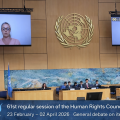 HRC 61 Item 5 Media-Fueled Persecution: Establishing Accountability for Sensationalist Coverage of Religious Minorities
 YURII SHELIAZHENKO*, conscientious objector to military service and human rights defender, under immediate threat
 Submission to UN Special Rapporteur Details Systemic Discrimination in German Public Procurement