CAP Liberté de Conscience May 2026
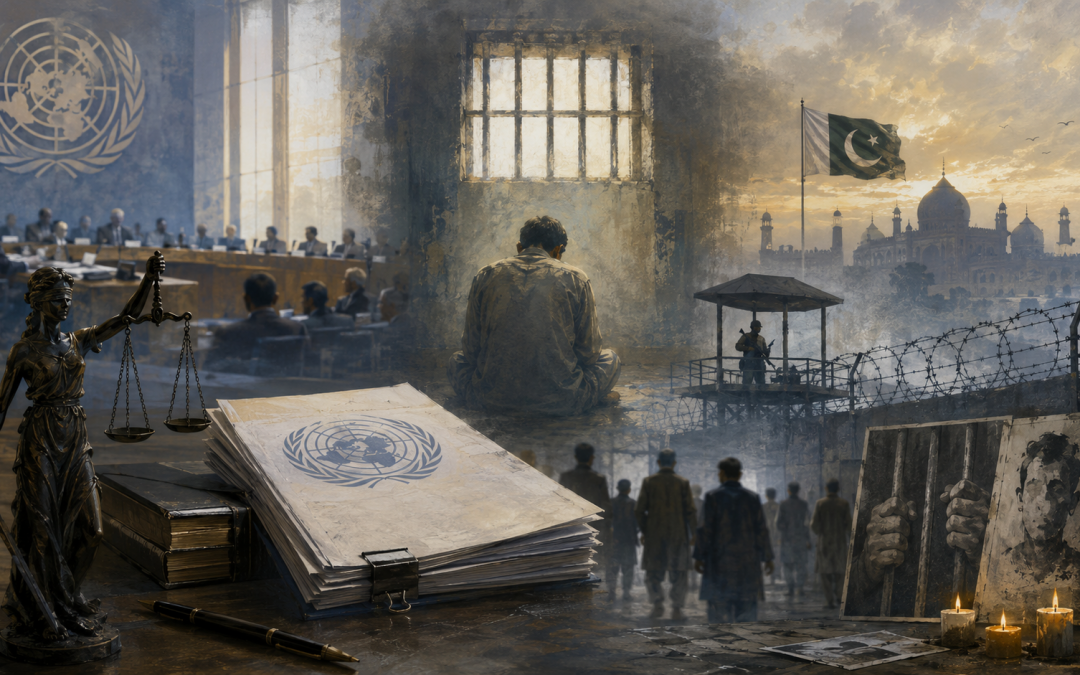
When the UN Committee Against Torture concluded its 84th session on 29 April 2026, its findings on Pakistan read less like a diplomatic document and more like an indictment of systemic failure. After years of delay — Pakistan’s second periodic report was submitted a full year late — the Committee’s concluding observations lay out, methodically and without embellishment, a country where torture is practiced with near-impunity, where blasphemy accusations land people in solitary confinement for a decade, and where the gap between legislation on paper and reality on the ground remains vast.
The document, formally titled Concluding Observations on the Second Periodic Report of Pakistan (CAT/C/PAK/CO/2), adopted on 29 April 2026, covers the period examined at the Committee’s 2250th and 2253rd meetings on 22 and 23 April. It is the most comprehensive international assessment of Pakistan’s compliance with the Convention Against Torture and Other Cruel, Inhuman or Degrading Treatment or Punishment in recent years.
The Committee’s Mandate and What It Was Reviewing
The Committee Against Torture is the body of independent experts tasked with monitoring implementation of the Convention by its States parties. Pakistan ratified the Convention in 2010 and was overdue for this second review. The exercise involves an examination of the State’s self-reported progress, written questions from the Committee, and a formal dialogue with the country’s delegation.
To its credit, Pakistan has passed legislation since the previous review. The Torture and Custodial Death (Prevention and Punishment) Act of 2022 was a real step — it criminalises torture by public officials and prohibits evidence obtained under coercion. Other legislative advances include the Anti-Rape Act of 2021, the Domestic Violence Act of 2026, and the Juvenile Justice System Act. These are not nothing. The Committee acknowledges them.
But the concluding observations make clear that laws alone do not constitute compliance. What the Committee found behind those laws — in police stations, military internment centres, prisons, and courtrooms — tells a different story.
Torture as Standard Practice: The Accountability Gap
One of the document’s most striking passages concerns the sheer absence of prosecutions under the 2022 Torture Act. Despite having a dedicated piece of legislation for over three years, the number of torture prosecutions initiated remains extremely low. The Committee identifies a climate of impunity — one where victims are reluctant to come forward, in part because article 11 of the same Act criminalises complaints deemed to have been made in bad faith. As the Committee notes, this provision risks being weaponised against complainants rather than perpetrators.
The definition of torture enshrined in the 2022 Act is also found wanting. It fails to explicitly cover severe mental pain or suffering — a gap that contradicts both the Convention’s text and, ironically, the Pakistani courts’ own jurisprudence, which has treated psychological harm as part of torture. The Committee calls for the Act to be amended accordingly, and for the establishment of specific penalties proportionate to the gravity of torture offences. Currently, the law relies on general Penal Code provisions for crimes like “grievous hurt,” which may result in lenient sentences for acts of torture that do not cause death.
Compounding this is the question of command responsibility. There is no explicit legal mechanism in Pakistan holding superior officers criminally liable when they knew — or should have known — that subordinates were committing torture. The Committee wants this changed. It also flags the 27th constitutional amendment, which grants lifetime immunity from criminal proceedings to the President, the Field Marshal, the Marshal of the Air Force and the Admiral of the Fleet. That provision alone raises profound questions about where impunity is structurally entrenched.
Religious Minorities and Blasphemy: A Category Apart
The Committee singles out one group in particular when it comes to conditions of detention: those imprisoned on blasphemy charges. The case of Junaid Hafeez — held in solitary confinement since May 2014, well beyond the 14-day legal maximum — is cited explicitly. It is, in the Committee’s framing, emblematic of a broader pattern: individuals accused of blasphemy face extended isolation, ostensibly for their own safety, in conditions the Committee considers potentially indistinguishable from ill-treatment.
More broadly, the Committee expresses concern that counter-terrorism legislation — specifically the Anti-Terrorism Act of 1997 — has been used beyond its intended scope to target critics of the government, members of ethnic communities, and members of religious minorities. Its definition of terrorism is described as “vague and overly broad,” and the Act permits detention for up to three months without court review. Confessions made to a district superintendent of police are admissible in anti-terrorism courts, unlike in civil courts — a discrepancy the Committee finds deeply troubling.
The section on fundamental legal safeguards (paragraphs 14–15) documents how, in practice, persons in custody — particularly those detained for terrorism-related offences and members of religious minorities — are often denied access to a lawyer during investigation, not informed of charges in a language they understand, and not brought before a judge within the constitutionally mandated 24-hour limit.
Enforced Disappearances and Extrajudicial Killings
Sindh and Balochistan surface repeatedly in the document. Members of the military, paramilitary forces, police and intelligence agencies are implicated in enforced disappearances and extrajudicial killings targeting human rights defenders, journalists, lawyers and members of ethnic and religious minorities. The National Commission of Inquiry on Enforced Disappearances — the body theoretically responsible for addressing these cases — is found insufficiently independent and under-resourced. Of the more than 10,000 cases registered between 2010 and August 2025, over 9,000 have reportedly been “disposed of,” with zero criminal convictions resulting from the Commission’s work.
Enforced disappearance is not, as of the date of these observations, a distinct criminal offence in Pakistani law. The Committee urges accelerated adoption of the Criminal Laws (Amendment) Bill 2021, which would add it to the Penal Code, and recommends that Pakistan consider acceding to the International Convention for the Protection of All Persons from Enforced Disappearance.
The political dimension is not avoided. The Committee specifically names former Prime Minister Imran Khan, his wife Bushra Bibi, and human rights defender Idris Khattak among those whose detentions have been confirmed as arbitrary by the UN Working Group on Arbitrary Detention, calling for access to adequate medical care and a review of their circumstances.
Detention Conditions: Overcrowding, Healthcare, and the Prison System
Pakistani prisons are operating at 163% capacity, according to the World Prison Brief data cited in the report. Nearly three-quarters of all prisoners are in pre-trial detention — a figure that reflects both judicial delay and the excessive use of custodial measures. The Committee finds that material conditions in many facilities fall well short of the Nelson Mandela Rules: inadequate sanitation, insufficient food and water, poor ventilation, limited healthcare including mental health services, and a chronic shortage of trained staff.
On deaths in custody, the Committee expresses frustration. There is no reliable statistical data on the number of deaths occurring in places of detention. Torture and denial of healthcare are identified as frequent contributing causes, but the investigations into such deaths — required under the 2022 Act — are not being conducted systematically or independently.
The recommendations here are concrete: prompt forensic investigation of all custodial deaths following the Minnesota Protocol, disaggregated data collection, and the elimination of prolonged solitary confinement — even when framed as protective measures.
The CAP LC/IHRC Submission: Corroborating Evidence from Civil Society
In advance of the 84th session, CAP Liberté de Conscience (CAP LC) and the International Human Rights Committee (IHRC) submitted a joint report to the Committee, focused specifically on the persecution of the Ahmadiyya Muslim Community in Pakistan. That submission, prepared under Rule 73 of the Committee’s Rules of Procedure, documented a pattern of state-facilitated violence against Ahmadis — from targeted assassinations and mob violence to custodial death and the criminalisation of religious practice.
The CAP LC/IHRC report centred, in particular, on the case of Dr. Tahir Mahmood, a 71-year-old Ahmadi Muslim who died in custody in Karachi in May 2025 after being arrested for offering Friday prayers. According to the documentation compiled by the IHRC, Dr. Mahmood was subjected to physical mistreatment in detention, denied adequate medical care despite visible signs of acute distress, and had been physically attacked during his bail hearing by TLP-affiliated individuals in the presence of law enforcement officers who failed to intervene. No independent investigation into his death has been initiated. The submission also raised the case of Mubarak Ahmad Sani, sentenced to life imprisonment for memorising the Quran and distributing a Quranic commentary — acts treated by a Pakistani court as criminal evidence of “posing as a Muslim.”
These documented cases find clear structural resonance in the CAT’s concluding observations. The Committee’s concern about deaths in custody and the absence of systematic investigation (paragraphs 26–27) applies directly to what CAP LC and IHRC documented in Dr. Mahmood’s case. The pattern of blasphemy-related detention in degrading conditions — flagged in paragraph 22 of the CAT document — mirrors the situation of Mr. Sani and others like him. The CAT’s call for Pakistan to amend the 2022 Torture Act to explicitly cover severe mental suffering, and to address legal safeguard violations affecting detained religious minorities, aligns with the specific violations the joint submission identified at the individual level.
What civil society testimony contributes — and what the CAP LC/IHRC report provides — is the human detail behind the structural failures: named individuals, documented incidents, dates, locations. The Committee’s concluding observations, by their nature, work in aggregates and legal categories. The two registers are complementary, and the convergence between them is not coincidental.
What Comes Next
The Committee has requested that Pakistan provide follow-up information by 1 May 2027 on four priority areas: non-refoulement, extrajudicial killings and enforced disappearances, accountability for torture allegations, and the protection of human rights defenders and journalists. The State Party is also asked to submit its third periodic report by 1 May 2030 and is invited to accept a simplified reporting procedure by 2027.
Beyond the procedural timeline, the concluding observations carry a clear message. The legislative framework Pakistan has built since 2018 — and the 2022 Torture Act in particular — represents a necessary foundation, but not a sufficient one. What the Committee documents is the distance between law and practice: investigations that don’t happen, prosecutions that don’t follow, safeguards that exist on paper and are routinely bypassed.
Accountability doesn’t emerge from legislation alone. It requires political will, independent institutions, and — as the CAP LC/IHRC submission underlines — the willingness to hear what civil society and the victims themselves are saying. The 84th session created a formal record. The question now is whether Pakistan acts on it.
Related posts:
 UN Submission: Pakistan’s Compliance with the Convention Against Torture and the Persecution of the Ahmadiyya Community
 HRC 61 Written Statement : Arbitrary Detention, Enforced Disappearance, Torture, Prolonged Pre-Trial Detention, and Religious Coercion of Members of the Ahmadi Religion of Peace and Light in Egypt
 UN HRC 61 1000 days of conflict. 1000 days of civilians suffering the first-hand consequences of the fighting