Side-Event at the 62nd Session of the UN Human Rights Council
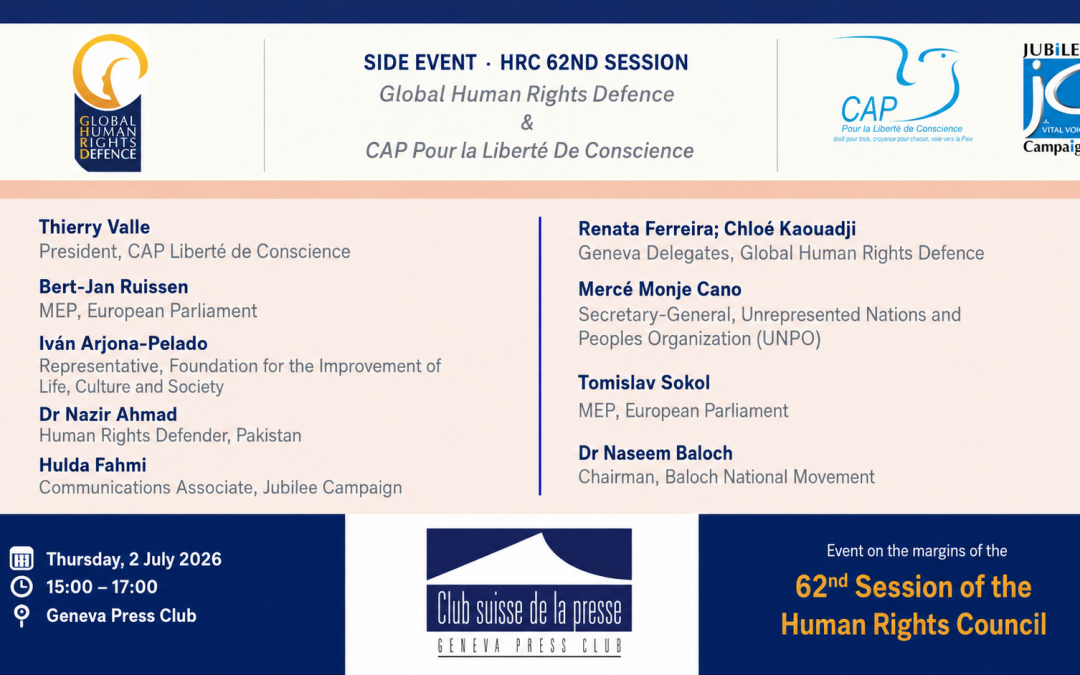
Geneva Press Club — 2 July 2026, 15:00–17:00 CEST
A Pattern of Systematic Abuse
For years, UN experts have documented a disturbing pattern in Pakistan: the abduction, forced religious conversion, and forced marriage of women and girls from religious minority communities. These are not isolated incidents. They are widespread, systematic, and largely unaddressed by domestic authorities.
In 2025, approximately 75% of recorded victims were Hindu and 25% Christian. Nearly 80% of documented cases occurred in Sindh province. The victims are overwhelmingly adolescent girls — some as young as 14, many between 14 and 18 — who are abducted, compelled to convert to Islam, and married against their will to men significantly older than themselves.
The consequences are devastating. Survivors face physical and sexual abuse, social stigma, family rejection, and severe psychological trauma. Many never return to their communities. Those who try to seek justice encounter police indifference, judicial delays, and threats from perpetrators and their networks.
Compounded Vulnerabilities
The crisis is not limited to religious minorities. Baloch women and girls face a unique and acute form of persecution, combining ethnic marginalisation, enforced disappearances, displacement, and religious persecution. Their situation illustrates how multiple forms of discrimination intersect to create extreme vulnerability.
Structural factors — poverty, statelessness, and armed conflict — exacerbate these risks. Women and girls living in conditions of deprivation are disproportionately targeted. Their lack of legal documentation, economic independence, and social protection makes them easy prey for abductors who operate with impunity.
A Call for International Accountability
Pakistan has ratified international conventions that prohibit these practices. Yet domestic accountability mechanisms remain ineffective. Perpetrators are rarely prosecuted. Victims are rarely protected. The cycle of impunity continues.
This side-event, co-organised by CAP Liberté de Conscience and Global Human Rights Defence, will bring together parliamentarians, human rights defenders, and civil society representatives to examine these violations and identify concrete international accountability mechanisms.
Speakers
-
Bert-Jan Ruissen, Member of the European Parliament (ECR), Co-President of the EP Intergroup on Freedom of Religion or Belief
-
Tomislav Sokol, Member of the European Parliament (PPE)
-
Dr Naseem Baloch, Chairman, Baloch National Movement
-
Iván Arjona-Pelado, Foundation for the Improvement of Life, Culture and Society
-
Dr Nazir Ahmad, Human Rights Defender, Pakistan
-
Mercè Monje Cano, Secretary-General, UNPO
-
Hulda Fahmi, Communications Associate, Jubilee Campaign
-
Renata Ferreira & Chloé Kaouadji, Geneva Delegates, Global Human Rights Defence
Moderator: Thierry Valle, President, CAP Liberté de Conscience
Key Themes
-
Forced conversion and marriage as tools of religious and ethnic persecution
-
The compounded vulnerabilities of Hindu, Christian, and Baloch women and girls
-
The role of poverty, statelessness, and conflict in exacerbating risks
-
International accountability mechanisms and urgent protection measures
Join us on Thursday, 2 July 2026, from 15:00 to 17:00 CEST at the Geneva Press Club.
Co-organised by CAP Liberté de Conscience and Global Human Rights Defence
Related posts:
 HRC 62 side event : Forced Conversions and Minority Women in Pakistan: A Human Rights Emergency
 CAP Liberté de Conscience Submits Report to UN Women CSW70 Addressing Barriers to Justice for Women and Girls
 HRC 62 : Ethiopia: The Amhara Cry at the United Nations — A Silence the Council Must Break
 The EU Reinforces Trade Preferences: Human Rights and the GSP+ Revision