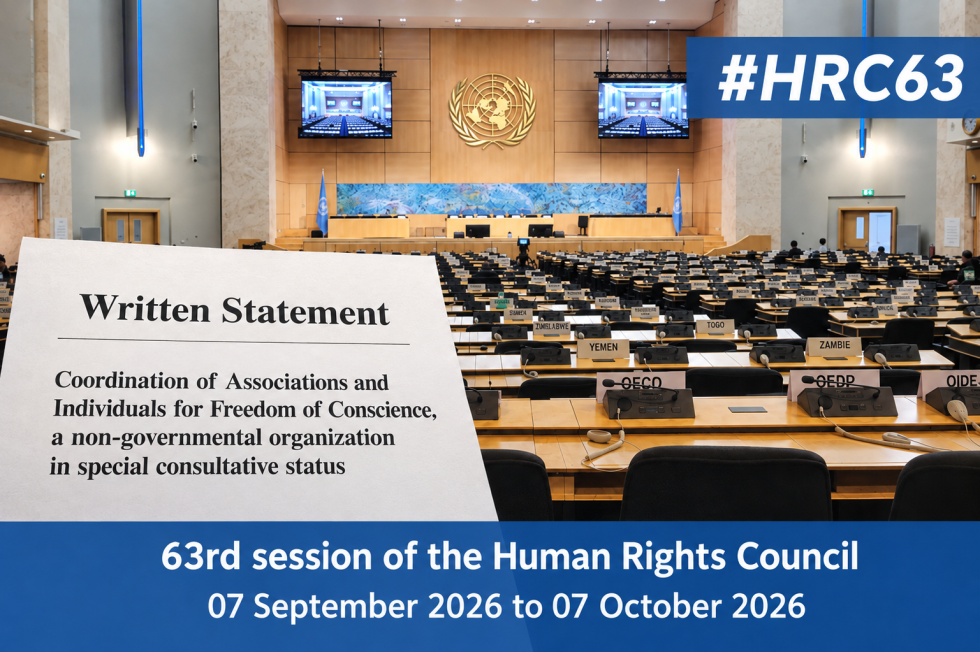
Citoyens en action pour la démocratie et le développement and the Coordination des Associations et des Particuliers pour la Liberté de Conscience submitted this joint written statement during the 63rd session of the United Nations Human Rights Council, held from 7 September to 9 October 2026, under Agenda Item 4. The statement reports recent developments in the case of Konstantin Rudnev and raises concerns about procedural safeguards and Argentina’s international human rights obligations.
The statement notes that Rudnev is recovering from surgery and hospitalization, with medical prescriptions requiring strict bed rest and continuous assistance. It warns that any return to prison in these circumstances would create serious risks for his health and life.
The organizations focus on the decision of the Federal Chamber of Criminal Cassation to examine and grant a prosecutorial complaint against the ruling that replaced pretrial detention with house arrest. According to the statement, the Federal Code of Criminal Procedure assigns decisions concerning coercive measures during the preliminary investigation to judges with review functions and excludes them from the jurisdiction of the Cassation Court. The organizations argue that admitting this complaint departs from the statutory framework and weakens safeguards designed to preserve legality and the presumption of innocence.
The statement also summarizes concerns raised by Rudnev’s lawyer regarding the legal basis and reasoning of the ruling, its compatibility with Supreme Court jurisprudence, and the right to an effective remedy. It further expresses concern about the conduct of Prosecutor Fernando Arrigo, arguing that prosecutorial strategy should not displace the wording of the law or alter the institutional balance between prosecution and judiciary.
The organizations urge the Argentine authorities and competent judicial bodies to apply the Federal Code of Criminal Procedure according to its terms, respect its jurisdictional boundaries, and avoid using appeals that the Code does not authorize to prolong or intensify coercive measures. They call for full consideration of Rudnev’s medical condition and for decisions that prevent a return to prison which his health could not sustain.
Related posts:
 Deterioration of the Situation of Konstantin Rudnev in Argentina and the Risks of Transnational Repression
 OSCE 2026 : Transnational repression reaches the OSCE floor
 HRC 61 Written Statement : The Inhumane Detention of Konstantin Rudnev in Argentina
 La chaîne n’a pas disparu, elle a changé de nom Dialogue sur la servitude 2.0