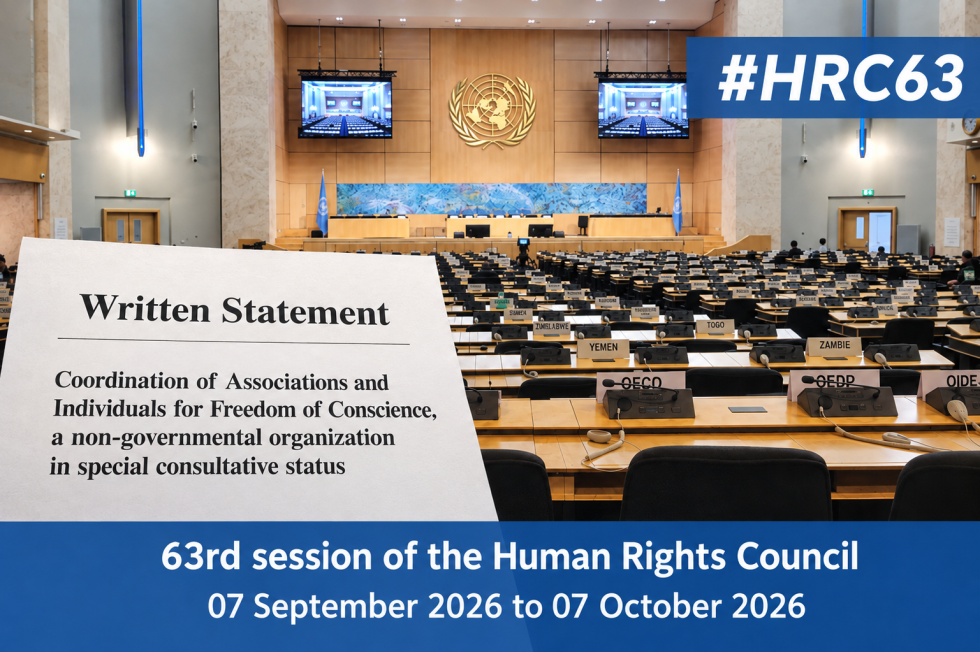
Citoyens en action pour la démocratie et le développement and the Coordination des Associations et des Particuliers pour la Liberté de Conscience submitted this joint written statement during the 63rd session of the United Nations Human Rights Council, held from 7 September to 9 October 2026, under Agenda Item 8. The statement examines how victims of state violence can continue to seek justice when truth emerges slowly but procedural deadlines prevent the consideration of new evidence.
The organizations argue that transitional justice mechanisms often cover only a closed historical period, while administrative and judicial systems impose limitation periods that may expire before concealed evidence, testimony, or official findings become available. Referring to examples in Rwanda, Latin America, the United States, Germany, and Canada, the statement maintains that justice requires mechanisms capable of responding to the delayed emergence of truth, including for abuses committed after the formal end of authoritarian rule.
Within this global framework, the statement draws attention to the unresolved Tai Ji Men case in Taiwan. It recalls that the events began in 1996, after the end of martial law, and that the criminal charges were later dismissed. According to the statement, five of the six disputed tax years were corrected to zero, while one remained unresolved and administrative enforcement continued, including the nationalization of land intended for spiritual purposes.
The organizations state that new testimonies and official findings have cast doubt on the legality of the original administrative actions. They argue that the five year limitation period for seeking a retrial under the Administrative Litigation Act has prevented this evidence from being considered. The case is presented as an illustration of the obstacles faced by victims of post authoritarian abuses when procedural rules remain closed to subsequently discovered facts.
The statement calls on states to adopt legal frameworks that allow cases involving severe human rights violations to be reopened whenever new evidence emerges. It also proposes that administrative agencies should have a duty to revoke illegal acts on their own initiative when substantive justice requires it, and that victims should have an enforceable right to seek redress when new facts come to light.
Related posts:
 Quand le partenaire de la Miviludes ressemble furieusement à une dérive sectaire
 Serbia Condemned by the European Court of Human Rights for Banning Falun Gong Protests During Xi Jinping’s Visit
 UN HRC 61 1000 days of conflict. 1000 days of civilians suffering the first-hand consequences of the fighting
 La chaîne n’a pas disparu, elle a changé de nom Dialogue sur la servitude 2.0