What is “Coordination des Associations et des Particuliers pour la Liberté de Conscience” (CAP Freedom of Conscience)?
CAP Freedom of Conscience is a secular European NGO with United Nations Consultative Status, created in 1995 and dedicated to protect the Right of Freedom of Religion and Belief.
CAP Freedom of Conscience combats all forms of discrimination based on religion or belief by alerting European and International bodies.
CAP Freedom of Conscience collects testimonies of discrimination and human rights violations affecting religious or belief communities in order to disseminate them to international bodies, and in order to raise awareness and inform them as well as to generate debate on the protection of Freedom of Religion and Belief.
CAP Freedom of Conscience also advocates for any religious or spiritual group facing discrimination to have their right to Freedom of Religion and Belief recognized.
CAP Freedom of Conscience is a member of the European Federation for Freedom of Belief (FOB), European Network Of Religion and Belief (ENORB) and participate to the Civil Society Platform of Fundamental Rights created by the EU Fundamental Rights Agency DAFOH Partners in Combating and Preventing Forced Organ Harvesting

new condemnation of UNADFI : no, UNADFI is not above the law
On December 2, 2024, the Marseille Magistrates’ Court ordered UNADFI (Union Nationale des Associations de Défense des Familles et de l’Individu) to publish a right of reply from CAP Liberté de Conscience on its website within 48 hours, subject to a penalty of 50 euros per day of delay. UNADFI had argued that its status as an organization of public utility meant that the law did not apply to it but the judge ruled that UNADFI was not above the law.

Human Rights Now And in the Future
By Thierry Valle President CAP Liberté de Conscience 10/12/2024 Strengthening international solidarity to improve the Human Rights situation in the future Why It Is Crucial to Promote the Idea of International Solidarity in Human Rights It is a great pleasure to...

Systematic Persecution: Pakistan’s Continued Assault on Ahmadiyya Religious Freedom
On November 22, 2024, a horrifying incident of religious persecution unfolded in Kot Karam Bakhsh, Sialkot, revealing the systematic marginalization of the Ahmadiyya Muslim community in Pakistan. According to the International Human Rights Committee (IHRC) incident report, approximately 150 extremists from Tehreek-e-Labbaik Pakistan (TLP), accompanied by local police, launched a coordinated attack on a 70-year-old Ahmadiyya mosque.

Tackling Hate Crimes: Insights and Recommendations from the OSCE
Hate crimes pose a significant threat to societal harmony and individual safety, necessitating urgent and effective action. The OSCE’s Office for Democratic Institutions and Human Rights (ODIHR) has underscored the critical need to prosecute these crimes as distinct offenses, emphasizing their profound impact on victims and communities.

Systematic Persecution of Ahmadis Continues in Pakistan: A Disturbing Pattern of Religious Discrimination
“Persecution against Ahmadis has ramped up as of late, as the IHRC has reported almost daily incidents against the minority group. Graveyards vandalism and Mosque Minarets’ demolition has been a favored tactic of the Anti-Ahmadiyya element in Pakistan for years. This shameful tactic means Ahmadis are not free from persecution even after their death.”

Chinese Government Tightens Grip on Citizen Travel Abroad
On February 24, 2023, the French newspaper Le Monde published an article detailing the new restrictions imposed by the Chinese government on its citizens’ travel abroad. According to the report, an increasing number of Chinese, including ordinary civil servants and teachers, can no longer hold their own passports, which must be handed over to their work units. They then have to apply to their superiors if they wish to travel outside China’s borders.
CAP Freedom of Conscience involvement UNITED NATIONS
LASTEST NEWS
Adhésion CAP LC 2024
CAP Freedom of Conscience involvement in Europe
SUPPORT CAP Liberté de Conscience
IBAN BE61 9670 0987 0017
SWIFT / BIC TRWIBEB1XXX
Address
TransferWise Europe SA
Square de Meeûs 38 bte 40
Brussels
1000
Belgium


Side-event OSCE HDIM 2018 : How Universal is “The Universal Declaration of Human Rights
Globalization underline that the UDHR is often applied relative to regional culture, rather than securing universal principles. Especially when it comes to Freedom of Thought, Religion or Belief we find how cultural bias influence policy and law-making. What one considers a religious practice – such as devotional work in monastery – others consider criminality – in this case human trafficking.
Side-event OSCE HDIM 2018 : Freedom of Belief, No Discrimination and Telorance in the OSCE area
THE EUROPEAN COURT OF HUMAN RIGHTS INVALIDATES APPLICATION OF THE RUSSIAN LAW ON EXTREMISM TO PEACEFUL RELIGIOUS GROUPS By Patricia Duval Human Rights Attorney In a landmark decision, Ibragim Ibragimov and others v. Russia of 28 August 2018, the European Court of...
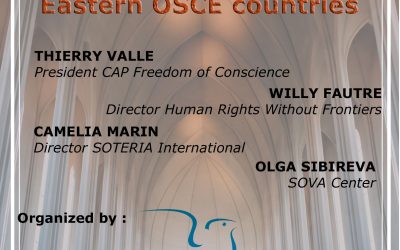
Side-event OSCE HDIM 2018 : The Religious Freedom in Eastern OSCE countries :The Denial of Religious Plurality in Russia
For one thousand years, Russia has been an Orthodox country, a bulwark against the expansion of Catholicism and other religions. “Russian Orthodox lands” are considered canonical territories where competition by other Christian religions has never been acceptable in the eyes of Moscow Patriarchy.
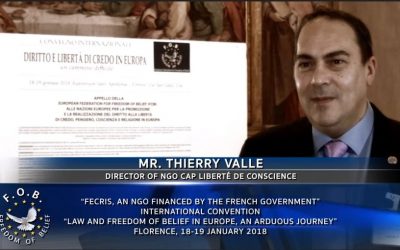
FECRIS, an NGO financed by the French government
FECRIS, an NGO financed by the French government
International Convention «Law and Freedom of Belief in Europe, a difficult journey»
In the prestigious setting of Sant'Apollonia Auditorium at the homonymous XIV century convent complex located in Via San Gallo, in the historic center of Florence, the international convention of the European Federation for the Freedom of the Belief (FOB) took place...
Laïcité and religious freedom: A coalition of NGOs questions France at the United Nations
CAP/ LC HRWF (15.01.2017) – In a side-event following the Universal Periodic Review of France in Geneva this Monday 15th January, several NGOs and an international law expert have called upon President Emmanuel Macron and his Prime Minister to revise the financing of...