CAP Liberté de Conscience | June 2026 |
A Bureaucratic Simplification with Theological Consequences
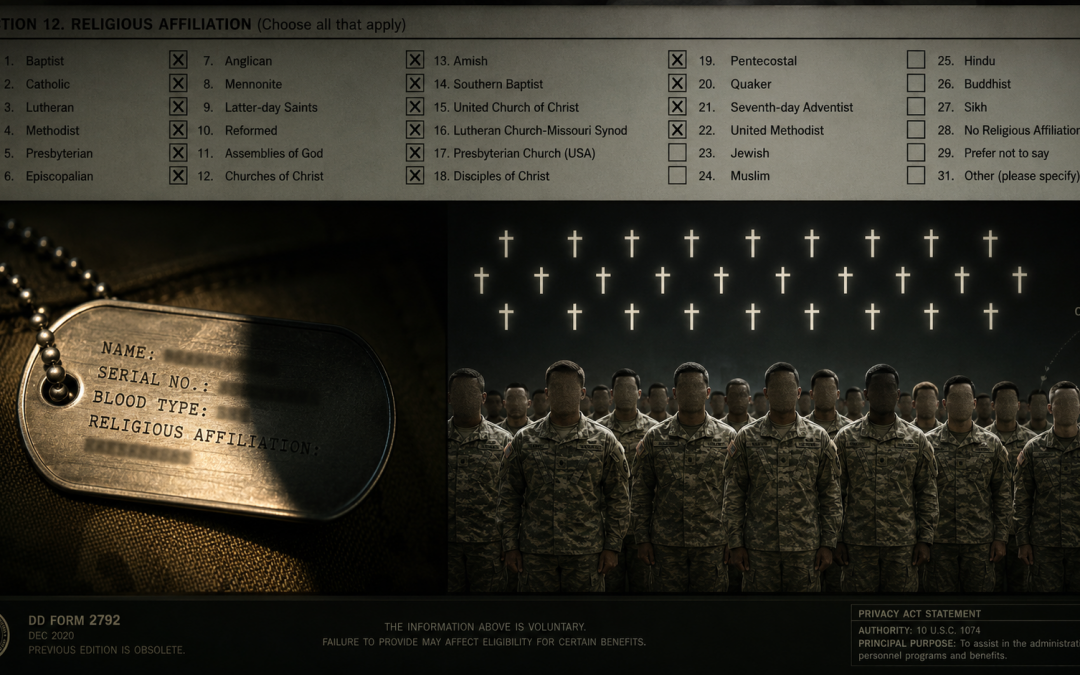
On 20 May 2026, the United States Department of Defense issued a memorandum that reduced the military’s religious affiliation codes from 211 to 31. The change, directed by Secretary of War Pete Hegseth and signed by Under Secretary Anthony Tata, was presented as an administrative streamlining measure. Within days, however, the omission of the Church of Jesus Christ of Latter-day Saints from the initial published list ignited a controversy that exposed deeper tensions about state recognition of religious identity, the boundaries of Christian orthodoxy, and the government’s role in cataloguing belief.
The Pentagon’s stated rationale was practical. According to the Tata memorandum, the previous system had “ballooned to well over 200 faith codes” and become “impractical and unusable.” Hegseth noted in March 2026 that 82% of religious service members used only six of the available codes. The new list, the Department argued, would allow chaplains to “quickly look at the religious composition of their units and determine how they structure resources.” It included 21 Christian denominations, alongside Buddhism, Hinduism, Islam, Judaism, Sikhism, and categories for agnostics, those with no religion, and other faiths.
Yet the devil lay in the details of what was excluded — and what was initially miscategorised.
The Mormon Omission and Its Aftermath
Among the 180 eliminated codes were groups such as atheists, Asatru, Deists, Druids, Eckankar, Heathens, Humanists, Pagans, Wiccans, Unitarian Universalists, and numerous Christian sub-denominations. The Church of Jesus Christ of Latter-day Saints — commonly known as the Mormon or LDS Church, with nearly 18 million members worldwide — was also absent from the 8 June publication of the revised list.
The reaction was swift and politically significant. Senator Mike Lee, a Republican from Utah and a Latter-day Saint, released a video statement calling the omission “shocking” and declaring it violated “every sense of decency, our common heritage, and our shared conviction that the government must not pronounce on doctrinal disputes between faiths.” His colleague, Senator John Curtis, posted on X: “Latter-day Saints are among the most patriotic, service-oriented individuals in our country. They are also unequivocally Christian — just look at who is in the name of the Church.”
The Pentagon corrected the list on 8 June, adding the Church of Jesus Christ of Latter-day Saints under the code “CJ.” But the manner of the correction proved equally contentious. Rather than labelling the LDS Church as Christian, the Pentagon removed the “Christian” designation from 20 other traditions, including Catholic, Lutheran, and Pentecostal. All faiths were now listed without denominational qualifiers — a solution that avoided theological adjudication but left the underlying question unresolved.
A Two-Century-Old Theological Dispute Enters the Military Bureaucracy
The incident reignited a debate that has persisted for nearly 200 years: are Latter-day Saints Christians? The LDS Church’s own website states it is a “Christian Church, but is neither Catholic nor Protestant,” describing itself as “a restoration of the Church of Jesus Christ as originally established by the Savior in the New Testament.” Most Latter-day Saints identify as Christians. Yet many mainstream Christian clergy and scholars dispute this, citing doctrinal differences regarding the nature of God, the Trinity, and the authority of the Book of Mormon alongside the Bible.
Philip McLemore, who served as a Latter-day Saint chaplain in the Air Force from 1984 to 2005, told PBS that he and others had faced discrimination and been passed over for promotions because other Christian chaplains “believed Mormon chaplains were not Christian.” He observed that some colleagues feared LDS chaplains were using the military to proselytise — a suspicion rooted in the church’s history of claiming exclusive divine authority through its founder Joseph Smith’s “First Vision,” in which Jesus reportedly told Smith that all existing churches were false.
The Pentagon’s dilemma was therefore not merely administrative. By assigning or withholding a “Christian” label, the government found itself wading into precisely the kind of doctrinal dispute that the First Amendment’s Establishment Clause was designed to prevent.
Beyond the Mormon Question: Minority Faiths and the Risk of Invisibility
While the LDS Church’s omission drew the most political attention, other groups raised fundamental concerns about the broader implications of the code reduction. The Military Association of Atheists and Freethinkers has long criticised the religious preference system as “an immediate and constant source of discrimination.” Under the new list, atheists are no longer explicitly coded; they must select “No Religion” or “Agnostic.” Similarly, Pagans, Wiccans, Heathens, Druids, and practitioners of various indigenous and New Age spiritualities have been collapsed into the generic “Other Religions” category — if they are tracked at all.
Pentagon spokesman Sean Parnell insisted that the changes “make no claims on the legitimacy of any faith or religious belief, nor is it intended to provide a list of ‘officially approved’ religions.” He emphasised that service members remain free to specify any religion on their dog tags, which are used to identify wounded soldiers and ensure appropriate religious support. Yet the distinction between administrative tracking and symbolic recognition is not always clear in practice. When a faith group disappears from official statistics, its visibility within the chaplaincy corps — and its claim to targeted resources — diminishes.
Retired Major General Steven Schaick, a former Air Force Chief of Chaplains, acknowledged that “smaller faith groups [may] feel a bit marginalised” by the loss of specific tracking. Randall Kitchens, another former Chief of Chaplains, defended the reform as representing “major faith groups” while admitting the prior list had become “difficult to manage.”
The Hegseth Context: A “Cultural Shift” or Christian Primacy?
The code reduction cannot be fully understood outside the broader policy context of the Hegseth tenure. In March 2026, Hegseth announced his intention to “make the Chaplain Corps great again,” pledging a “top-down cultural shift, putting spiritual well-being on the same footing as physical and mental health.” He ordered chaplains to replace their military rank insignia with religious symbols on their uniforms — a change he described as reflecting that chaplains “are first and foremost called and ordained by God, and an officer second.”
Critics have characterised these moves as part of a wider push toward what they term a “military-wide ascent towards Christian theocracy.” Hegseth has hosted Christian prayer services in the Pentagon auditorium and publicly invoked Scripture when discussing military operations. In September 2025, he singled out Pagan service members who had requested religious exemptions to grow beards, declaring: “If you want a beard, you can join Special Forces. We don’t have a military full of Nordic pagans.”
Against this backdrop, the slashing of religious codes from 211 to 31 — with 22 of the remaining categories being Christian denominations — takes on a more charged significance. The proportionality of representation matters. While the Pentagon insists the list is not a hierarchy of legitimacy, the visual reality of a form offering 22 Christian options and one catch-all “Other Religions” slot sends a message about whose beliefs are deemed sufficiently distinct to merit recognition.
The Chaplaincy Imperative: Service Over Classification
The military chaplaincy exists to serve the spiritual needs of all service members, regardless of faith. Its effectiveness depends on accurate information about the religious composition of units, but also on a culture of respect that transcends administrative categories. As Philip McLemore noted from his two decades of service, “service members would not know what your denomination was, and they didn’t care. They needed chaplains for personal problems and issues with work, mental health and marriage.”
This observation points to a deeper truth: the ultimate test of religious freedom in the military is not the comprehensiveness of a code list, but the quality of care provided to the human beings behind the codes. A system that tracks 211 faiths yet tolerates discrimination against chaplains from minority traditions is less just than one that tracks 31 categories while ensuring equitable treatment for all.
The Pentagon’s reform, whatever its administrative merits, has exposed the fragility of this equilibrium. The political firestorm over the Mormon omission demonstrated that religious identity remains a volatile and consequential domain in American public life. The quieter exclusion of atheists, Pagans, and other minority believers raised questions about whose visibility matters in a political calculus. And the broader context of Hegseth’s “cultural shift” suggested to critics that the streamlining may serve an agenda of Christian primacy rather than neutral efficiency.
The Limits of Administrative Neutrality
The reduction of military religious codes from 211 to 31 was presented as a technical adjustment. Its consequences have proven anything but. The affair has illuminated the enduring difficulty of state neutrality in religious matters, the political salience of theological identity, and the vulnerability of minority faiths to bureaucratic erasure.
The Pentagon’s retreat from labelling — removing “Christian” from all denominations to avoid adjudicating the Mormon question — may be read as a prudent separation of state and theology. Yet it also reveals the limits of such neutrality: when the state refuses to name difference, it may protect itself from controversy, but it also risks obscuring the distinct needs and dignities of diverse communities. The solution strips all traditions of recognition equally, leaving Catholics and Pagans, Lutherans and Wiccans, in the same undifferentiated grey. Equality through erasure is not the same as equality through respect.
For minority faiths, the concern is concrete. Collapsing into “Other Religions” or “No Religion” risks making them statistically invisible, reducing their ability to advocate for chaplaincy resources, dietary accommodations, burial rites, and other forms of religious support to which service members are entitled. The Pentagon’s assurance that dog tags remain unrestricted does not resolve this; tracking data shapes budgets, training, and institutional attention. What is not counted is not served.
The task ahead is not to expand the code list indefinitely, but to ensure that administrative simplification does not become a mechanism for marginalisation. Freedom of conscience in the military — as in society — requires not only the absence of coercion, but the presence of recognition. Whether 31 categories can deliver that recognition remains an open question, one that will be answered not in memoranda, but in the lived experience of service members whose faiths may or may not appear on a form, but whose humanity demands equal regard regardless of the box they check.
Related posts:
 YURII SHELIAZHENKO*, conscientious objector to military service and human rights defender, under immediate threat
 Human rights organisations express concern over the immediate risk of deportation of russian war resister maksim kuzmin to the russian federation
 UN UPR 53rd Session: CAP LC Submits Report on Hungary to the UN Universal Periodic Review: The Weaponization of Data Protection Laws
 Afghanistan: The European Parliament Confronts Institutionalised Gender Apartheid