
Once again, the International Human Rights Committee (IHRC) has sounded the alarm on a situation of discrimination in Pakistan. The British-based organisation, and committed for years to the rigorous documentation of fundamental freedoms violations, published on 10 August 2026 a detailed press release on the removal of a provincial administration official. The victim, Naghman Ahmad, an Ahmadi Muslim, had been appointed Assistant Director Land Records in Lalian, District Chiniot. His only distinguishing feature, in the eyes of the groups that orchestrated his downfall, was his religious affiliation. CAP Liberté de Conscience, whose mandate covers the defence of freedom of conscience and religion before international bodies, notes this alert and examines its implications in light of the obligations Pakistan assumed upon ratifying the International Covenant on Civil and Political Rights.
A Routine Appointment, a Targeted Individual
The appointment of Naghman Ahmad by the Punjab Land Records Authority (PLRA) should have followed the ordinary course of provincial land administration postings. The position of Assistant Director Land Records, within the Arazi Record Center of Lalian, places its holder at the heart of an essential district function: recording land mutations, issuing property documents, maintaining agricultural registers, direct contact with citizens. Chiniot, located in central Punjab, is an area where land structures economic and social relations. The presence of a competent official in this post matters beyond the administrative sphere; it conditions local residents’ access to the legal security of their assets.
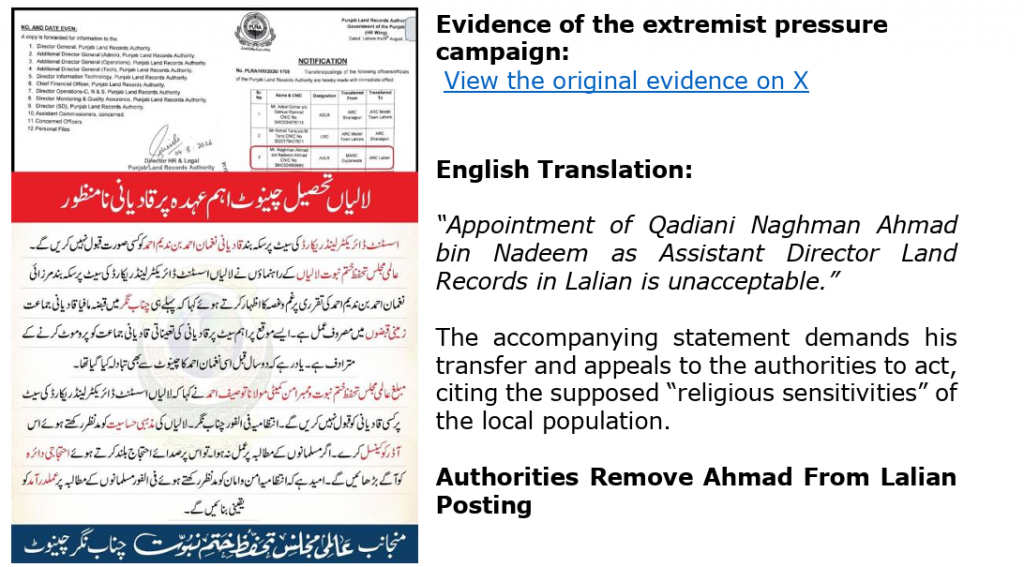
Naghman Ahmad, son of Nadeem Ahmad, bearer of national identity number 38403-2466868-5, had been designated for this function according to standard PLRA procedures. His name appeared on the official notification table, an administrative document organising personnel movements between various recording centres. This table, later reproduced in activists’ publications, clearly showed his posting to Lalian, framed among other nominations and transfers of the same batch.
Almost immediately after this publication, individuals affiliated with Khatm-e-Nabuwwat organisations launched a targeted public campaign. These groups, structured around an ideology hostile to the Ahmadiyya community, identified Naghman Ahmad by the pejorative term “Qadiani.” This designation, devoid of any neutral descriptive value, functions as a marker of exclusion. It signals to authorities and the population that the designated individual has no place in public functions, regardless of professional qualification or seniority.
A statement circulated as part of this campaign displayed the PLRA notification table topped by a red banner bearing Urdu text. The English translation, provided by IHRC in its release, leaves no ambiguity: “The appointment of Qadiani Naghman Ahmad bin Nadeem as Assistant Director Land Records in Lalian is unacceptable.” The accompanying text demanded his immediate transfer and appealed to authorities to act, invoking the supposed “religious sensitivities” of the local population. This formulation, presented under the guise of a community request, concealed a demand for confessional purge within the state apparatus. The image showed the official document framed by a call to action against Ahmadi presence in public administration. The official’s national identity number appeared in plain sight, exposing his personal data to public vindictiveness.
The Order of 8 August
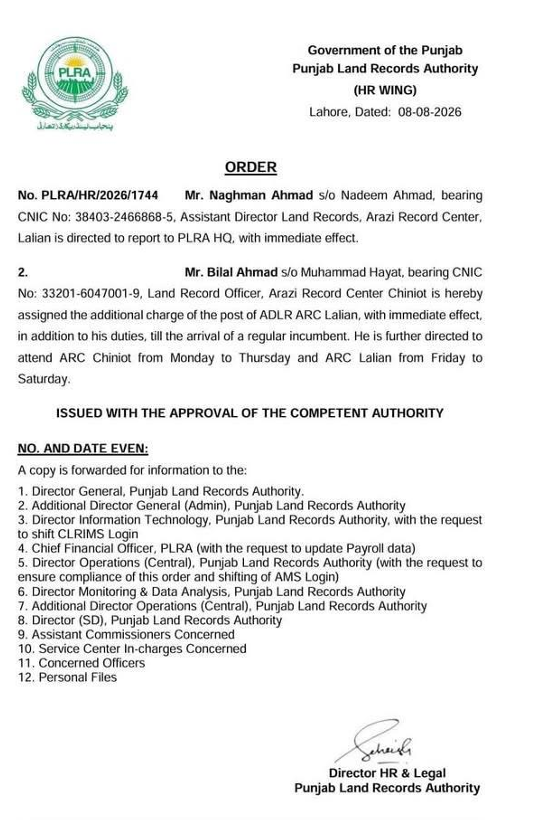
On 8 August 2026, the Human Resources and Legal Director of the Punjab Land Records Authority issued Order No. PLRA/HR/2026/1744. This document, signed by the Director HR & Legal, bore the official letterhead of the Government of Punjab and the PLRA HR Wing in Lahore. It was dated 8 August 2026 and circulated with the explicit approval of the competent authority.
The order reduces to two essential points. The first instructs Naghman Ahmad, son of Nadeem Ahmad, to report immediately to PLRA headquarters. The second assigns Bilal Ahmad, son of Muhammad Hayat, Land Record Officer at the Chiniot recording centre, the additional charge of the ADLR post in Lalian. The latter is now required to ensure presence at Chiniot from Monday to Thursday, and at Lalian on Friday and Saturday, until the arrival of a regular incumbent. The additional charge, far from a sustainable solution, reflects the urgency with which the administration sought to fill the vacant position.
No professional motive is invoked in this order. No disciplinary fault, no administrative irregularity, no competence deficiency is mentioned. The document merely moves the official from his posting to the central headquarters, with immediate effect. The administration’s silence on the reasons for this decision is total. The twelve recipients of the order copy, from the Director General to the Chief Financial Officer, through operations and IT directors, received no further clarification on the justification for this move. The order does not mention the extremist campaign. It does not refute it either. It ignores it, which amounts to granting it effect.
The temporal sequence is eloquent. The campaign begins shortly after the publication of the appointment notification. The administrative order follows within days. The groups behind the mobilisation immediately claim the decision as their success. The absence of any interrupting element between the pressure and the decision suggests a causal link that the authorities take care not to deny.
Public Claim of Victory
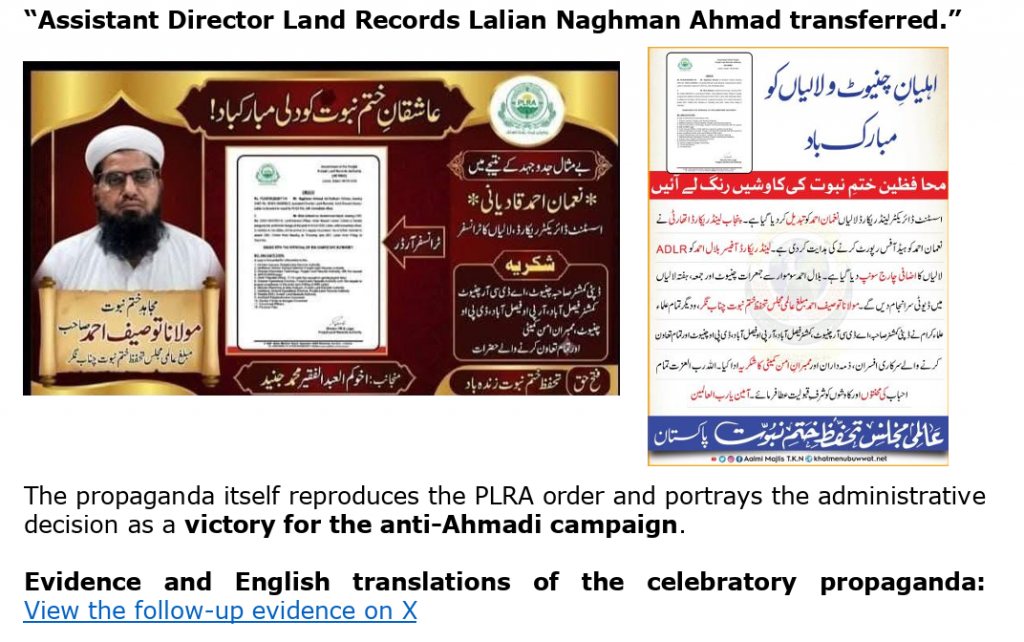
Post-8 August publications confirm the interpretation militants give to this order. Graphics circulating on social media display the text of the PLRA order framed by congratulatory messages. One of them, adorned with a militant’s portrait and gold decoration, proclaims: “Congratulations to the devotees of Khatm-e-Nabuwwat!” It presents Naghman Ahmad’s removal as the result of sustained campaigning and thanks those who participated, specifically naming local movement leaders.
A second document, circulated through the same networks, states: “Alhamdulillah! Across the country, efforts for the protection of Khatm-e-Nabuwwat are bearing fruit.” It then announces: “Assistant Director Land Records Lalian Naghman Ahmad has been transferred.” These publications faithfully reproduce the 8 August administrative order, sometimes with the PLRA seal visible. They present it not as an internal human resources management measure, but as a political and religious victory. The provincial administration has, to date, provided no public explanation capable of countering this interpretation.
The absence of official justification creates a narrative void that extremist groups fill with their own version of events. An administrative order, stripped of transparent motivation, becomes in their propaganda an ideological trophy. The boundary between state sphere and militant sphere blurs. The administrative apparatus ceases to appear as a neutral arbiter and presents itself, in the eyes of the campaign’s authors, as an instrument subject to their will. This confusion of roles, maintained by the authorities’ silence, undermines the very legitimacy of public administration.
Pakistan’s International Obligations
Pakistan ratified the International Covenant on Civil and Political Rights (ICCPR) on 17 April 2010. This ratification obliges it to respect several provisions directly at stake in this case.
Article 18 of the Covenant guarantees every individual the right to freedom of thought, conscience and religion. This freedom includes the right to have a religion of one’s choice, to change it, and to manifest one’s religion, alone or in community, in public as in private. The eviction of a public official because of his Ahmadiyya community affiliation constitutes direct interference with the exercise of this freedom. The fact that this measure follows an open campaign of religious stigmatisation reinforces the discriminatory character of the administrative act. The State, by yielding to this pressure, deprives a citizen of the possibility of exercising his profession without renouncing his religious identity.
Article 26 provides that all persons are equal before the law and are entitled, without discrimination, to equal protection of the law. The Punjab administration operated a distinction between Naghman Ahmad and other officials on the sole basis of his religious affiliation. This distinction, materialised by a transfer order without professional justification, violates the fundamental guarantee of equality. Article 2 of the Covenant, which commits the State to respect the rights recognised in the treaty without distinction of religion, finds here direct and binding application.
Article 25 recognises every citizen’s right to participate in the conduct of public affairs. Access to public employment, without discrimination other than that based on required qualifications and competencies, flows from this provision. Naghman Ahmad’s removal from a post for which he had been appointed according to standard procedures, under pressure from non-state actors motivated by religious hatred, deprives a citizen of the effective exercise of this right. Article 17, which protects against arbitrary interference in private life, is also at stake: the public campaign exposed the official’s religious identity, his name, his national identity number and his workplace, transforming personal data into instruments of collective pressure.
Article 20 of the ICCPR prohibits any propaganda for war and any advocacy of national, racial or religious hatred that constitutes incitement to discrimination, hostility or violence. The statements by Khatm-e-Nabuwwat groups, which publicly identify a government official by his religious affiliation and demand his exclusion from public function, fall within this incitement. The Pakistani State, by giving concrete effect to these speeches through an administrative order, evades its obligation to suppress such advocacy and violates Article 20.
A Legislative Framework of Systemic Discrimination
This case does not constitute an isolated incident. It fits within a legislative and institutional framework that structurally weighs upon the Ahmadiyya community. Articles 298-B and 298-C of the Pakistan Penal Code, as well as Ordinance XX of 1984, prohibit Ahmadis from presenting themselves as Muslims, qualifying their place of worship as a mosque, or publicly professing their faith. These provisions, maintained despite repeated recommendations from international human rights protection mechanisms, create a legal environment where discrimination is not merely tolerated but codified by criminal law.
The pressure exercised against Naghman Ahmad draws upon this legislative soil. The groups that demanded his departure operate with relative impunity, in a context where the stigmatisation of Ahmadis is institutionalised. The provincial administration, by transferring the official without professional justification, yielded before a demand whose motivation is explicitly religious and exclusionary. The administrative decision of 8 August 2026, far from a simple personnel reassignment, illustrates how ordinary state mechanisms can be diverted to serve exclusionary objectives. The banality of the procedure — a transfer order, a signature, a copy to twelve concerned services — makes the mechanism all the more disturbing. It is not street violence that removes Naghman Ahmad; it is the routine functioning of an administration that has integrated discrimination as a management parameter.
Conclusion
Naghman Ahmad’s case exposes the concrete mechanics through which religious intolerance penetrates the state apparatus. A regular appointment. A campaign of identity-based denigration. A silent administrative order. Public celebration by the pressure’s initiators. Each step of this sequence is documented, dated, verifiable. CAP Liberté de Conscience notes that Pakistan, by ratifying the ICCPR, committed to protecting its citizens against such discrimination. The international community now has additional evidence to measure the gap between these commitments and the practices observed on the ground. The Punjab authorities’ silence on the motivations for the 8 August order speaks as loudly as the militants’ slogans. It reveals a passive complicity that, in the eyes of international law, engages the State’s responsibility.
Related posts:
 Eighty Incidents in Eighteen Months: IHRC Launches Its Report on the Persecution of Ahmadis in Pakistan at Jalsa Salana UK
 Submission to UN Special Rapporteur Details Systemic Discrimination in German Public Procurement
 CAP LC and Nazir Ahmad Publish First Pakistan Human Rights Fact Sheet
 UN UPR 53rd Session: CAP LC Submits Report on Hungary to the UN Universal Periodic Review: The Weaponization of Data Protection Laws