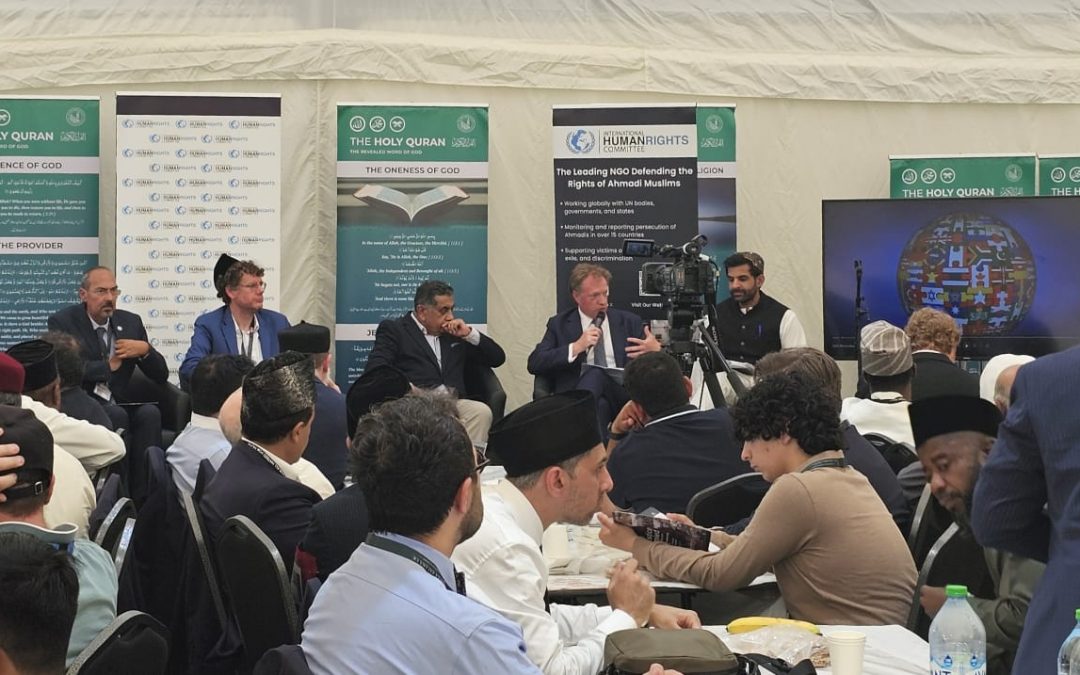
Over eighty major incidents in eighteen months. More than two hundred graves desecrated, dozens of mosques sealed or demolished, worshippers arrested for praying, doctors assassinated in their clinics, and a man sentenced to life imprisonment for memorising the Qur’an. These are the figures compiled by the International Human Rights Committee (IHRC) in its report A Year in Review 2024–2025, covering the period from June 2024 to December 2025. The report was formally presented on Saturday 25 July 2026 during Jalsa Salana UK, the annual convention of the Ahmadiyya Muslim Community, in Hadeeqatul Mahdi, near Alton in Hampshire — a setting that gave the launch a particular weight.
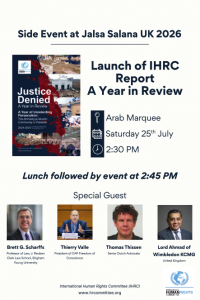 The International Human Rights Committee
The International Human Rights Committee is an independent non-governmental organisation dedicated to the defence of the rights of Ahmadi Muslims and other persecuted communities. It works with UN bodies, governments and parliamentarians, monitors and reports persecution of Ahmadis in more than fifteen countries, and supports victims of faith-based violence and discrimination. Its documentation — verified incidents, names, dates, legal records and firsthand testimonies — feeds the advocacy work of partner organisations, including CAP Liberté de Conscience, which holds ECOSOC consultative status at the United Nations. The report’s launch event was organised by IHRC Secretary-General Nasim Malik.
A System, Not a Series of Incidents
The report’s central finding is that the persecution of the Ahmadiyya Muslim Community in Pakistan cannot be reduced to isolated attacks by lone perpetrators. It documents a coordinated, state-enabled system built on the Second Constitutional Amendment of 1974, which declared Ahmadis “non-Muslims”, on Ordinance XX of 1984, and on Sections 298-B and 298-C of the Pakistan Penal Code, which criminalise Ahmadis for calling themselves Muslims, using Islamic terminology, or referring to their places of worship as mosques. Within this framework, police forces participated in mosque demolitions and grave desecrations, courts denied bail to peaceful worshippers, and extremist groups — chiefly Tehreek-e-Labbaik Pakistan (TLP) — conducted intimidation campaigns without consequence. Clerics such as Naeem Chatta Qadri and Maulvi Manzoor Mengal delivered public sermons calling for the extermination of Ahmadis. No prosecution followed.
Behind the structure lie individual lives. Dr. Sheikh Mahmood, a 58-year-old gastroenterologist, was shot dead inside his own hospital in Sargodha on 16 May 2025, after hate flyers naming Ahmadi professionals as “worthy of death” had circulated nationwide. Tahir Mahmood, aged 71, arrested for attending Friday prayers, died in police custody after being beaten and denied bail. Muhammad Asif, a 19-year-old student, was murdered in Kasur in April 2025. In October 2025, Rabwah — the community’s headquarters city — came under a coordinated extremist attack after days of open incitement, with law enforcement largely absent. And on 27 December 2025, a court sentenced Mubarak Sani to life imprisonment for memorising and teaching the Qur’an, a ruling the report describes as extending state punishment from expression into the realm of belief and conscience itself.
From Documentation to Demands
The report’s recommendations are addressed to three audiences. The government of Pakistan is asked to repeal Sections 298-B and 298-C and halt the enforcement of Ordinance XX, to prosecute incitement to violence, to restore and protect Ahmadi mosques and cemeteries in accordance with the 2014 Supreme Court judgment, to release prisoners of conscience jailed under blasphemy laws, and to create an independent commission to investigate police complicity. The UN Human Rights Council and Special Procedures are asked to adopt a country-specific resolution on religious persecution in Pakistan, to mandate a fact-finding mission, and to ensure that Pakistan’s failure to protect religious minorities is addressed in future Universal Periodic Reviews and treaty body assessments. UN Member States are asked to link aid, trade and diplomatic engagement to verifiable improvements, to provide asylum and emergency protection to Ahmadis facing immediate threats, and to raise the issue consistently in bilateral and multilateral settings, including within the OIC.
A Launch in a Significant Setting
The choice of venue was not incidental. Jalsa Salana UK is one of the largest regular Muslim gatherings in Europe. The 2026 edition marked the sixtieth UK Jalsa and brought together more than 50,000 participants from over one hundred countries for three days of religious instruction, with parliamentarians, civic leaders and diplomats addressing the convention. The gathering is blessed by the presence of His Holiness Hazrat Mirza Masroor Ahmad, the Caliph and worldwide head of the Ahmadiyya Muslim Community, who resides in the United Kingdom. A community whose members cannot pray openly in Pakistan convened, in the English countryside, in full freedom — and used that freedom to put its persecuted members’ situation on the international agenda.
Within this setting, IHRC held two events on Saturday 25 July. The first, in the morning, was devoted to the report itself. The second, in the afternoon, took the form of a National Lawyers Meeting focused on asylum law and the role of Pakistani bar associations.
The Report Launch Conference
The morning conference brought together jurists, parliamentarians and human rights representatives around a shared conclusion: registration alone is no longer considered sufficient. Participants called for parliamentary follow-up, diplomatic pressure, targeted sanctions, refugee protection and a stricter linkage between human rights obligations and trade preferences. The discussion also noted that violence did not stop when the reporting period closed. On 5 June 2026, a masked gunman opened fire on three Ahmadi volunteers providing security at Bait-ul-Aqsa in Rabwah, leaving two in critical condition; further arrests, mosque closures and confiscations of sacrificial animals were reported around Eid-ul-Adha 2026.
Thomas Thissen, a Dutch asylum lawyer who has represented Ahmadi asylum seekers from Pakistan since 2015, brought the human consequences into focus. He described the cases of women who arrived in the Netherlands after a husband or son was killed for his faith, and of families threatened or turned away from cemeteries while burying a parent. He also described the daily dilemma of concealment: the employee asked why he does not join colleagues for Friday prayer, the schoolchild questioned about the family’s beliefs. Hiding offers, at best, temporary protection — and asylum law, he stressed, cannot require a refugee to renounce or permanently hide his faith. He pointed to a February 2026 Dutch court ruling that found the authorities had insufficiently explained why group persecution of Ahmadis should not be recognised.
Professor Brett G. Scharffs of Brigham Young University, Director of the International Center for Law and Religion Studies, anchored the discussion in international law. He recalled that Article 18 of the Universal Declaration owes part of its formulation to Sir Muhammad Zafrulla Khan — Pakistan’s first Foreign Minister, later President of the UN General Assembly and of the International Court of Justice, and an Ahmadi — who defended the right to change one’s religion during the drafting negotiations. The demolition, in January 2025, of the Daska mosque built by Zafrulla Khan and his family gave this history a sharper edge: the discrimination of living believers now reaches their public legacy. Scharffs advocated targeted sanctions — travel bans, visa denials, asset freezes — against responsible officials, judges and organisers, noting that the UK’s Global Human Rights Sanctions Regulations already provide the legal instrument. The challenge, he argued, is not the absence of tools but the willingness to use them.
Gregory Stafford, Conservative MP for Farnham and Bordon and secretary of the All-Party Parliamentary Group for the Ahmadiyya Muslim Community, addressed the parliamentary dimension. His constituency includes the land where the Caliph resides, and he receives regular reports of discrimination and attacks. The APPG — chaired by Dame Siobhain McDonagh, with Ed Davey as vice-chair and Luke Taylor as treasurer — offers a cross-party channel for questions, debates and written inquiries. His message to citizens and organisations was direct: write to your MP, provide verified incidents, ask what steps the government is taking towards Pakistan. A file that circulates only in specialised circles, he warned, easily disappears from political view.
Thierry Valle, President of CAP Liberté de Conscience, explained how the dossier can be fed into UN mechanisms. Generic references to religious freedom, he noted, are insufficient when the laws and practices targeting Ahmadis are not named explicitly: submissions must identify which law must change, which prisoners need protection, which mosques were attacked and which state bodies were involved. Beyond the UPR, information can be brought to the treaty bodies and to the mandate of the UN Special Rapporteur on freedom of religion or belief, Nazila Ghanea. Valle also drew a direct line to European trade policy: Pakistan benefits from GSP+ preferences, conditional on the effective implementation of 27 international conventions, including the ICCPR. A state that structurally disregards Article 18, he argued, cannot see that disregard treated as separate from the conditions of preferential market access.
Lord Tariq Ahmad of Wimbledon, UK Minister of State for the Commonwealth and the UN from 2017 to 2024 and himself an Ahmadi with family ties to Pakistan, described the limits of quiet diplomacy. Pakistani interlocutors, he recounted, regularly acknowledged in private that the treatment of Ahmadis is unjust, while public reform never followed. He illustrated the constitutional contradiction with a personal exchange: when Prime Minister Shehbaz Sharif invited him to visit Pakistan, he replied that he would leave the United Kingdom as a Muslim but, on arrival, would not be recognised as one by the Pakistani constitution. His minimum demand is simple to state: Ahmadis must hold the same civil rights as every other Pakistani citizen — to vote without a discriminatory procedure, to work, to worship, to go to court. Targeted sanctions, he added, gain effect when allies act together.
The National Lawyers Meeting
Later that day, lawyers from Europe, North America, Pakistan and Southeast Asia reconvened for a working session that opened with a silent prayer, each participant praying according to his or her own conviction. Amjad Mahmood Khan, a lawyer and law lecturer from Los Angeles, recalled that lawyers themselves have paid with their lives in Pakistan for defending prisoners of conscience — and that when counsel is threatened, the right to defence and a fair trial is threatened with him. Eight Ahmadis, he reported, were imprisoned as prisoners of conscience at the time of the meeting. Professor Scharffs stressed again that documentation determines what is legally possible: without verified names, dates and court records, no case can be built and no government held to account. He had met, during the Jalsa, a survivor of a recent attack on an Ahmadi mosque who had lost an eye — a reminder, he said, that the debate is not theoretical.
Two operational outcomes emerged. First, participants warned about the EU Migration and Asylum Pact, applied since 12 June 2026, under which asylum seekers from countries with a recognition rate below twenty percent — including Pakistan — may face accelerated border procedures. A low average recognition rate, the Dutch lawyer cautioned, says nothing about the risk faced by a specific applicant: country information explicitly lists Ahmadis among risk groups, and two of his clients were released from border detention only after he invoked that information. Faster procedures make the international exchange of case law, country reports and legal files more urgent. Second, the meeting examined a dossier of 69 resolutions adopted by Pakistani bar associations seeking to prevent Ahmadis from celebrating Eid, praying at home, or joining the profession. The lawyers agreed to prepare a joint international resolution — addressed to the government of Pakistan, the Chief Justice, the United Nations and EU institutions — with national bar associations in the Netherlands, Luxembourg, Romania and the United States to be approached in turn. A petition on Pakistan’s GSP+ status has already been filed with the European Parliament.
From Record to Action
The report closes with a sentence that summarises the day: the world knows — now it must act. The two conferences at Jalsa Salana translated that appeal into five working lines: restoration of equal civil and political rights; individual accountability through targeted sanctions; asylum policies that recognise the structural nature of the persecution; systematic use of UN mechanisms, treaty bodies and national parliaments; and the use of trade and diplomatic relations to enforce existing obligations. For CAP Liberté de Conscience, this work continues in Geneva and Brussels, where documented incidents, treaty obligations and trade policy are being brought into the same political file. Documentation, as the speakers insisted, only becomes protection when someone follows up — with a date, a responsible institution, and a measurable result.
Related posts:
 The EU Reinforces Trade Preferences: Human Rights and the GSP+ Revision
 Pakistan: Amnesty International Warns of Escalating Persecution Against Ahmadis Ahead of Eid
 Maria Shahbaz and the Girls Pakistan’s Courts Refuse to Protect
 Pakistan Before the UN Committee Against Torture: A Reckoning Long Overdue