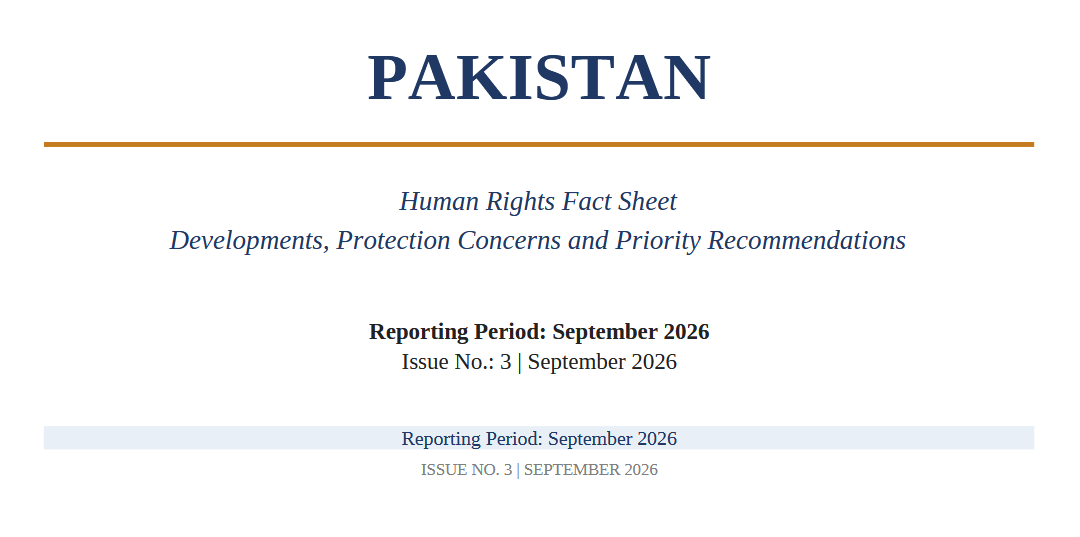
The third issue of the Pakistan Human Rights Fact Sheet, prepared by Nazir Ahmad and published by the Coordination of Associations and Individuals for Freedom of Conscience (CAP LC), reviews reported human rights developments in Pakistan during September 2026, together with several late August items closely linked to the month’s coverage. It follows the two first issues, released in July and September 2026, and keeps the same method: developments are reported as documented, assessments are drawn conservatively, and each section identifies the human rights standards most closely engaged, from the Universal Declaration of Human Rights to the Constitution of Pakistan.
Afghan students, religious minorities and blasphemy proceedings
Among the month’s principal developments, the directive of the Pakistan Medical and Dental Council ordering Afghan medical and dental students to leave the country stands out. The Lahore High Court suspended the directives for the petitioners, allowing students, many of them women close to graduation, to continue their education while the case proceeds. The month also recorded renewed targeted attacks on Ahmadis, the contested destruction of a historic Hindu temple in Narowal, and further cases of abduction and forced conversion of minor girls, even as the Supreme Court upheld monthly support for two Hindu girls and UN experts urged Pakistan to end the persecution of Ahmadis. In blasphemy related proceedings, the Lahore High Court admitted the appeal of Junaid Hafeez, sentenced to death in 2019 and held in solitary confinement since 2013, nearly seven years after his conviction.
Insecurity, enforced disappearances and fair trial concerns
Insecurity in Khyber Pakhtunkhwa and Balochistan continued at a high level, marked by the Kohat Police Lines attack that killed 23 people, while casualty figures released by state and military sources could not be independently verified. Enforced disappearances again drew the attention of UN experts, in a case involving the death of Imran Ali after a year of concealment, and more than 1,400 persons remain missing before the Commission of Inquiry. Fair trial concerns widened with the rearrest of lawyers Imaan Mazari and Hadi Ali Chattha immediately after the Supreme Court suspended their sentences, the acquittal of the last officers accused in the Naqeebullah Mehsud case, and the adoption by Punjab of legislation providing for anonymous trials in designated security cases. Preventive detentions, blanket assembly bans and communications restrictions ahead of a planned opposition march narrowed the space for peaceful protest, and cybercrime provisions were used against journalists.
Women, children, mixed signals and the European frame
Violence against women and children remained at the centre of public attention, with 7,071 gender based violence cases recorded in 2025 and a UNICEF estimate that about 1.5 million children experienced online sexual exploitation in one year. Courts and parliamentary committees sent mixed signals: judicial rulings on Afghan students, child marriage, solitary confinement, dower and marital rape offered protection, while other decisions illustrated continuing accountability gaps. The European Union added a further frame, its Ambassador cautioning that GSP+ benefits cannot be taken for granted as the current scheme nears its end.
Recommendations offered as leads for reflection
The fact sheet closes with priority recommendations addressed to the federal and provincial governments, the judiciary and independent oversight institutions, and international partners. Rather than a general appeal, they propose concrete lines of action: individualised assessment before any removal of Afghan nationals, independent verification of age and consent in cases involving minors, open and verifiable trials, a funded national strategy against gender based violence, protection of children in institutions and online, and a time bound compliance roadmap for the concerns identified by the European Commission. These recommendations are offered as leads for reflection and discussion, for all those, in Pakistan and abroad, who work to protect human dignity and seek to better understand the situation of human rights in the country.
Pakistan_Human_Rights_Fact_Sheet_September_2026
Related posts:
 Pakistan Human Rights Fact Sheet No. 2: August 2026 Developments, Protection Concerns and Priority Recommendations
CAP LC and Nazir Ahmad Publish First Pakistan Human Rights Fact Sheet
Pakistan: CAP LC and Nazir Ahmad Publish a Comprehensive Report on the Human Rights of Religious Minorities
Pakistan Human Rights Fact Sheet No. 2: August 2026 Developments, Protection Concerns and Priority Recommendations
CAP LC and Nazir Ahmad Publish First Pakistan Human Rights Fact Sheet
Pakistan: CAP LC and Nazir Ahmad Publish a Comprehensive Report on the Human Rights of Religious Minorities
 Maria Shahbaz and the Girls Pakistan’s Courts Refuse to Protect