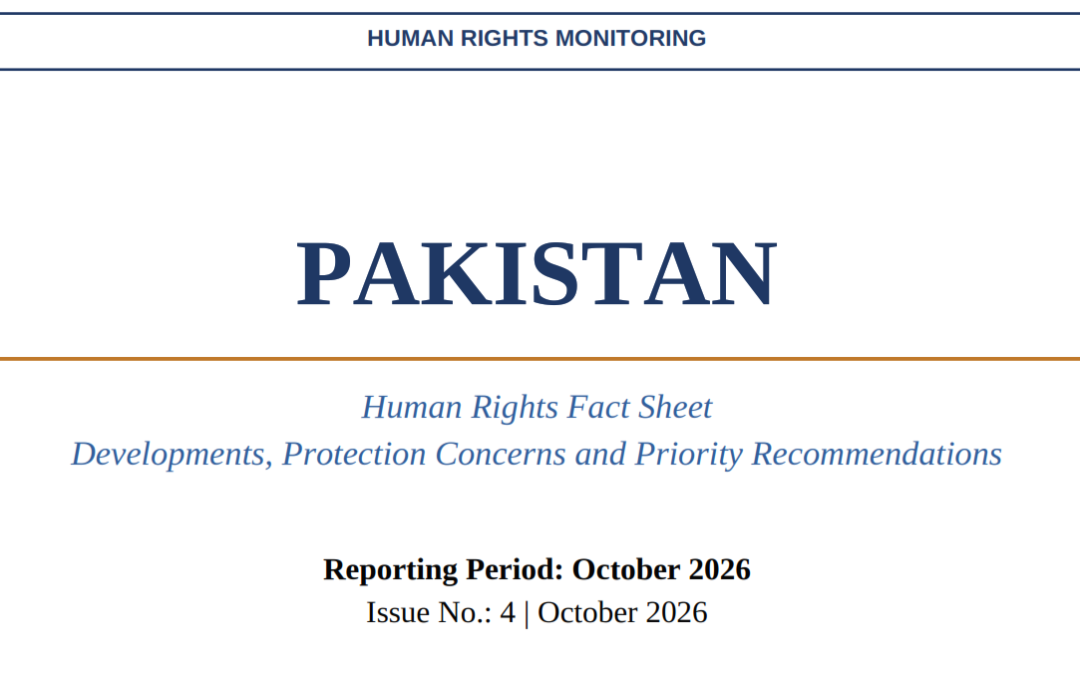
The fourth issue of the Pakistan Human Rights Fact Sheet, prepared by Nazir Ahmad and published by the Coordination of Associations and Individuals for Freedom of Conscience (CAP LC), reviews reported human rights developments in Pakistan during October 2026 and a few late September items. As in the three previous issues, developments are reported as documented, assessments are drawn conservatively, and each section identifies the human rights standards most closely engaged.
Afghan students, religious minorities and blasphemy sentences
The expulsion of Afghan medical students continued despite interim court protection: the Peshawar High Court stayed the deportation of 86 students, while one college in Bahawalpur began expelling 20 of them. The students estimate that about 1,000 Afghan students, some 350 of them women, are affected. Mob violence returned to the centre of minority concerns: after a blasphemy accusation in Sheikhupura, a mob set fire to the home and clinic of a Christian man, and more than 35 Christian families fled their village, in an episode recalling Jaranwala in 2023. The Supreme Court upheld a death sentence in one blasphemy case and a Lahore court imposed four more, while acquitting a co accused in the first, as UN Special Rapporteurs cautioned that legislation alone would not protect abducted girls such as Maria Shahbaz.
Deteriorating security, enforced disappearances and fair trial
Militant violence rose sharply, with research centre CRSS recording 1,415 deaths in the third quarter, an increase of 83 per cent. Planned relocations of some 30,000 civilians in Kalat and the blocking of 138,166 identity cards in Balochistan raised concerns of collective measures, while operational casualty figures remained unverifiable. On 29 October, lawyers Imaan Mazari and Hadi Ali Chattha were convicted, after a trial held inside jail, to an effective ten years each under antiterrorism law, deepening fair trial concerns. Prisons held about 160 per cent of their capacity, three in four inmates awaited trial, and 113 prisoners in Punjab, including 11 children, remained behind bars despite bail for inability to pay surety.
Women, children and a narrowing space for politics
Killings of women and girls continued, and the family of Hina Javed demanded a judicial commission, citing an untested DNA report; the Supreme Court condemned the customs of ghag, swara and watta satta, and a Bench Book for gender based violence courts was launched. The collapse of a school roof in Peshawar killed 33 people, most of them schoolchildren, a UNICEF study estimated that 1.5 million children experienced online sexual exploitation in one year, and the Lahore High Court questioned police over more than 500 missing girls in Punjab. The space for politics and expression narrowed: a long march met detentions and mobile network suspensions, the federal government imposed emergency and governor’s rule in Khyber Pakhtunkhwa, and the cybercrime agency announced a fake news enforcement policy that the press warned could amount to mass surveillance. Courts again sent mixed signals, and the European Union added a further frame: GSP+ preferences, its Ambassador stated, depend on implementation rather than new legislation.
Recommendations offered as leads for reflection
The fact sheet closes with priority recommendations addressed to the federal and provincial governments, the judiciary and independent oversight institutions, and international partners. They propose concrete lines of action: honour court orders on Afghan students, prosecute those who lead or incite mobs, end the death penalty for blasphemy and reinstate a moratorium on executions, make any relocation of civilians voluntary and lawful, reform bail so that no one remains in custody solely for inability to pay, restore constitutional government in Khyber Pakhtunkhwa through dialogue, and adopt a time bound compliance roadmap for the concerns identified by the European Commission. These recommendations are offered as leads for reflection and discussion, for all those, in Pakistan and abroad, who work to protect human dignity and seek to better understand the situation of human rights in the country.
Pakistan_Human_Rights_Fact_Sheet_October_2026
Related posts:
 International Day of the Girl 2026: End Child Marriage and Invest in Girls’ Rights
 Pakistan Human Rights Fact Sheet No. 2: August 2026 Developments, Protection Concerns and Priority Recommendations
 Pakistan Human Rights Fact Sheet, Issue No. 3: September 2026 Developments
 Maria Shahbaz and the Girls Pakistan’s Courts Refuse to Protect