CAP Liberté de Conscience November 2026
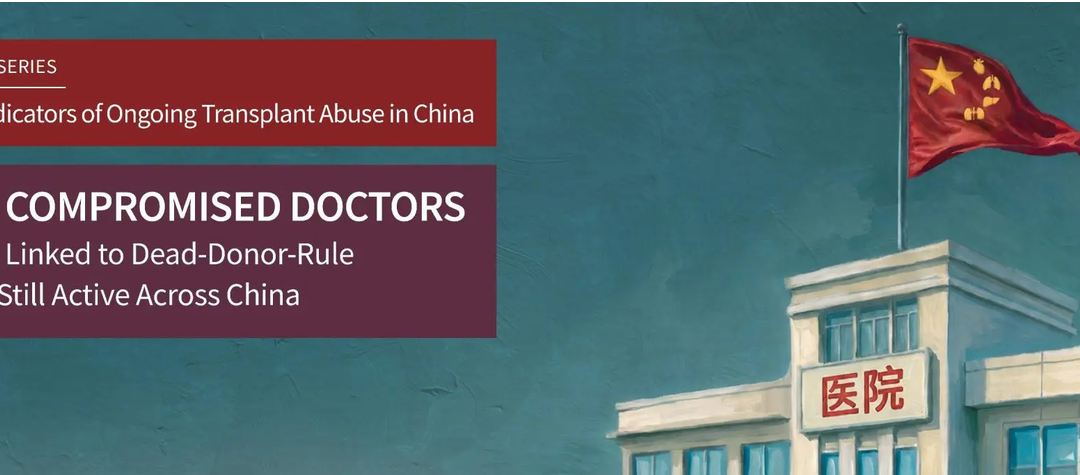
In April 2022, the American Journal of Transplantation published a study identifying 348 Chinese medical workers as authors of clinical papers describing organ procurement that could only have caused the donor’s death. More than three years later, how many of them have faced an investigation? According to ETAC’s second “Red Flags” report, the answer is none.
The International Coalition to End Transplant Abuse in China, a non-partisan organisation founded in 2016 and bringing together lawyers, ethicists, physicians and researchers, released this second instalment of its investigative series in November 2026. The research was led by Sarah Cook, former China Research Director at Freedom House and founder of China Rights Analytics and Advising. CAP Liberté de Conscience covered the first part of the series, on Chinese Communist Party control over the transplant sector, and published an interview with Ms Cook in The European Times on 8 November 2026.
Mandate and Scope of the Series
Launched in late 2025, the Red Flags project examines China’s transplant sector from January 2020 to December 2025. Its stated aim is to identify indicators of ongoing abuse and to provide policymakers, journalists, medical associations and companies with a due-diligence resource. The series responds to a recurring claim by Chinese officials that the system was fully reformed after 2015, a claim no independent assessment has verified.
Part 2 takes a narrow but documented starting point: the 2022 study by Matthew Robertson of the Australian National University and Dr Jacob Lavee, a heart transplant surgeon at Sheba Medical Center. Using computational text analysis of 2,838 Chinese-language papers on heart and lung transplantation, the two researchers identified 71 publications, dated 1980 to 2015, in which the donor was intubated after brain death was declared, or only at the moment of chest opening. Under international standards, brain death cannot be determined in a non-ventilated patient. The surgical sequence described therefore made a legitimate death determination impossible, meaning the procurement itself was the proximate cause of death.
Because voluntary donation was negligible in China throughout that period, Robertson and Lavee concluded that the donors were almost certainly prisoners. The papers came from 56 hospitals, including 12 military facilities, in 15 provinces. Three-quarters were published after 1999, the year the Party banned Falun Gong, with a concentration between 2002 and 2010.
What the New Research Adds
ETAC’s team set out to answer a simple question: where are these authors now? By cross-referencing hospital websites, professional directories and Chinese-language profiles, researchers found that at least 100 of the 348 named individuals were professionally active at 40 hospitals in 16 provinces during the past six years.
The report pays particular attention to 53 “recurring authors” who appear on two or more problematic papers, some on as many as six. Of these, 39 (74 per cent) have confirmed current affiliations at 13 hospitals in Hubei, Anhui, Guangdong, Shanghai and Jiangsu. Seven of those 13 institutions were already on the original list of implicated hospitals. The report argues that repeated authorship points to sustained participation in, or at minimum awareness of, procurement practices that breached the dead donor rule.
Four case studies illustrate the pattern. At Wuhan Union Hospital, seven physicians named on papers from 1995 and 2005 remain in senior posts; one now directs the hospital’s Organ Transplant Centre, is a Party member and was elected to the American Association for Thoracic Surgery in 2016. At the First Affiliated Hospital of Guangzhou Medical University, ten recurring authors are still active, four of them listed on six papers each; one serves as Deputy Secretary of the hospital’s Party Committee. In Jiangsu, a cluster of ten doctors formerly at Zhenjiang First People’s Hospital has dispersed to leadership positions across the province, Shanghai and Anhui. At Beijing Chaoyang Hospital, eight surgeons who co-authored a single 2006 paper have risen to lead the thoracic surgery department; one sat on the hospital’s ethics review committee as recently as 2020.
Several of these physicians trained or held visiting posts in the United States, Switzerland, Germany and Ireland, both before and after publication of the relevant papers.
Institutional Silence, With One Exception
The report records that no Chinese hospital, medical association or health authority has announced an inquiry, and no named physician has faced licence review or disciplinary proceedings. A 2026 article co-authored by two senior Chinese transplant officials refers to the Robertson and Lavee study as an example of “misunderstandings, criticism, and misinterpretations.”
Internationally, only the International Society for Heart and Lung Transplantation acted, announcing in April 2022 that it would no longer accept submissions involving organs or tissue from donors in China. The Transplantation Society and other bodies have adopted no comparable measure.
By way of contrast, the report cites two recent accountability cases: the United States Department of Health and Human Services’ decertification of an organ procurement organisation in August 2026 after reviews found donors who may not have been deceased, and Taiwan’s 2024 conviction and 2026 licence revocation of a transplant surgeon for illegal organ brokering.
ETAC calls on international medical societies to screen members and conference participants against the published author list, on journals and universities to apply existing ethical guidelines before accepting Chinese transplant research or visiting scholars, and on governments to consider targeted sanctions and mandatory due-diligence requirements for institutions collaborating with Chinese transplant centres. It also urges China’s National Health Commission to open a formal investigation.
Source https://endtransplantabuse.org/red-flags-investigative-series/part2-compromised-doctors/
Related posts:
 Investigation Finds Chinese Communist Party Control Extends Across China’s Organ Transplant System
 Serbia Condemned by the European Court of Human Rights for Banning Falun Gong Protests During Xi Jinping’s Visit
 Submission to UN Special Rapporteur Details Systemic Discrimination in German Public Procurement
 Sudan’s War by Remote Control: HRC 63 Confronts the Networks That Fuel the Conflict