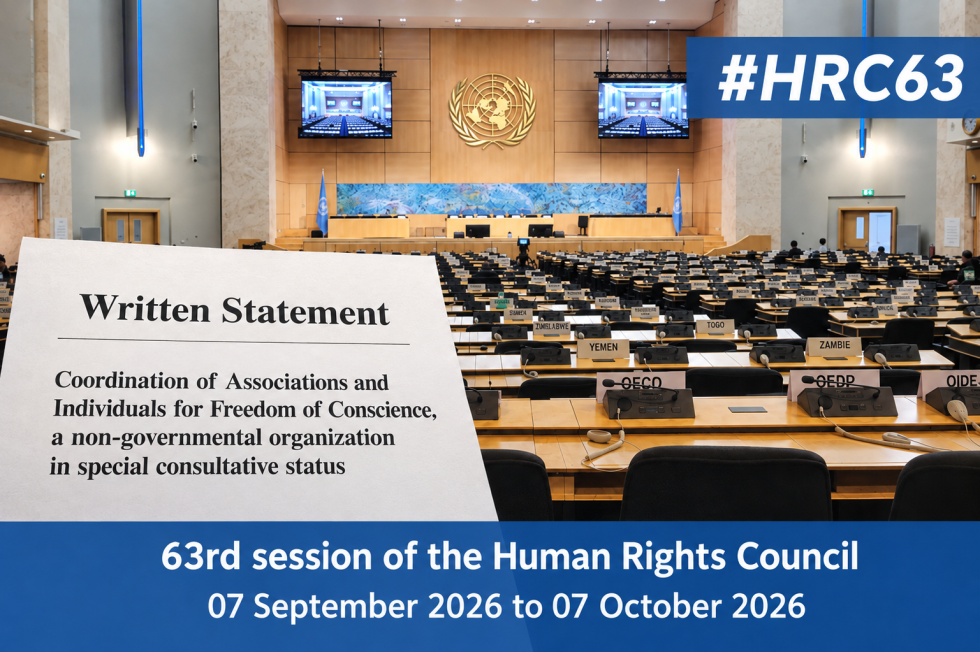
Citoyens en action pour la démocratie et le développement and the Coordination des Associations et des Particuliers pour la Liberté de Conscience submitted this joint written statement during the 63rd session of the United Nations Human Rights Council, held from 7 September to 9 October 2026, under Agenda Item 3.
The statement raises concerns about the application of the Trafficking Victims Protection Act to religious and spiritual communities in the United States. It focuses on the federal OneTaste case, also known as United States v. Cherwitz, and warns that interpreting psychological influence, spiritual pressure, communal expectations, or religious discipline as serious harm may extend forced labor legislation beyond its intended purpose.
While reaffirming the need to prosecute genuine trafficking and exploitation, the statement calls for legislative clarification during the reauthorization of the Act. It proposes safeguards to ensure that religious teaching, spiritual counseling, and voluntary communal practices are not treated as forced labor unless undertaken with the specific purpose of extracting labor in violation of the statute. It also calls for reliability standards for federal training materials, so that methodologies rejected by courts or scientific bodies, including discredited brainwashing theories, are not used without a particularized finding of reliability.
The statement urges Congress to preserve the essential mission of the Act while protecting freedom of religion or belief and preventing belief, communal belonging, or voluntary service from being treated as evidence of coercion.
g2614556 Concerns Regarding the Application of Forced‑Labor Law
Related posts:
 HRC 62 Written Statement : The OneTaste Case and the Expansion of Trafficking Law A Dangerous Precedent with Global Implications
 Quand le partenaire de la Miviludes ressemble furieusement à une dérive sectaire
 Débat anti-scientologie sur France TV, les dés étaient pipés
 CAP LC Addresses the OneTaste Case at the Warsaw Human Dimension Conference 2026