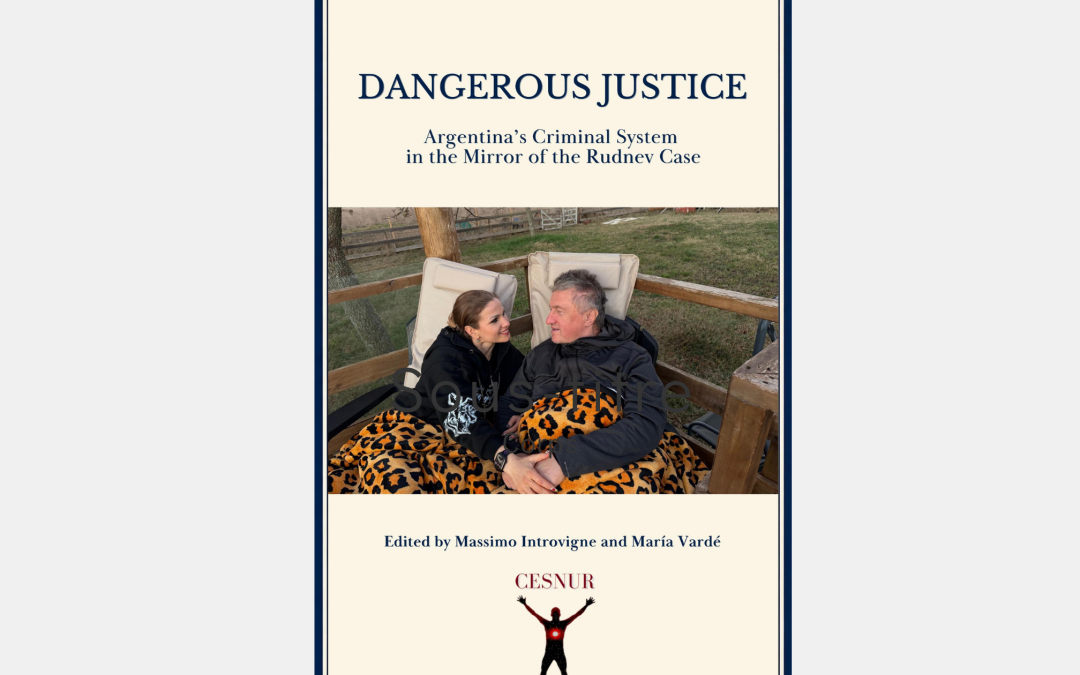
“Dangerous Justice,” edited by Massimo Introvigne and María Vardé, documents how pre-trial detention and anti-cult prejudice met in Patagonia.
by Thierry Valle
For CAP-LC, the Coordination des associations et des particuliers pour la liberté de conscience, the name of Konstantin Rudnev has become familiar. Our organization holds special consultative status with the United Nations Economic and Social Council (ECOSOC), and we have repeatedly raised the case of this Russian dissident and spiritual teacher, detained in Argentina since March 2025, before the UN Human Rights Council in Geneva. Most recently, we brought it to the attention of the Organization for Security and Co-operation in Europe (OSCE), since the campaign against Rudnev started in Russia and follows him across borders, a pattern of transnational repression the OSCE has good reasons to monitor. In these international forums, we have described a prosecution built on prejudice, an alleged victim who denies being one, and a seriously ill defendant kept in custody for reasons that do not withstand scrutiny.
Advocacy has its limits, however. Diplomats and UN experts rightly ask for documentation, and a written statement of a few pages cannot contain everything. This is why I welcome the publication of “Dangerous Justice: Argentina’s Criminal System in the Mirror of the Rudnev Case,” edited by Massimo Introvigne and María Vardé and published by CESNUR in Turin, with an introduction by the American sociologist of religion and law James T. Richardson. The book can be downloaded free of charge. Its twelve contributors include scholars, lawyers, an Argentine prosecutor, an Argentine public defender, a journalist, a former diplomat, and the woman whom the prosecution persists in calling a victim. Together, they provide the dossier that international bodies need.
Reading it from the perspective of an NGO working at the UN, I was first drawn to the chapters that measure the Argentine proceedings against international law. Patricia Duval, a Paris attorney who has defended religious minorities before international bodies for many years, recalls two sets of UN standards. The Tokyo Rules of 1990 state that pre-trial detention must be a means of last resort and must be administered humanely. The Nelson Mandela Rules of 2015 require that untried prisoners be treated according to the presumption of innocence and kept separate from convicted criminals. Argentina played an active role in drafting the Mandela Rules and hosted expert meetings that prepared them. According to Duval, Rudnev was nevertheless held in solitary confinement in a punishment cell, given medication without explanation, denied an interpreter despite a court order, and placed with convicted prisoners who smoked heavily, although he suffers from pulmonary fibrosis. A country that helped write the rules apparently forgot to apply them.
Duval also examines the legal device that allowed the detention to be prolonged. Argentina’s Code of Criminal Procedure permits longer time limits in complex cases involving organized or transnational crime. In Rudnev’s case, no transnational organization was identified, and no investigation was conducted in any other country. The label “transnational” served, in her reading, mostly to keep a defendant in jail while prosecutors pressed him to accept an abbreviated trial, which requires a confession. Rudnev has always refused.
Alessandro Amicarelli, a London-based human rights lawyer, takes the analysis to the European Court of Human Rights. From classic judgments such as “Letellier v. France,” “Clooth v. Belgium,” and “Ilijkov v. Bulgaria,” he extracts three tests that any detention before trial should pass: its length must be reasonable, the investigation must proceed with diligence, and effective remedies must be available. Argentina is not bound by Strasbourg case law, of course, yet these decisions are widely regarded as authoritative interpretations of principles that Argentina accepted by ratifying the International Covenant on Civil and Political Rights. Applied to Rudnev, and to another case in which police officers spent six years in pre-trial detention, the three tests all give a negative answer. Amicarelli also quotes official data: at the end of 2024, more than 45,000 people in Argentina were deprived of liberty without a final sentence.
Michele Olzi, a political scientist at the University of Insubria, addresses an issue that we at CAP-LC regard as central to freedom of conscience. Article 17 of the Covenant protects individuals against arbitrary interference with their private life, and the UN Human Rights Committee has explained that an interference may be arbitrary even if a law authorizes it. Elena Makarova, the young Russian mother identified as Rudnev’s victim, has consistently stated that she never met him and was never trafficked. Argentine prosecutors answered that her denial proves she is under “coercive control.” Olzi argues that imposing the status of victim on an adult who rejects it, and then treating her rejection as evidence of the crime, is exactly the kind of arbitrary interference Article 17 prohibits.
Other chapters explain how Argentina arrived at this point. Marisa Tarantino, an assistant prosecutor in Buenos Aires, shows how the 2012 reform of the anti-trafficking law declared the consent of the alleged victim irrelevant and stretched the notion of “vulnerability” until it could cover almost anybody. Cecilia Varela and María Vardé document how Argentine agencies in charge of trafficking adopted the language of the anti-cult movement, rebranding “cults” as “coercive organizations” and “brainwashing” as “coercive persuasion,” and inserted these notions into prevention plans and training courses. Organizations like ours have seen this vocabulary at work in France and elsewhere in Europe, and its arrival in Latin American criminal law should concern everybody who defends freedom of religion or belief. Ezequiel Kostenwein, a sociologist at the National University of La Plata, adds an inside view of the courts based on interviews with judges and prosecutors, who admit that releasing a defendant can damage a career if the press turns against them.
The book also gives space to the human dimension. Makarova’s own testimony, first published in “Bitter Winter,” describes threats to take away her newborn son and weeks without a lawyer of her choice, and ends with her request to be left in peace. Rosita Šorytė, a former Lithuanian diplomat, analyzes the videos of a Russian blogger who presents himself as a champion of science and whose material has reached Argentine audiences, a useful case study in how Russian narratives travel abroad. Alejandro Agostinelli, an Argentine journalist, examines the role of the media with remarkable honesty about his own past. Introvigne’s opening chapter sums up the case in ten falsehoods, from the “cult leader” label to the drug charges that collapsed when the seized substances were analyzed.
I particularly appreciated the editors’ decision to include the chapter by Liliana Eva Cucurullo, a public defender who reviewed part of the court record and found objective grounds for an investigation. Her conclusions are more cautious than ours, yet she too insists that the threshold of proof must rise as proceedings advance and that a hypothesis in which every contrary statement becomes evidence of guilt can never be refuted. Her presence makes the book more credible to the officials we address, who are rightly wary of one-sided accounts.
CAP-LC will continue to raise the Rudnev case at the UN and the OSCE. “Dangerous Justice” makes this work easier, because it replaces slogans with documents and analysis. I recommend it to diplomats, human rights officers, members of the Argentine judiciary, and anyone who wonders how a democracy can drift so far from the standards it helped to write. Argentina has the legal tools to correct this course. The book shows, in detail, why it should use them without delay.
Related posts:
 Deterioration of the Situation of Konstantin Rudnev in Argentina and the Risks of Transnational Repression
 HRC 61 Written Statement : The Inhumane Detention of Konstantin Rudnev in Argentina
 OSCE 2026 : Transnational repression reaches the OSCE floor
 HRC 63 Written Statement: The Protection of Procedural Guarantees in the Case of Konstantin Rudnev in Argentina