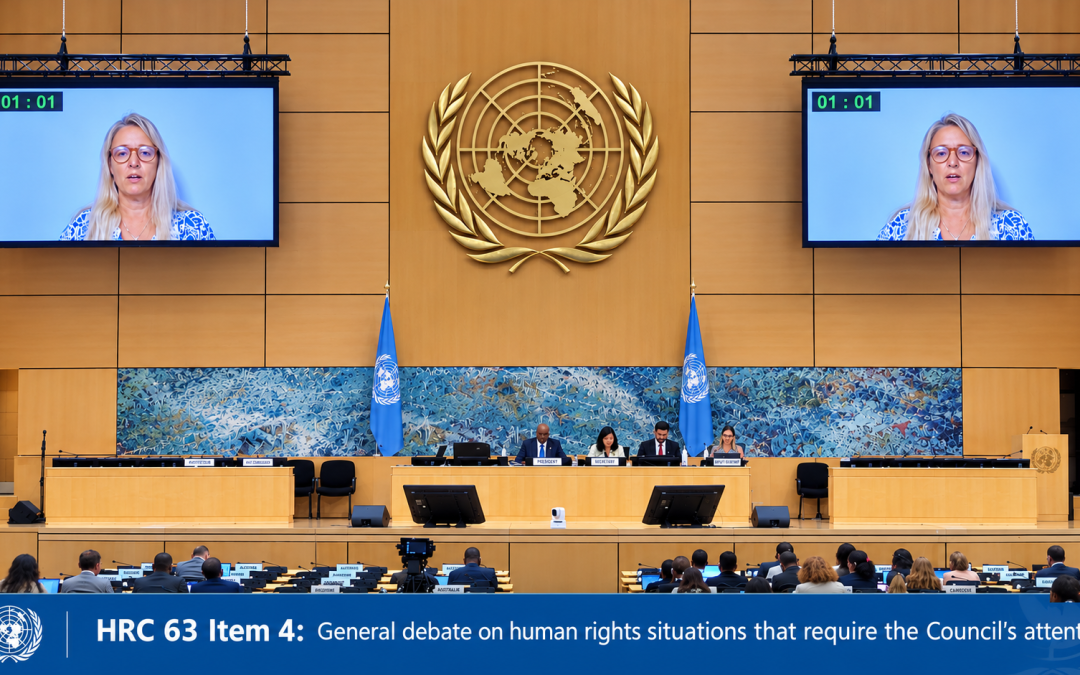
Geneva, Palais des Nations. During the general debate under Item 4 of the 63rd session of the Human Rights Council, the following statement on the situation in Sudan was delivered. It followed the report of the Independent International Fact-Finding Mission for the Sudan (A/HRC/63/23), which documents how external support, weapons and fighters keep a conflict alive in which drone strikes have become a leading cause of civilian death.
Mr. President,We thank the Fact-Finding Mission for its rigorous report. Its central finding is stark: external support is fuelling both parties, enabling drone strikes on hospitals, schools, markets and displacement sites — attacks that may amount to war crimes.The Mission documented a transnational network sustaining the Rapid Support Forces in El-Fasher and Zamzam, where war crimes, crimes against humanity and conduct displaying hallmarks of genocide were committed.On the Sudanese Armed Forces (SAF) the Mission’s findings on external support remain preliminary — yet it has already verified Turkish-designed Akinci drones and Yiha-III loitering munitions in strikes on civilian objects, including Yabus market. Credible reporting also points to financial and logistical facilitation involving Saudi Arabia and Egypt. We encourage Turkiye, Saudi Arabia and Egypt to cooperate fully with the Mission.We also note, without prejudging, the unresolved allegations of chemical-weapons use in 2024, which the SAF deny, and we would welcome unhindered access for the Technical Secretariat of the OPCW.Accountability must reach all those who commit, order, finance, supply or facilitate international crimes, on all sides and without selectivity. We therefore ask the Mission: what concrete steps should States take now to trace, halt and sanction these networks?Thank you.
The statement echoes, point by point, the findings examined by the Council under Item 2. The Mission’s advance unedited report, issued on 1 September 2026, found reasonable grounds to believe that a transnational network moved artillery, drones, electronic warfare equipment, logistics and personnel to the Rapid Support Forces through the United Arab Emirates, Chad, southeastern Libya and Puntland. On the Sudanese Armed Forces, the Mission verified imagery of Turkish designed Akinci drones and Yiha III munitions, systems not manufactured in Sudan, in strikes such as Yabus market. It reminded the Council of its earlier documentation of conduct displaying hallmarks of genocide in El Fasher.
The call on Turkiye, Saudi Arabia and Egypt to cooperate mirrors a concern already raised at the Palais des Nations. On 10 September 2026, CAP Freedom of Conscience and Human Rights Without Frontiers convened a panel at the Geneva Press Club on besieged civilians, from chemical attacks to the denial of safe passage. The panel urged the Council to scrutinise arms transfer disclosure and embargo compliance by all external actors that sustain the war while remaining under the radar, naming Saudi Arabia, Egypt and Turkiye, and to guarantee safe passage for the populations besieged in El Obeid and El Fasher.
The appeal for unhindered access for the Technical Secretariat of the OPCW also originates from that event. Panellists recalled that journalists have documented weaponised chlorine used by the Sudanese Armed Forces, that the United States has made a formal determination, and that there is still no independent investigation with OPCW participation. That gap, they said, is the scandal.
Related posts:
 EU Parliament and Council Take Firm Stand on Sudan Crisis as Accountability Efforts Widen
 Sudan’s War by Remote Control: HRC 63 Confronts the Networks That Fuel the Conflict
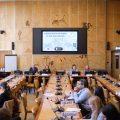 UN HRC 61 1000 days of conflict. 1000 days of civilians suffering the first-hand consequences of the fighting
 HRC 63 : Sudan: CAP LC Written Statement to the UN Human Rights Council Denounces Chemical Weapons, Human Shields, and External Support