What is “Coordination des Associations et des Particuliers pour la Liberté de Conscience” (CAP Freedom of Conscience)?
CAP Freedom of Conscience is a secular European NGO with United Nations Consultative Status, created in 1995 and dedicated to protect the Right of Freedom of Religion and Belief.
CAP Freedom of Conscience combats all forms of discrimination based on religion or belief by alerting European and International bodies.
CAP Freedom of Conscience collects testimonies of discrimination and human rights violations affecting religious or belief communities in order to disseminate them to international bodies, and in order to raise awareness and inform them as well as to generate debate on the protection of Freedom of Religion and Belief.
CAP Freedom of Conscience also advocates for any religious or spiritual group facing discrimination to have their right to Freedom of Religion and Belief recognized.
CAP Freedom of Conscience is a member of the European Federation for Freedom of Belief (FOB), European Network Of Religion and Belief (ENORB) and participate to the Civil Society Platform of Fundamental Rights created by the EU Fundamental Rights Agency DAFOH Partners in Combating and Preventing Forced Organ Harvesting
The 2024 Warsaw Conference is focused on advocating for the rights of Ahmadi Muslim asylum seekers.
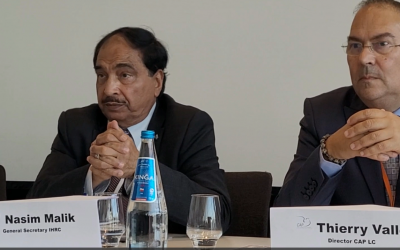
On the 8th of October 2024, at the Warsaw Human Dimension Conference hosted by CAP Liberté de Conscience a side-event was held to discuss the challenges faced by Ahmadi refugees in Europe. The discussion was led by two speakers – Willy Fautré from Human Rights Without Frontiers and Nasim Malik, from Sweden who also General Secretary of the International Human Rights Committee (IHRC).

Religious Freedom and Populism: The Appropriation of a Human Right and How to Counter It
The rise of populism presents a significant challenge to the universal principles of human rights. In the anthology Religious Freedom and Populism: The Appropriation of a Human Right and How to Counter It, editors Bernd Hirschberger and Katja Voges compile a series of scholarly contributions that examine how right-wing populists and extremists worldwide appropriate and distort the human right to freedom of religion or belief (FoRB). This critical volume not only dissects the rhetorical strategies employed in this appropriation but also delves into the societal dynamics that facilitate such distortions. It offers valuable insights and proposes strategies to strengthen human rights and foster a constructive culture of debate in democratic societies.

OSCE-PAKISTAN: Why shouldn’t the Ahmadi Muslim asylum-seekers be deported from Europe to Pakistan?
HRWF (09.10.2024) – The Ahmadiyya Muslim Community in Pakistan is enduring an alarming rise in violence and systemic persecution in 2024, with a disturbing trend of targeted murders, desecration of mosques and graves, and the continued denial of basic civil rights.

WARSAW HUMAN DIMENSION CONFERENCE side event : Why shouldn’t the Ahmadi Muslim asylum-seekers be deported from Europe to Pakistan?
The Ahmadiyya Muslim Community has long faced systemic persecution and violence, particularly in Pakistan. Despite Pakistan being a signatory to international human rights instruments, the state has codified religious discrimination against Ahmadis into its constitution and legal frameworks, most notably through the Second Amendment of 1974, which declared Ahmadis as non-Muslims, and Ordinance XX of 1984, which criminalised their religious practices. As a result, Ahmadis in Pakistan live under constant threat of violence, imprisonment, and societal exclusion. The United Nations (UN), through its eligibility guidelines and various human rights bodies, has repeatedly affirmed that Ahmadis fleeing persecution in Pakistan qualify as refugees under international law.

2024 WARSAW HUMAN DIMENSION CONFERENCE Session Germany Amhadiyya
We are deeply concerned about Germany’s refusal to grant asylum to Ahmadiyya Muslims and their forced return to Pakistan, where they face persecution and denial of rights. The Ahmadiyya Muslim Community in Pakistan is enduring an alarming rise in violence and systemic persecution, with a disturbing trend of targeted murders, desecration of mosques and graves, and the continued denial of basic civil rights. By sending back the Ahmadis to Pakistan, Germany contravene its obligation under:

2024 WARSAW HUMAN DIMENSION CONFERENCE Session 7 Freedom of religion or belief
We are very concerned about the systematic discrimination and exclusion of law-abiding citizens who follow the teachings of the Scientology religion in Germany.
In fact, there have been at least three thousand ninety-five cases in the last ten years in which German government agencies have included “faith-breaking” clauses in their invitations to bid, requiring bidders to renounce any association with Scientology.
CAP Freedom of Conscience involvement UNITED NATIONS
LASTEST NEWS
Adhésion CAP LC 2024
CAP Freedom of Conscience involvement in Europe
SUPPORT CAP Liberté de Conscience
IBAN BE61 9670 0987 0017
SWIFT / BIC TRWIBEB1XXX
Address
TransferWise Europe SA
Square de Meeûs 38 bte 40
Brussels
1000
Belgium

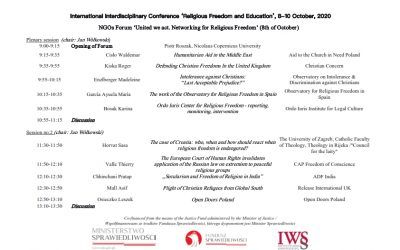
International Interdisciplinary Conference ‘Religious Freedom and Education’, 8-10 October, 2020
THE EUROPEAN COURT OF HUMAN RIGHTS INVALIDATES APPLICATION OF THE RUSSIAN LAW ON EXTREMISM TO PEACEFUL RELIGIOUS GROUPS
In a landmark decision, Ibragim Ibragimov and others v. Russia (28 August 2018), the European Court of Human Rights has invalidated the Russian Extremism Law as far as the Law’s definition of extremism allows the ban of religious publications even in the absence of any violence or hate speech.
The decision is extremely significant as the Human Rights Court found that any application of the Extremism Law must be based on actual incitement to hatred or violence in order to justify any restriction of freedom of expression of religious beliefs.
It is also significant that the Human Rights Court rejected the national courts’ reliance and wholesale adoption of the findings of one-sided experts’ reports to rule religious publications extremist, without any meaningful and independent analysis by the courts of materials characterized as extremist by experts retained by the government. The Human Rights Court also emphasized that the civil or criminal parties must be given an opportunity to adduce counter-evidence to counter extremist charges. The total process relied on by the courts in Russia in extremist cases has constituted a breach of the equality of arms principle, a practice of Russian courts which has become systematic in the recent years.
COVID-19 and Religious Freedom: Scapegoating Shincheonji in South Korea
A webinar organized by the Center for Studies on New Religions (CESNUR) and Human Rights Without Frontiers (HRWF) Date/Time: Monday, July 20, 2020, 17:00 (UTC +2, Brussels time) The fact that one member of Shincheonji, a Christian new religious movement in South...

Media Briefing The Coronavirus and the Shincheonji Church: True facts and fake news
Tuesday, 17 March 2020, 14h Press Club Brussels Europe Rue Froissart 95, 1000 Brussels In 2019, while no one knew the Shincheonji Church outside of South Korea, Massimo Introvigne, Willy Fautré and Rosita Soryté were studying the Shincheonji Church in Seoul, meeting...

Droits des Femmes et Objectifs de développement durable
Nations Unies 05 Mar 2020 Room VII 16:00-17:00 Droits des femmes et ODD
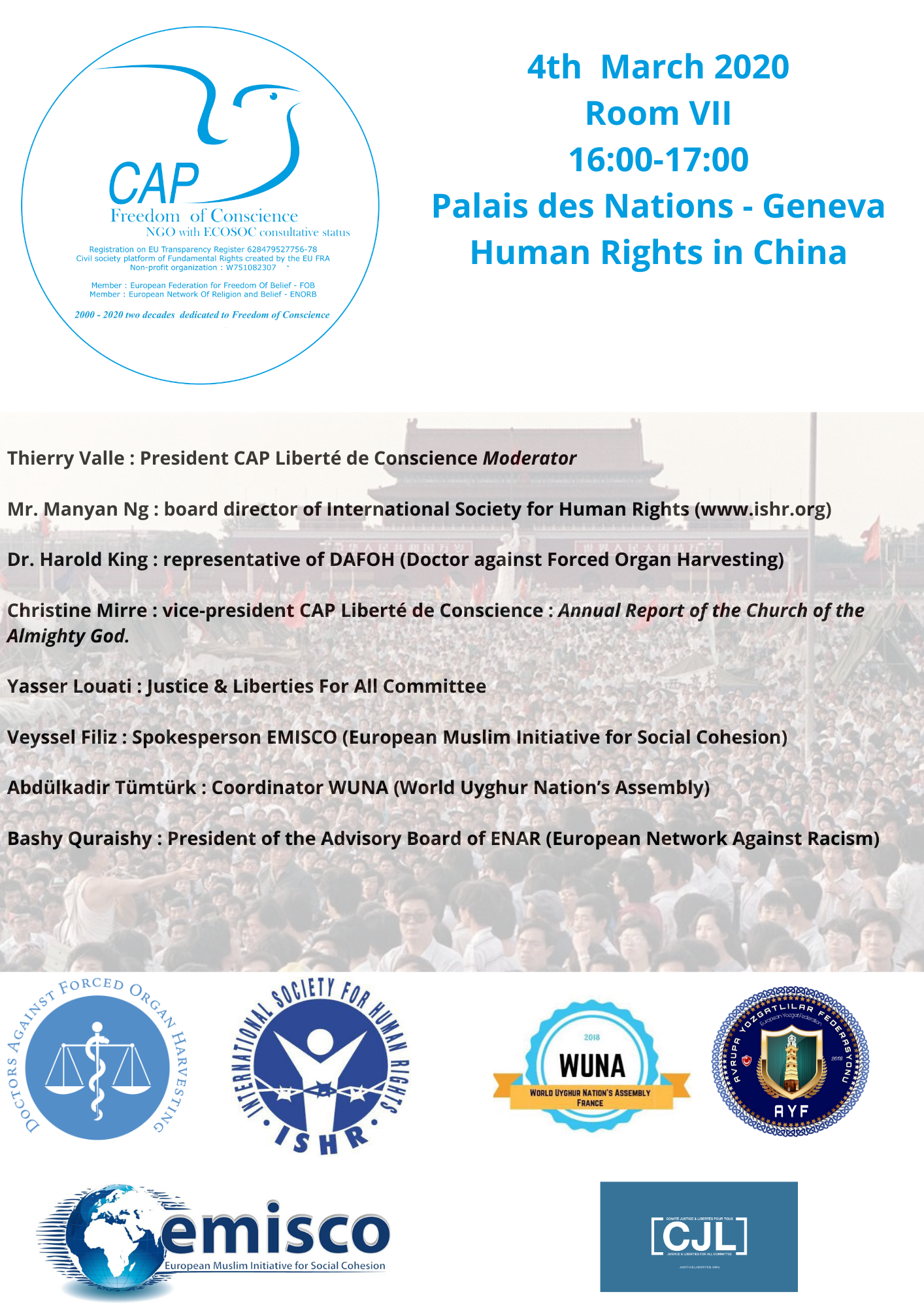
Human Rights Council 43rd : Human Rights in China
04th March 2020 Room VII 16:00-17:00 Palais des Nations - Geneva Human Rights in China

Human Rights in Thailand and Malaysia : The case of the Ahmadis refugees in Thailand and Malaysia
06th March 2020 Room VIIPalais des Nations - Geneva 15:30-16:30 Human Rights in Thailand and Malaysia :The case of the Ahmadis refugees in Thailand and Malaysia M. Ahmed Shaheed The United Nations Special Rapporteur on Freedom of Religion or Belief and Senior Lecture...