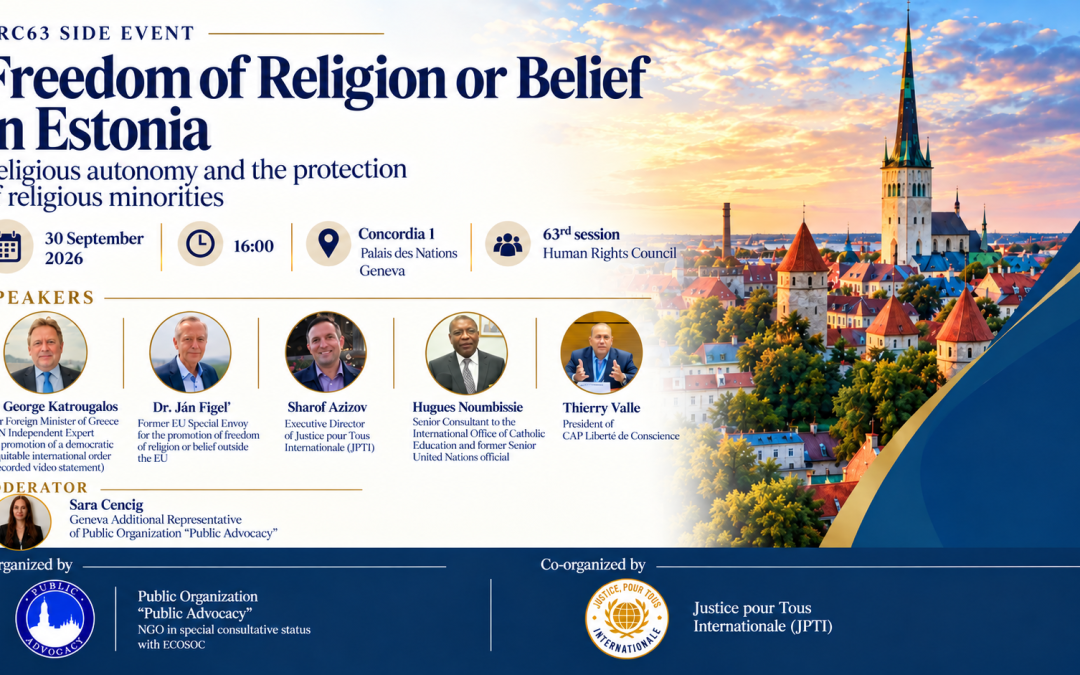
Geneva, 30 September 2026 — On the occasion of the 63rd session of the Human Rights Council, CAP Freedom of Conscience will take part, on 30 September at 16:00 in Concordia 1, Palais des Nations, in a side event dedicated to freedom of religion or belief in Estonia, with a focus on religious autonomy and the protection of religious minorities.
The event, organized by Public Organization “Public Advocacy”, an NGO holding special consultative status with ECOSOC, and co organized by Justice pour Tous Internationale (JPTi), will examine the impact of the amendments to Estonia’s Churches and Congregations Act on freedom of religion or belief, religious autonomy and minority rights. Particular attention will be paid to the Estonian Christian Orthodox Church (ECOC), the Pühtitsa Convent and Metropolitan Evgenii. The event will also identify concrete practical follow up, following the adoption of the outcome of Estonia’s Universal Periodic Review (UPR), scheduled for 24 September 2026.
A dense legal and institutional context
The Act on Amendments (570UA) was first adopted on 9 April 2025. The President of the Republic of Estonia refused to promulgate it twice, on 24 April and 3 July 2025, on grounds of proportionality and legal certainty. Parliament adopted an amended text on 18 June 2025, and then the same text again on 17 September 2025. The President then referred the Act to the Supreme Court.
On 8 June 2026, the Supreme Court, sitting en banc with seventeen justices, dismissed the President’s application by eleven votes to six (Case No. 5-25-49). The majority held that the threat invoked must be real rather than abstract, that confessional and doctrinal affiliation is excluded from the prohibition, and that compulsory dissolution is a remedy of last resort. Six justices, including the President of the Court, dissented on legal certainty. This review was abstract: it does not decide whether the Act may lawfully be applied to the ECOC, the Pühtitsa Convent or Metropolitan Evgenii.
The amended Act entered into force on 27 June 2026. Section 3(21) prohibits any connection, statutory or economic, with a foreign spiritual centre, governing body, religious association or spiritual leader that poses a threat to national security, constitutional order or public order. Section 3(22) provides that such a threat may arise where the foreign body “supports or has supported military aggression”, without an express temporal limit. A Ministry of the Interior circular of 3 July 2026 set two tracks for compliance: associations have until 28 December 2026 to bring their statutes, board composition and activities into conformity, after which the Ministry may hear the association and apply to a court for dissolution. The clergy eligibility restrictions, for their part, applied immediately.
An international debate that remains open
The event is grounded in the applicable international standards: Articles 18, 26 and 27 of the International Covenant on Civil and Political Rights, and Article 9 of the European Convention on Human Rights. The selection of religious leaders is a protected element of freedom of religion, and canonical confirmation is not, in itself, an administrative connection. In this regard, the concept note recalls the statement of the human rights ambassadors of Estonia, France, Germany, Iceland, Lithuania, the Netherlands and the United Kingdom of 6 July 2025, which affirmed the right of the Tibetan Buddhist community to identify a successor to the Dalai Lama without State interference.
Estonia’s UPR (fourth cycle) took place on 5 May 2026; the Working Group adopted its report on 15 May 2026 (A/HRC/63/7). The published exchange with the Special Procedures (AL EST 2/2025 of 6 August 2025, with the Government reply of 3 October 2025) completes this framework.
Speakers
The discussion will be moderated by Sara Cencig, Geneva Additional Representative of Public Organization “Public Advocacy”. Speakers include:
-
Professor George Katrougalos, former Minister of Foreign Affairs of Greece and former UN Independent Expert on the promotion of a democratic and equitable international order, by prerecorded video statement;
-
Dr Ján Figel’, former EU Special Envoy for the promotion of freedom of religion or belief outside the EU, by prerecorded video statement, with confirmation of his attendance in person still pending;
-
Thierry Valle, President of CAP Freedom of Conscience;
-
Sharof Azizov, Executive Director of Justice pour Tous Internationale;
-
Hugues Noumbissie, Senior Consultant to the International Office of Catholic Education and former Senior United Nations official (to be confirmed).
Practical information
Date: 30 September 2026, 16:00 Venue: Concordia 1, Palais des Nations, Geneva Working language: English, in person and recorded Organizer: Public Organization “Public Advocacy” (special consultative status with ECOSOC) Co organizer: Justice pour Tous Internationale (JPTi)
Related posts:
 Pakistan: A Two Week Escalation Against the Ahmadiyya Muslim Community
 Eighty Incidents in Eighteen Months: IHRC Launches Its Report on the Persecution of Ahmadis in Pakistan at Jalsa Salana UK
 UN Human Rights Council Adopts Twin Resolutions on Freedom of Religion or Belief and Minority Rights at 61st Session
 Serbia Condemned by the European Court of Human Rights for Banning Falun Gong Protests During Xi Jinping’s Visit