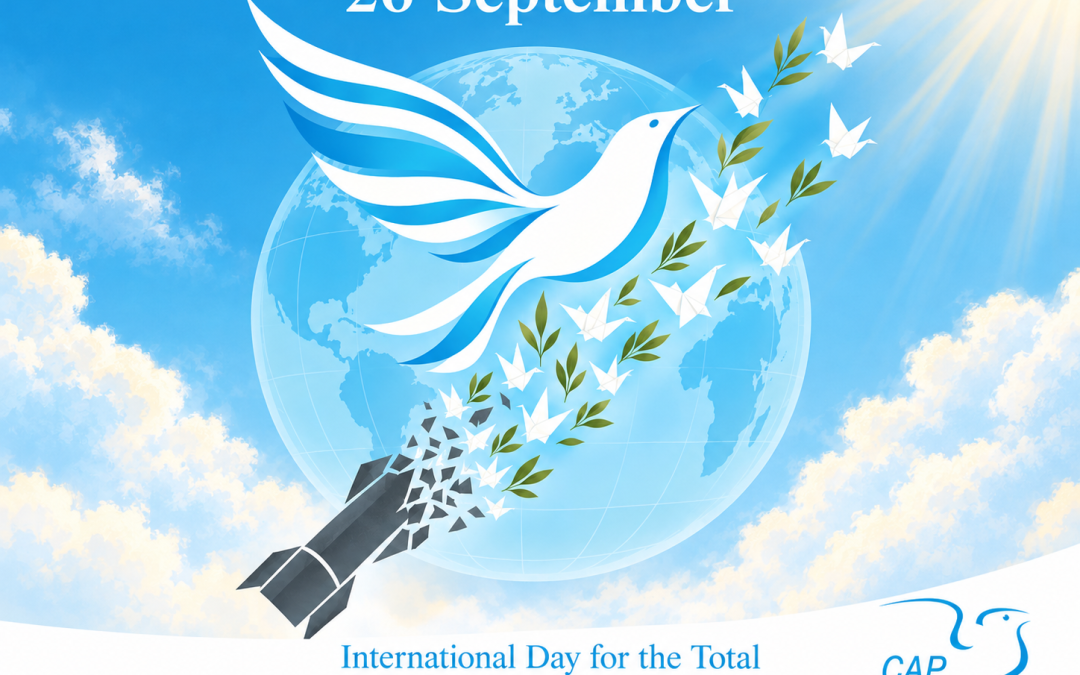
The United Nations General Assembly declared 26 September the International Day for the Total Elimination of Nuclear Weapons in December 2013, through resolution 68/32, as a follow up to the first ever high level meeting of the General Assembly devoted to nuclear disarmament, held in New York on 26 September 2013. The Day has been observed every year since 2014. Its purpose is to enhance public awareness and education about the threat posed to humanity by nuclear weapons and the necessity for their total elimination.
The need for such awareness is stark. According to the United Nations, an estimated 12,187 nuclear weapons remain in the world today. Not one nuclear weapon has ever been physically destroyed pursuant to a treaty, and no nuclear disarmament negotiations are currently underway. The doctrine of nuclear deterrence persists in the security policies of all possessor States and many of their allies. The international arms control framework is under severe strain: the Intermediate Range Nuclear Forces Treaty ended in 2019, and the Treaty on Measures for the Further Reduction and Limitation of Strategic Offensive Arms (New START) expired on 5 February 2026 without a successor arrangement. For the first time since the 1970s, no agreed limits constrain the strategic nuclear arsenals of the two largest nuclear powers.
The date itself carries a sobering memory. On 26 September 1983, a Soviet early warning facility detected what appeared to be an incoming ballistic missile attack from the United States. It was a false alarm. Colonel Stanislav Petrov, the duty officer, broke protocol by refusing to confirm the attack to senior command, thereby preventing a possible retaliatory nuclear strike. Humanity survived that day thanks to the courage and composure of a single individual. The future of civilization cannot rest on such fortunate coincidences. States must move to sanity for our safety.
Civil society has responded with an unprecedented mobilization. In 2025, CAP Liberté de Conscience (CAP LC) joined hundreds of organizations and prominent individuals from around the world in signing the Joint Appeal for Nuclear Abolition Day, coordinated by the global civil society platform NuclearAbolitionDay.org. The Appeal calls on leaders at all levels of governance to affirm that the threat or use of nuclear weapons is inadmissible; to stand down nuclear forces and adopt policies never to initiate a nuclear war; to cut the roughly 100 billion US dollars spent annually on nuclear arsenals and end investments in the nuclear weapons industry; and to commit to the global elimination of nuclear weapons no later than 2045, the centenary of the United Nations, redirecting those funds to peacekeeping, climate protection and pressing human needs.
By September 2026, the Appeal had been endorsed by more than 2,000 organizations and eminent individuals from 105 countries. It was presented to the nations of the world at the United Nations General Assembly high level meeting on 29 September 2026, which addressed a simple and urgent question: how can we end the threat of nuclear war and achieve the global abolition of nuclear weapons?
On 26 September 2026, NuclearAbolitionDay.org organized a worldwide webinar, Towards a World Free of Nuclear Weapons, open to all time zones. The event opened with a message from Izumi Nakamitsu, UN Under Secretary General and High Representative for Disarmament Affairs, and brought together Nobel Laureates, current and former political officials, parliamentarians, academics, scientists, medical professionals, faith leaders, and youth representatives. Ela Gandhi, granddaughter of Mahatma Gandhi and Co President of Religions for Peace, reminded the audience that nuclear weapons are a hazard for all of humanity and must be dismantled altogether from our planet, our home. Gareth Evans, former Foreign Minister of Australia, warned that the risk of nuclear war is as great now as it has been since the height of the Cold War. Bill Kidd, Co President of Parliamentarians for Nuclear Nonproliferation and Disarmament, called for diplomacy, cooperative leadership, common security and the rule of law. The program also premiered global screenings of An Ordinary Insanity, the Oscar nominated short film featuring renowned whistleblower Daniel Ellsberg.
Source :
https://www.un.org/en/observances/nuclear-weapons-elimination-day
https://www.nuclearabolitionday.org/joint-letter
https://www.nuclearabolitionday.org/post/un-day-for-the-elimination-of-nuclear-weapons-september-26
Related posts:
 YURII SHELIAZHENKO*, conscientious objector to military service and human rights defender, under immediate threat
 EU Parliament and Council Take Firm Stand on Sudan Crisis as Accountability Efforts Widen
 Pakistan: A Two Week Escalation Against the Ahmadiyya Muslim Community
 Sudan’s War by Remote Control: HRC 63 Confronts the Networks That Fuel the Conflict