Source : HRWF : https://hrwf.eu/sudans-besieged-civilians-from-chemical-attacks-to-denial-of-safe-passage/
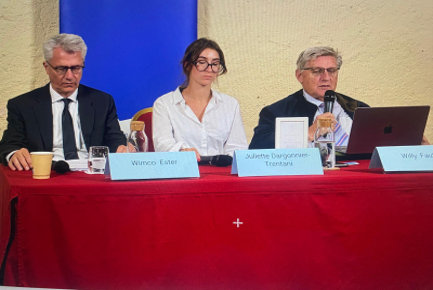
HRWF /GENEVA (10.09.2026) – On the occasion of the 63rd Session of the United Nations Human Rights Council in Geneva, Coordination des Associations et des Particuliers pour la Liberté de Conscience (CAP Freedom of Conscience) and Human Rights Without Frontiers hosted a panel discussion at the Geneva Press Club to put the spotlight on the ongoing humanitarian catastrophe taking place in Sudan
Thierry Valle, President of CAP Freedom of Conscience, opened the event: “The civilian suffering in Sudan is without parallel among today’s conflicts, and yet it is under-reported, under-funded and pushed aside. Let us be honest: there is no ceasefire, no credible political process, no meaningful accountability. That is why we convened this panel during UNHRC 63, to put the spotlight on Sudan and to put concrete recommendations in front of the Human Rights Council.”
Valle handed over to Matej Tonin MEP, who gave a keynote speech via video address, commenting: “As an MEP, I will continue to do my utmost, together with my colleagues, to make sure that every Sudanese receives the humanitarian assistance they need, regardless of their background, religion or beliefs, and that humanitarian access is restored and protected, ensuring rapid, safe, unimpeded, principled and sustained assistance to those in need. And, above all, that justice and accountability prevail, with full respect for international law and with no impunity for those responsible for atrocities against civilians.”
The panel went on to discuss the specifics of the conflict, including recent allegations of chemical weapons and drone use. Willy Fautré, founder of Human Rights Without Frontiers, told the audience: “Let us retire the phrase ‘forgotten war’. No one living in Sudan has forgotten it — not the families in El Fasher, not the women in El Obeid who cannot reach a water point safely. This war is not forgotten; it is being ignored, and that is a political choice on our side, not theirs. Civilians have suffered at the hands of both parties. Journalists have documented weaponised chlorine by the Sudanese Armed Forces, the United States has made a formal determination, and armed drones are now the leading cause of civilian death. There is still no independent investigation with the participation of the Organisation for the Prohibition of Chemical Weapons (OPCW). That gap is the scandal.“
The panel also focused on the deteriorating situation for minorities. Wimco Ester, Advocacy Officer at Open Doors, detailed what is happening to religious minorities. “Bombed churches and Christians displaced and killed is not just collateral damage because of the war. Do we want to see that often the attacks are systematic, that a further Islamisation of society in different ranks will leave hardly any or even no room for other beliefs and convictions?”
The panel welcomed Fr. Dr. Jorge C. Naranjo Alcaide, Comboni College of Science and Technology, live from Port Sudan. This was an exceptional opportunity to hear a voice from Sudan itself. A long and rich conversation with an observer of the war and its impact on daily life.
He gave a first-hand account of current daily life in Sudan and the situation for civilians, as well as the work of his school, which welcomes Christian and Muslim relations and promotes interfaith and intercultural understanding.
Human Rights Without Frontiers proposed the following recommendations to the Human Rights Council:
- Set up an independent international investigation mission, with OPCW participation, into the use of chemical weapons allegations — with a fixed reporting deadline.
- Scrutinise, in their debates and resolutions, arms transfer disclosure and arms‑embargo compliance by all external actors sustaining this war but having remained under the radars, such as Saudi Arabia, Egypt and Turkey.
- Urgently guarantee a safe passage to the populations besieged in El Obeid, alongside El Fasher, as a civilian protection emergency, and to immediately put an end to human shielding practices.
The full panel discussion is available to view on replay via the YouTube page of the Geneva Press Club. (*)
Related posts:
 HRC 63 : Sudan: CAP LC Written Statement to the UN Human Rights Council Denounces Chemical Weapons, Human Shields, and External Support
 EU Parliament and Council Take Firm Stand on Sudan Crisis as Accountability Efforts Widen
 Sudan: CAP LC and Human Rights Without Frontiers Submit Joint Stakeholder Report to the UN Universal Periodic Review
 UN UPR 54th Session: On Procedural Bias and the Selective Handling of Human Rights Violations in Sudan