Anti Muslim hatred in France, laicite, and the OSCE response
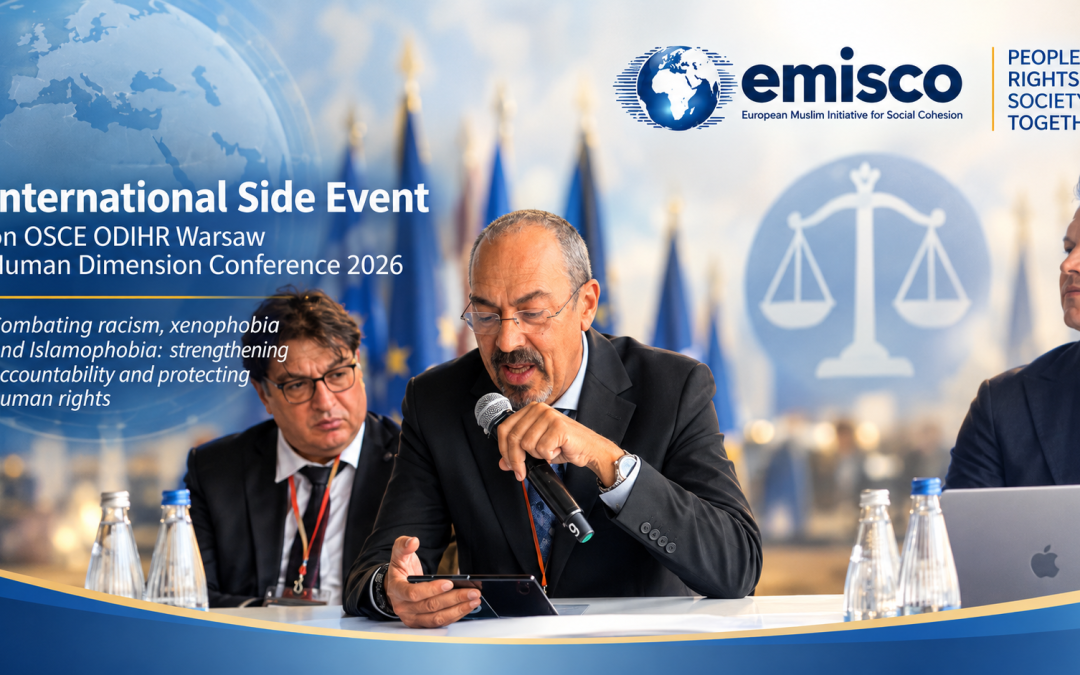
International Side Event, OSCE ODIHR Warsaw Human Dimension Conference 2026
Combating racism, xenophobia and Islamophobia: strengthening accountability and protecting human rights
Hotel Sofitel Victoria Warsaw, Room 2 Saski, 8 October 2026
By Thierry Valle, President of CAP Freedom of Conscience (CAP LC)
Mr Moderator, Excellencies, representatives of participating States, dear colleagues,
I would like to begin with three numbers. Six hundred and thirty nine. Forty seven. Three.
In the school year that followed the French law of 15 March 2004 on religious symbols in schools, the Ministry of Education recorded 639 pupils who had come to class wearing a visible religious sign. Within a year, 47 young girls had been formally excluded from public education. And three Sikh boys had been expelled for refusing to remove their turbans.
Twenty two years later, the Ministry of the Interior counted 326 anti Muslim acts in 2025, an increase of 88 per cent in one year, including two assassinations: Aboubakar Cisse, shot inside his mosque, and Hichem Miraoui, killed in the Var. Those three numbers opened a trajectory. Today I want to speak about where it has led, and how we can change its course.
A word about who we are
CAP Freedom of Conscience, CAP LC, is a French NGO founded in 1995, with consultative status at the United Nations ECOSOC. For thirty years we have defended freedom of religion or belief for people of every religion and for people of none. This defence is indivisible: an attack on the freedom of one community is an attack on the freedom of all.
When laicite is turned against the citizen
The French principle of laicite, anchored in the 1905 law on the separation of churches and State, is a duty of the State, not of the citizen: public authorities and civil servants must be neutral and show restraint in the exercise of their functions. Citizens remain free. The law of 2004 inverted this logic, imposing a duty of neutrality on schoolgirls who are not civil servants.
The perverse effects were predicted. Girls were pushed out of the education system, some into distance learning, some into early marriage, some abroad. And it was not only Muslim girls: Sikh children were forced to choose between education and faith, an expulsion upheld by France’s highest administrative court in 2007 and confirmed by the European Court of Human Rights in 2009.
The sequence continued. In 2010 France banned the covering of the face in all public spaces. The European Court upheld the law in 2014, but the United Nations Human Rights Committee found in Yaker and Hebbadj v. France in 2018 that it violated articles 18 and 26 of the International Covenant on Civil and Political Rights and amounted to intersectional discrimination against Muslim women. In 2023 the abaya was banned by administrative guidance, validated by the Conseil d’Etat in 2024. In February 2025 the Senate voted to extend prohibitions to sports competitions.
Each step was presented as the answer to a specific problem. Taken together, they have built a system in which the visible religious identity of a woman or a girl is treated first as a threat to be managed.
A normalization that the figures confirm
France reported 6,096 hate crimes of all categories to ODIHR for 2024, and ODIHR observes that France would benefit from strengthening the capacity of prosecutors and judges to sentence hate crimes. Behind the figures stands a deeper reality of underreporting: the Defender of Rights found in December 2025 that 34 per cent of people who are Muslim or perceived as such report discrimination on religious grounds, against 4 per cent of Christians.
This climate is fed by a political offering that plays on fear of the foreigner: the National Rally won 31.37 per cent of the vote in the 2024 European elections and led the first round of the legislative elections with one third of the vote. It is amplified by influential media: the regulator Arcom warned CNews in December 2025 for sequences inciting discrimination regarding immigration and Islam, and fined the channel 200,000 euros in July 2026. Fear of the other is no longer marginal speech. It is a structured communication and electoral strategy.
From a religious debate to a civic rights debate
Here lies our central proposal. This question must be moved out of the religious register and into the register of civic rights protected by article 18 of the Universal Declaration of Human Rights, articles 18 and 26 of the ICCPR, article 9 of the European Convention, and by the OSCE human dimension commitments that France herself has defended for fifty years.
The freedom to manifest religion or belief is a right of the person, not a concession of the State. Laicite, correctly understood, protects that right: the State is neutral, citizens are free, and the State must do everything in its power so that each person, believer or non believer, can live in full dignity, safety and equal participation.
Five lines of action, built on tools the OSCE has already given us.
First, measure. France already reports hate crime data to ODIHR under Ministerial Council Decision 9/09. The priority is to close the gap between recording and prosecution, and to make the findings public.
Second, protect. ODIHR’s Practical Guide on Understanding Anti Muslim Hate Crimes and Addressing the Security Needs of Muslim Communities gives governments concrete steps on security, investigation and victim support. France should implement it fully, in partnership with the associations that document anti Muslim acts, such as ADDAM.
Third, review. Legislation must be brought back into line with international obligations, starting with the findings of the Human Rights Committee, and with the OSCE Guidelines for Educators on Countering Intolerance and Discrimination against Muslims.
Fourth, regulate the public conversation consistently. Media freedom is not in question; incitement to discrimination is. The regulator’s powers must be applied with the same firmness against every form of hatred.
Fifth, educate. Counter narratives, religious literacy and the inclusion of the history of Muslim citizens in the teaching of the Republic are long term investments in social cohesion.
Conclusion
Our message is simple. The neutrality of the State is a duty of the State. The freedom of the citizen is a right of the citizen. When these two sentences are reversed, laws that promise cohesion produce exclusion, and exclusion produces the hatred we have gathered in Warsaw to combat.
I thank you.
Related posts:
 Eighty Incidents in Eighteen Months: IHRC Launches Its Report on the Persecution of Ahmadis in Pakistan at Jalsa Salana UK
 UN Human Rights Council Adopts Twin Resolutions on Freedom of Religion or Belief and Minority Rights at 61st Session
 The Quietest Violation: The Working Group on Arbitrary Detention at HRC 63
 UN Special Rapporteur Examines Freedom of Religion or Belief in Relation to Death and Burial Practices