by CAP Liberté de Conscience | Feb 7, 2024 | news, UN UPR
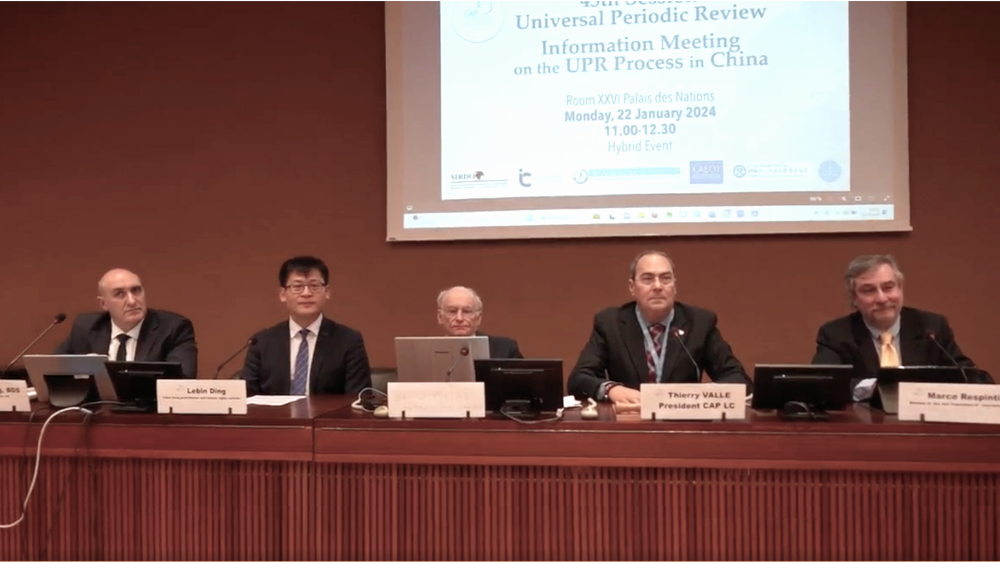
The Coordination of associations and individuals for Freedom of Conscience (CAP LC in French), a non-governmental organization with consultative status with the United Nations , together with Doctors Against Forced Organ Harvesting ( DAFOH ), held a meeting in On January 22, the day before the fourth round of the Universal Periodic Review ( UPR ) of China’s human rights by the United Nations Human Rights Council, a message titled “China’s Deprivation of Universal Human Rights ” was held at the United Nations Palais des Nations. Meeting.
by CAP Liberté de Conscience | Jan 20, 2024 | news, UN UPR
1. This joint submission addresses the state of freedom of religion or belief and freedom of opinion and expression in Nigeria. In particular, it presents an overview of the country’s domestic legal framework and draws attention to specific concerns related to the criminalization of blasphemy. Additionally, the report examines the rise in acts of terrorism and mob violence against Christians and religious minorities, including Muslim minorities, and the related climate of impunity over the reporting period.
by CAP Liberté de Conscience | Jan 19, 2024 | news, UN UPR
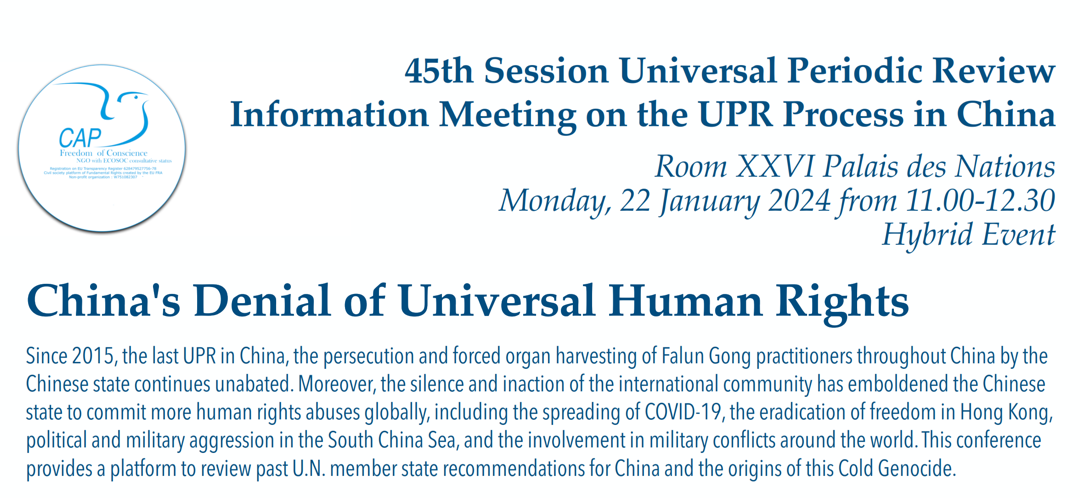
We are pleased to extend an invitation to you for a crucial conference addressing pressing human rights issues in China. The focus of this event revolves around the impending Universal Periodic Review (UPR) of China, with particular attention to the ongoing persecution and forced organ harvesting of Falun Gong practitioners.
by CAP Liberté de Conscience | Dec 1, 2023 | UN UPR
The Universal Periodic Review (UPR) is a unique mechanism of the Human Rights Council that requires each UN Member State to undergo a peer review of its human rights record every 4.5 years. The UPR provides an opportunity for each state to regularly
Report on the measures it has taken to improve the human rights situation in its country and to address challenges to the enjoyment of human rights; and
Receive recommendations for continuous improvement from UN Member States, based on input from various stakeholders and pre-session reports.
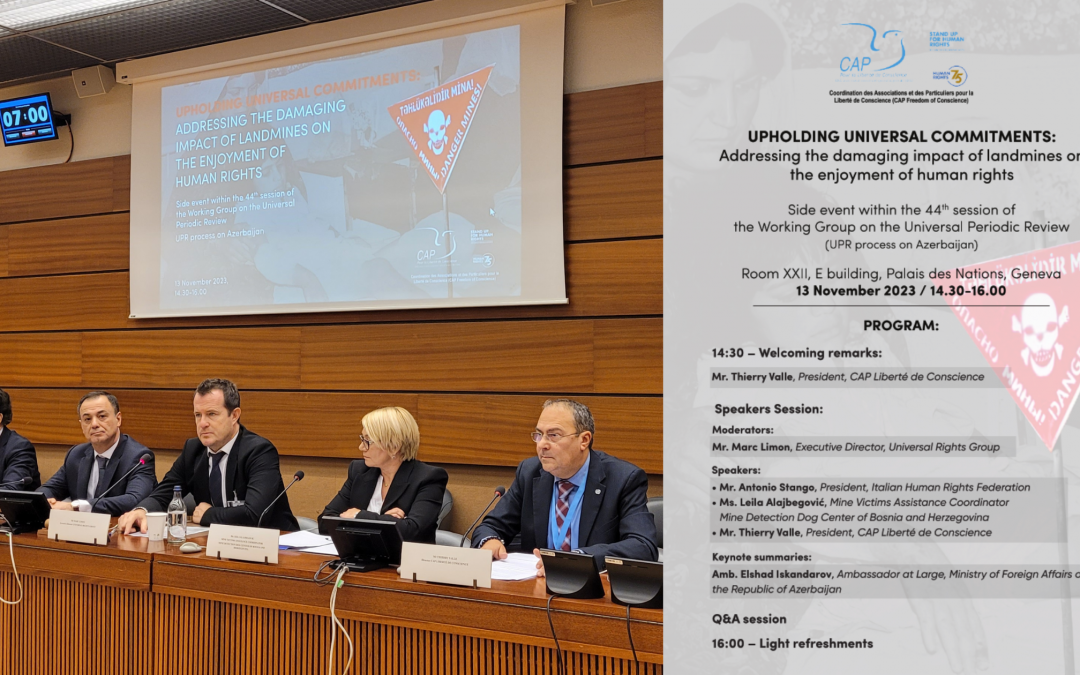
The aim of this side-event we are organising today is to highlight points 203 and 204 of Azerbaijan’s national report on landmines.
by CAP Liberté de Conscience | Nov 11, 2023 | UN UPR
With an estimated 26,000 people a year becoming landmine victims, this indiscriminate weaponry poses one of the most challenging threats to human life and dignity and thus affects inalienable fundamental human rights.
The UN human rights machinery has a key role in addressing the negative impact of landmines, explosive remnants of war and other improvised explosive devices on the enjoyment of human rights of mine victims in the context of humanitarian mine action. It can also be instrumental in bringing to the fore the utmost importance of providing international assistance in mine action including protection and restoration of inalienable human rights of mine victims.
The side event intends to discuss humanitarian mine actions in light of this very role of the UN human rights machinery. It also aims to raise awareness on the importance of full and effective protection of fundamental human rights when related to humanitarian mine action. Other objectives of the event include exploring effective ways to address the humanitarian, socio-economic and environmental impact of landmines, explosive remnants of war and other IEDs; highlighting the importance of international cooperation and assistance in mine action which aims at eliminating the threat posed by mine contamination to the security of States and safety of their populations, facilitating post-conflict rehabilitation, including the return of refugees and IDPs to their homes, and contributing to sustainable peace and development.
by CAP Liberté de Conscience | Nov 10, 2023 | CAP LC Event Coming, UN UPR
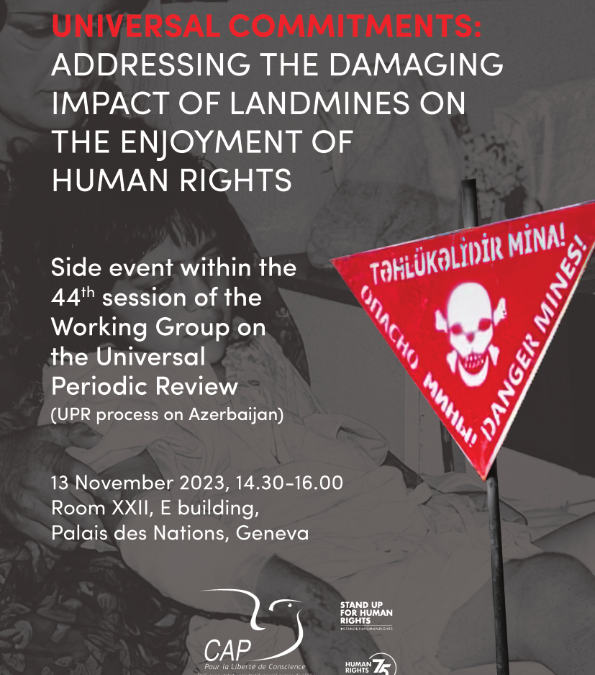
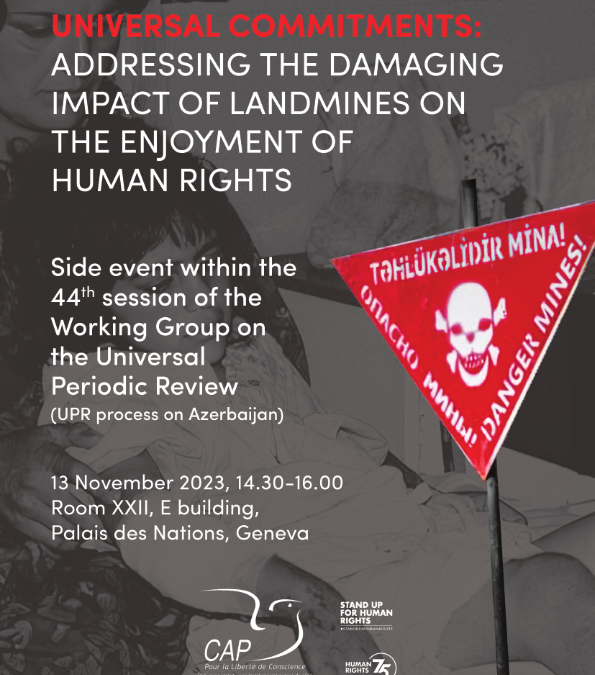
UPHOLDING UNIVERSAL COMMITMENTS:
Addressing the damaging impact of landmines on the enjoyment of human rights
Side event within the 44 session of the Working Group on the Universal Periodic Review
Room XXII, E building, Palais des Nations, Geneva 13 November 2023 / 14.30-16.00
by CAP Liberté de Conscience | Oct 2, 2023 | UN UPR
68. JS2, JS5,JS9 and JS20 expressed concerns about discrimination, persecution, and limited access to justice faced by marginalized communities.115
JS2 highlighted the discrimination and stigma experienced by Dalits, recommending immediate action through the enactment of an Anti-discrimination Act, representation, access to social services, and addressing discrimination in education and employment. JS5 focused on the persecution of Ahmadi Muslims and called for stronger legislative and institutional responses, protecting religious practices, ensuring access to justice, and addressing violence and discrimination. JS9 and JS16 were concerns about the limited justice access, violent attacks, and religious intolerance affecting various religious minorities.
by CAP Liberté de Conscience | Oct 2, 2023 | CAP LC Event Coming, news, UN UPR
Thousands of Ahmadi Muslims in Germany who have fled severe religious persecution in Pakistan are awaiting a decision on their asylum applications. They belong to a religiously and politically persecuted minority – the Ahmadiyya Muslim Community. It is recognized around the world by human rights groups that Ahmadi Muslims are constantly, ruthlessly persecuted.