What is “Coordination des Associations et des Particuliers pour la Liberté de Conscience” (CAP Freedom of Conscience)?
CAP Freedom of Conscience is a secular European NGO with United Nations Consultative Status, created in 1995 and dedicated to protect the Right of Freedom of Religion and Belief.
CAP Freedom of Conscience combats all forms of discrimination based on religion or belief by alerting European and International bodies.
CAP Freedom of Conscience collects testimonies of discrimination and human rights violations affecting religious or belief communities in order to disseminate them to international bodies, and in order to raise awareness and inform them as well as to generate debate on the protection of Freedom of Religion and Belief.
CAP Freedom of Conscience also advocates for any religious or spiritual group facing discrimination to have their right to Freedom of Religion and Belief recognized.
CAP Freedom of Conscience is a member of the European Federation for Freedom of Belief (FOB), European Network Of Religion and Belief (ENORB) and participate to the Civil Society Platform of Fundamental Rights created by the EU Fundamental Rights Agency DAFOH Partners in Combating and Preventing Forced Organ Harvesting
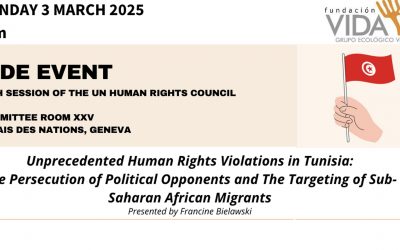
HRC 58 Side-event : Human Rights In Tunisia
On 18 February 2025, UN Human Rights Chief Volker Türk urged the Tunisian authorities to cease all forms of persecution against political opponents and to respect the rights to freedom of opinion and expression, while several UN experts have repeatedly raised concerns about the safety of sub-Saharan migrants.
The Situation of Bahá’ís in Egypt: The Case of Systematic Discrimination and the EU’s Response to the Human Rights Issue
European Parliament member Per Clausen in the Written Question (E-000676/2025) submitted the 13th February highlighted a diplomatic lever: Egypt’s macro-financial assistance from the European Commission is linked with human rights guarantees. The crux of the matter is this: What are the concrete measures that the EU is going to use in order to make Egypt undo the 1960 discriminatory decree?

HRC 58 Written Statement : Religious Freedom Under Scrutiny: Shincheonji’s Canceled Event Raises Concerns in South Korea
In a written statement presented to the Session of the United Nations Human Rights Council recently We highlighted an issue regarding religious freedom infringement linked to the Shincheonji Church, in South Korea.
A situation arose regarding a gathering scheduled for October 29th to 31st in the year 2024 at Imjingak Pyeonghwa Nuri Park, in Paju area in South Korea. Shincheonji is the group behind the event and has faced criticism for its beliefs in the past; however this time they obtained all the required permits and paperwork to use the venue legally. The event was expected to attract, about 100 000 attendees and involved a commitment of approximately $7 Million.
HRC 58 written statement : Tai Ji Men Case: A Persistent Challenge to Religious Freedom and Judicial Integrity
We urges global vigilance, arguing that taxes should never be weaponized to target innocent citizens or suppress religious and cultural practices. The Tai Ji Men case exemplifies how bureaucratic mécanismes can be manipulated to marginalize and harass spiritual communities that do not align with prevailing political narratives.
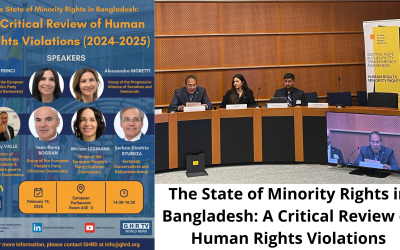
The State of Minority Rights in Bangladesh: A Critical Review of Human Rights Violations
CAP Liberté de Conscience is an international non-governmental organization dedicated to defending human rights, with a specialized focus on protecting religious minorities worldwide. While our expertise centers on religious freedom, we recognize that a comprehensive understanding requires insights from diverse expert perspectives.

Religious Persecution and Human Rights: UN Report Examines Torture and Religious Freedom
In the report “Freedom of Religion or Belief and the Prohibition of Torture”, the UN Special Rapporteur Nazila Ghanea looks at how religious persecution is linked with human rights violations. The study which was discussed at the 58th session of the Human Rights Council and later made news by European Times News, focuses on how religious prejudice can lead to institutional violation.
The focus of the report is on the connection between coercion and religious freedom. According to European Times News, Ghanea said, “Not all forms of coercion reach the threshold of torture or ill-treatment, but all forms of torture committed on persons on the basis of their religion or belief constitute coercion.”
CAP Freedom of Conscience involvement UNITED NATIONS
LASTEST NEWS
Adhésion CAP LC 2024
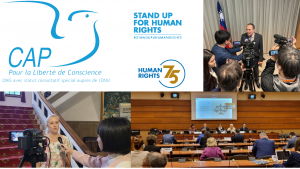
CAP Freedom of Conscience involvement in Europe
SUPPORT CAP Liberté de Conscience
IBAN BE61 9670 0987 0017
SWIFT / BIC TRWIBEB1XXX
Address
TransferWise Europe SA
Square de Meeûs 38 bte 40
Brussels
1000
Belgium


First Week of World Summit draws over 200,000 viewers
First Week of World Summit draws over 200,000 viewers
The World Summit on Combating and Preventing Forced Organ Harvesting
This World Summit is presented by five non-governmental organizations dedicated to the exposure and prevention of unethical organ harvesting with the goal to further promote medical ethics and basic human rights. The World Summit is a noble and solemn gathering of experts who are united by the wishto provide not only objective findings about one of the most egregious crimes in human history, but also by the understanding that the forced harvesting of organs from living people is a threat to the basic values and rights of humanity. The World Summit is also an appeal to humankind to return to a life of compassion and sympathy.
World Summit on Organ Harvesting Presented by Five NGOs
Forced organ harvesting is an unethical and illegal yet highly profitable practice where organs are removed from non-consenting, healthy people and sold to patients for fast-tracked transplantation operations. Although illegal organ trafficking has occurred in several regions, it is only in China that it is government sanctioned and under military control, involving disenfranchised, vulnerable populations.
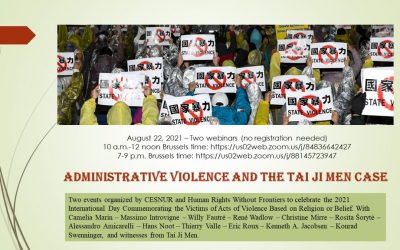
Administrative Violence and the Tai Ji Men Case Seminar 22 August 2021
Administrative Violence and the Tai Ji Men Case Seminar 22 August 2021
International Day Commemorating the Victims of Acts of Violence Based on Religion or Belief
Invitation World Summit on Combating and Preventing Forced Organ Harvesting in China
The crime of forcibly removing organs from living non-consenting prisoners for profit, for the purpose of transplantation, research or other medical procedures, commonly known as forced organ harvesting, poses a great danger to humankind as it violates universal ethical values, moral principles of life and human dignity, thus turning the medical profession into an abusive practice. In that process, persecuted prisoners of conscience in China, primarily Falun Gong are being killed (executed) and thus becoming the human sources of those organs.
ADMINISTRATIVE VIOLENCE AND THE TAI JI MEN CASE
Two events organized by CESNUR and Human Rights Without Frontiers to celebrate the 2021 International Day Commemorating the Victims of Acts of Violence Based on Religion or Belief. With Camelia Marin – Massimo Introvigne – Willy Fautré – René Wadlow – Christine Mirre – Rosita Šorytė – Alessandro Amicarelli – Hans Noot – Thierry Valle – Eric Roux – Kenneth A. Jacobsen – Konrad Swenninger, and witnesses from Tai Ji Men.