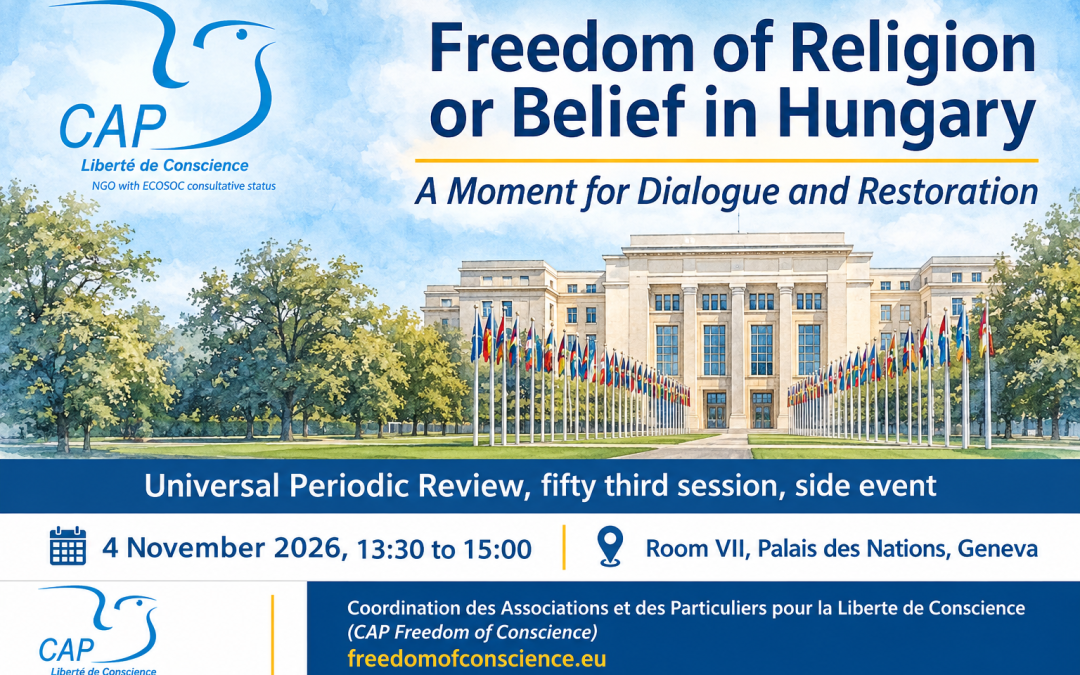
On 4 November 2026, Justice pour Tous Internationale delivered a keynote statement at the information meeting convened by the Coordination des Associations et des Particuliers pour la Liberté de Conscience (CAP Freedom of Conscience) during the fifty-third session of the Universal Periodic Review.
The information meeting
Justice pour Tous Internationale (JPTi) thanks Thierry Valle and CAP Freedom of Conscience for the invitation to participate in this information meeting on the Universal Periodic Review of Hungary. The meeting was held on 4 November 2026, from 13:30 to 15:00, in Room VII of the Palais des Nations, during the 53rd session of the Working Group on the Universal Periodic Review (2 to 13 November 2026). It was organised by the Coordination des Associations et des Particuliers pour la Liberté de Conscience (CAP Freedom of Conscience).
The panel was composed of Thierry Valle, President of CAP Freedom of Conscience, and Iván Arjona Pelado, President of the European Office of the Church of Scientology for Public Affairs and Human Rights, President of the NGO Committee on Freedom of Religion or Belief for the United Nations in Geneva, and President of the Fundación para la Mejora de la Vida, la Cultura y la Sociedad. JPTi’s Executive Director, Sharof Azizov, delivered the keynote statement.
A review at a time of transition
Hungary is examined only months after a change of government. The national report reflects the previous administration and records very limited progress since 2021. The new Government, formed in May 2026, will present its own evaluation during the review. The purpose of the gathering was not to assign blame. It was to encourage correction of inherited errors and the opening of dialogue with communities that have been affected.
What is striking is that the restrictions on freedom of religion or belief have often been driven less by continuing political direction than by the operation of bureaucracy. This includes administrative authorities, the judiciary, law-enforcement agencies and, in particular, state security services. A change of political majority does not, by itself, resolve these problems. Unless the systemic features of the administrative, judicial and security apparatus are addressed, the same patterns can continue, whoever holds the parliamentary majority.
The 2011 Church Law and its application
The principal legal framework remains Act CCVI of 2011 (Law No. 206 of 2011) on the right to freedom of conscience and religion and the legal status of churches, denominations and religious communities. This 2011 Church Law established a tiered system of recognition. Higher status requires a two-thirds majority in Parliament. Once enacted, the framework has been applied by administrative bodies, courts and security authorities in ways that place a disproportionate burden on minority communities and on ordinary believers who have committed no wrong.
The principle of individual responsibility requires that any restriction rest on concrete, individualized findings, be used only as a last resort, and remain subject to effective independent review. Collective measures against a community, or the destruction of confidential religious records central to spiritual practice, cannot be justified by the mere existence of a general legal regime.
Confidential religious records
A concrete illustration is the handling of confidential religious records. In one well-documented case concerning the Church of Scientology, the National Authority for Data Protection and Freedom of Information ordered the destruction of seized materials. A criminal investigation later found no evidence of wrongdoing. Despite that finding, the Metropolitan Court upheld the destruction order in January 2026. The practical effect falls on ordinary believers whose confessions, pastoral counselling notes and administrative records are treated as ordinary data subject to retention or destruction, rather than as protected religious communications.
Similar patterns of application of general rules to minority communities appear in the registration process itself, where political-majority requirements and discretionary criteria continue to govern access to legal personality and associated rights.
Muslims, Jews and other minority communities
The same pattern of disproportionate application of general measures affects other communities. The Special Rapporteur on freedom of religion or belief, following the 2024 country visit, reported that anti-Muslim rhetoric remains widespread, including from senior officials who have linked strong anti-immigrant discourse to the defence of a “Christian Europe.” Verbal insults against women wearing headscarves, persons of darker skin and those speaking foreign languages continue to be frequent, even though physical attacks are reported as rare.
Antisemitic incidents and hate speech directed at Jewish communities have also been documented by United Nations mechanisms and other observers. These practices, together with the registration and data-protection measures affecting smaller denominations, illustrate how ordinary believers belonging to minority faiths bear the practical burden of frameworks that are formally general but applied unequally.
The national human rights institution
The independent national human rights institution has a crucial role. It is the body best placed to remind the bureaucracy of Hungary’s international obligations under the International Covenant on Civil and Political Rights and to recommend concrete corrective action. The Hungarian Commissioner for Fundamental Rights, downgraded to B status by the Global Alliance of National Human Rights Institutions in 2021, has not demonstrated consistent capacity to perform this function in relation to freedom of religion or belief. No clear remedial engagement with the relevant authorities on the registration framework, on the handling of confidential religious records, or on patterns of hate speech and discriminatory rhetoric is visible.
Publication 125 already recorded this institutional fact in the legal reading of the documents before the fifty-third session: the Commissioner was downgraded from A to B in 2021, the national report gives the budget and does not give the downgrade, and the measures of the previous term represent very limited progress. The statement delivered on 4 November carries that finding into the specific field of freedom of religion or belief.
Follow-up by the United Nations
The United Nations system itself faces well-known constraints of resources, global coverage and the requirement of regional balance. These constraints make continuous engagement on every situation difficult. Yet the difficulty does not explain the absence of sustained follow-up once findings exist. Mechanisms are in place, including the Special Procedures, the Office of the High Commissioner for Human Rights, and the expectation of a National Mechanism for Implementation, Reporting and Follow-up, but they have not been directed toward positive engagement with the Hungarian Commissioner for Fundamental Rights or with the administrative bodies applying the contested measures.
The High Commissioner for Human Rights did not mention freedom of religion or belief even once in the annual report for 2025. The result is that formal obligations remain on the books while the bureaucracy continues on a course already addressed by the Special Rapporteur on freedom of religion or belief in the report of the 2024 country visit.
What Member States can ask of this review
The Universal Periodic Review occupies a unique position. It is not a tribunal. It is a forum in which Member States can call on Hungary to comply with its international obligations on freedom of religion or belief and can assist the country’s administrative system in returning to a track consistent with those obligations.
Concrete steps that can be announced and monitored include:
- the establishment of objective, transparent and non-discriminatory criteria for the recognition of religious organizations;
- the removal of political-majority requirements;
- the protection of confidential religious communications from seizure or destruction, and the return of records whose retention has no individualized criminal or data-protection justification;
- effective independent review, and the strengthening of the national human rights institution’s capacity to intervene.
JPTi’s experience with structured advocacy, through open letters requesting individualized reassessment and written responses, shows that dialogue can move files even when positions initially appear fixed. The new Government has the chance to restore consistency between Hungary’s international positions and its domestic administration. The communities concerned, and the organizations that accompany them, remain ready to engage constructively.
Related posts:
 Pakistan: An Ahmadi Official Removed from Post After Extremist Pressure Campaign
 Quand le partenaire de la Miviludes ressemble furieusement à une dérive sectaire
 UN UPR 53rd Session: CAP LC Submits Report on Hungary to the UN Universal Periodic Review: The Weaponization of Data Protection Laws
 UN Human Rights Council Adopts Twin Resolutions on Freedom of Religion or Belief and Minority Rights at 61st Session