What is “Coordination des Associations et des Particuliers pour la Liberté de Conscience” (CAP Freedom of Conscience)?

CAP Freedom of Conscience is a secular European NGO with United Nations Consultative Status, created in 1995 and dedicated to protect the Right of Freedom of Religion and Belief.

CAP Freedom of Conscience combats all forms of discrimination based on religion or belief by alerting European and International bodies.

CAP Freedom of Conscience collects testimonies of discrimination and human rights violations affecting religious or belief communities in order to disseminate them to international bodies, and in order to raise awareness and inform them as well as to generate debate on the protection of Freedom of Religion and Belief.

CAP Freedom of Conscience also advocates for any religious or spiritual group facing discrimination to have their right to Freedom of Religion and Belief recognized.

CAP Freedom of Conscience is a member of the European Federation for Freedom of Belief (FOB), European Network Of Religion and Belief (ENORB) and participate to the Civil Society Platform of Fundamental Rights created by the EU Fundamental Rights Agency DAFOH Partners in Combating and Preventing Forced Organ Harvesting
From Stigmatization to Violence: A Public Health Approach to Media-Driven Persecution

From Stigmatization to Violence: A Public Health Approach to Media-Driven Persecution

CAP Liberté de Conscience (CAP LC) addressed the UN Human Rights Council (HRC 61) on the dangerous link between sensationalist media and violence against religious minorities. Applying the WHO’s “Public Health Approach to Violence Prevention,” we highlighted how media stigmatization acts as a precursor to physical attacks. Citing the “digital witch-hunt” against the Christian Gospel Mission and a recent hammer assault in Taiwan, we called for a UN expert group to monitor media bias and protect believers from persecution fueled by online hate.

read more
HRC 61 Item 5 Media-Fueled Persecution: Establishing Accountability for Sensationalist Coverage of Religious Minorities

HRC 61 Item 5 Media-Fueled Persecution: Establishing Accountability for Sensationalist Coverage of Religious Minorities

Sensationalist media coverage triggers systematic violence against religious minorities worldwide. Following the Public Health Approach to Violence Prevention, stigmatization by mainstream and digital platforms—such as Netflix documentaries on Jehovah’s Witnesses or South Korean coverage of Gospel Mission—precedes persecution and violence. Recent cases include hammer attacks on Shincheonji members in Taiwan. We urge the Human Rights Council to establish an expert group monitoring media-driven discrimination to protect believers from state and online violence fueled by inflammatory content.

read more
HRC 61 ITEM 4 Media-Driven Persecution: The Christian Gospel Mission Between Systemic Discrimination and Human Rights Violations

HRC 61 ITEM 4 Media-Driven Persecution: The Christian Gospel Mission Between Systemic Discrimination and Human Rights Violations

This statement draws urgent attention to the systematic persecution of Christian Gospel Mission members between 2023 and 2026. Following Netflix documentaries in 2023 and 2025, thousands of believers—accused of no crime—faced discrimination, doxxing, and violence. In Taiwan, 4,500 members suffered threats and public shaming. In South Korea, over 160 sworn statements document exclusion. Economic boycotts destroyed businesses; educators and professors lost jobs solely for their faith

read more
HRC 61 Side-event Human Rights In Pakistan

HRC 61 Side-event Human Rights In Pakistan

This side event critically examines Pakistan’s GSP+ trade status, questioning whether human rights conditionality is being rigorously enforced in line with international obligations. By combining legal analysis with victim testimonies, it aims to expose the gap between treaty commitments and the on-the-ground reality for those affected by abuses.

read more
HRC 61 Written Statement The Two Covenants, the Abuse of Tax Law Against Spiritual Minorities, and Two Shadow Reports

HRC 61 Written Statement The Two Covenants, the Abuse of Tax Law Against Spiritual Minorities, and Two Shadow Reports

During the 61st Human Rights Council session, CAP LC presented a written statement on the weaponization of tax law against spiritual minorities in Taiwan. It examines the Tai Ji Men case, involving perpetual tax bills despite judicial acquittals, resulting in sacred land seizure. The statement identifies structural tax administration flaws violating international human rights covenants, undermining religious freedom and due process. CAP LC urges resolution of the Tai Ji Men case and reforms ensuring taxation isn’t used discriminatorily against religious groups.

read more
HRC 61 Written Statement : The Inhumane Detention of Konstantin Rudnev in Argentina

HRC 61 Written Statement : The Inhumane Detention of Konstantin Rudnev in Argentina

CAP Liberté de Conscience presented a statement to the Human Rights Council regarding Russian spiritual teacher Konstantin Rudnev’s arbitrary detention in Argentina. Arrested following misunderstandings and unsubstantiated accusations of being a “cult leader,” Rudnev remains in pretrial detention despite lack of evidence. He faces due process violations and inadequate medical care with declining health. The organization argues his imprisonment violates religious freedom and liberty rights, based on imported disinformation rather than actual crimes. CAP LC demands his immediate release on humanitarian grounds.

read more

CAP Freedom of Conscience involvement UNITED NATIONS

LASTEST NEWS

Human Rights Council Universal Periodic Review 47th session (4 – 15 Nov 2024) Universal Periodic Review of the Federal Democratic Republic of Ethiopia

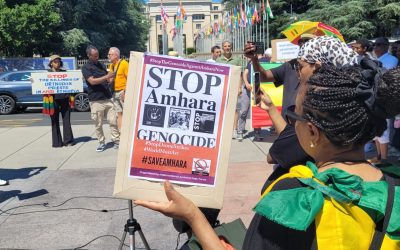
Ethiopia is a multi-ethnic country with over 76 different groups. The Amhara people are one of the largest ethnic groups with a history spanning over 4000 years in Ethiopia, distributed across various regions of the country. However, they have been impacted significantly by targeted attacks, displacement, and grave human rights violations. This report aims to address the widespread abuses faced by the Amhara community throughout Ethiopia,.

HRC 55 UPR outcomes of Germany

The report includes Germany’s responses to various human rights challenges, including efforts to combat racism, antisemitism, and discrimination, as well as measures to protect the rights of LGBTIQ+ persons, migrants, and other vulnerable groups.

Non-governmental organizations held a briefing at the United Nations to condemn the CCP’s organ harvesting

[Minghui.com, February 8, 2024] (Reported by Minghui Swiss Correspondent Station) On January 22, 2024, two non-governmental organizations – the European “CAP Freedom of Conscience” and “Doctors International” The Organization Against Forced Organ Harvesting (DAFOH) held a briefing on the Chinese Communist Party’s persecution of Falun Gong and organ harvesting from Falun Gong practitioners at the United Nations in Geneva, Switzerland.

A meeting on the persecution of Falun Gong and organ harvesting held before the United Nations human rights review was held at the Palais des Nations

[Voice of Hope January 26, 2024] (reported by our reporter Wen Simin) The 45th session of the fourth round of the Universal Periodic Review (Universal Periodic Review) of the United Nations Human Rights Council was held on January 22. It begins at the Palais des Nations (Palais des Nations) in Geneva, the European headquarters of the United Nations. The day before the review of human rights in China, a conference titled “China’s Deprivation of Universal Human Rights “, focusing on the persecution of Falun Gong and organ harvesting from living persons, was also held at the Palais des Nations . On the 22nd and 23rd, some Falun Gong practitioners from the Czech Republic, Finland, Germany, France, the German-speaking and French-speaking areas of Switzerland held truth-clarification activities at the Place des Nations opposite the Palais des Nations.

Anyone involved in China’s transplant field risks becoming complicit in human rights abuses

The day before the United Nations Human Rights Council held the fourth round of the Universal Periodic Review ( UPR ) of human rights in China, a non-governmental organization with United Nations consultative status – “Association for Freedom of Conscience and Individual Collaboration” (French abbreviation CAP LC) organized , together with the organization “Doctors Against Forced Organ Harvesting ” (DAFOH), held an information meeting titled “China’s Deprivation of Universal Human Rights ” on January 22, specifically focusing on the ongoing persecution of Falun Gong practitioners and organ harvesting. question.

Anti-forced organ harvesting organizations call for the establishment of an international criminal tribunal to target the CCP’s crimes of forced organ harvesting

The Coordination of associations and individuals for Freedom of Conscience (CAP LC in French), a non-governmental organization with consultative status with the United Nations , together with Doctors Against Forced Organ Harvesting ( DAFOH ), held a meeting in On January 22, the day before the fourth round of the Universal Periodic Review ( UPR ) of China’s human rights by the United Nations Human Rights Council, a message titled “China’s Deprivation of Universal Human Rights ” was held at the United Nations Palais des Nations. Meeting.

NIGERIA Submission to the 45th Session of the Human Rights Council’s Universal Periodic Review Working Group

1. This joint submission addresses the state of freedom of religion or belief and freedom of opinion and expression in Nigeria. In particular, it presents an overview of the country’s domestic legal framework and draws attention to specific concerns related to the criminalization of blasphemy. Additionally, the report examines the rise in acts of terrorism and mob violence against Christians and religious minorities, including Muslim minorities, and the related climate of impunity over the reporting period.

45th session Universal Periodic Review Working Group Information meeting on China

We are pleased to extend an invitation to you for a crucial conference addressing pressing human rights issues in China. The focus of this event revolves around the impending Universal Periodic Review (UPR) of China, with particular attention to the ongoing persecution and forced organ harvesting of Falun Gong practitioners.

UPHOLDING UNIVERSAL COMMITMENTS: Addressing the damaging impact of landmines on the enjoyment of human rights.

The Universal Periodic Review (UPR) is a unique mechanism of the Human Rights Council that requires each UN Member State to undergo a peer review of its human rights record every 4.5 years. The UPR provides an opportunity for each state to regularly
Report on the measures it has taken to improve the human rights situation in its country and to address challenges to the enjoyment of human rights; and
Receive recommendations for continuous improvement from UN Member States, based on input from various stakeholders and pre-session reports.
The aim of this side-event we are organising today is to highlight points 203 and 204 of Azerbaijan’s national report on landmines.

UN expert on truth and justice to visit Armenia from 16 to 24 November 2023.

During his visit, the UN expert will assess the measures in the areas of truth, justice, reparation, memorialisation and guarantees of non-recurrence that have been adopted by authorities in Armenia to address the legacy of serious violations of human rights committed in situations of conflict, state repression or civil unrest.

Call for inputs advocacy of hatred based on religion or belief: transformative responses

Purpose: To inform the Special Rapporteur on freedom of religion or belief’s thematic report to be delivered to the 55th session of the UN Human Rights Council.

Addressing the damaging impact of landmines on the enjoyment of human rights

With an estimated 26,000 people a year becoming landmine victims, this indiscriminate weaponry poses one of the most challenging threats to human life and dignity and thus affects inalienable fundamental human rights.
The UN human rights machinery has a key role in addressing the negative impact of landmines, explosive remnants of war and other improvised explosive devices on the enjoyment of human rights of mine victims in the context of humanitarian mine action. It can also be instrumental in bringing to the fore the utmost importance of providing international assistance in mine action including protection and restoration of inalienable human rights of mine victims.
The side event intends to discuss humanitarian mine actions in light of this very role of the UN human rights machinery. It also aims to raise awareness on the importance of full and effective protection of fundamental human rights when related to humanitarian mine action. Other objectives of the event include exploring effective ways to address the humanitarian, socio-economic and environmental impact of landmines, explosive remnants of war and other IEDs; highlighting the importance of international cooperation and assistance in mine action which aims at eliminating the threat posed by mine contamination to the security of States and safety of their populations, facilitating post-conflict rehabilitation, including the return of refugees and IDPs to their homes, and contributing to sustainable peace and development.

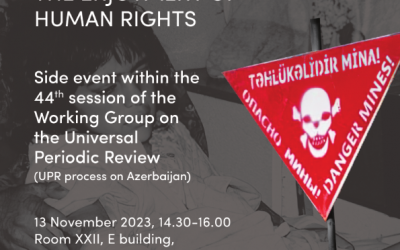
Information meeting on the UPR process in Azerbaijan

UPHOLDING UNIVERSAL COMMITMENTS:

Addressing the damaging impact of landmines on the enjoyment of human rights

Side event within the 44 session of  the Working Group on the Universal Periodic Review

Room XXII, E building, Palais des Nations, Geneva  13 November 2023 / 14.30-16.00

UPR Summary of stakeholders’ submissions on Bangladesh Report of the Office of the United Nations High Commissioner for Human Rights

68. JS2, JS5,JS9 and JS20 expressed concerns about discrimination, persecution, and limited access to justice faced by marginalized communities.115
JS2 highlighted the  discrimination and stigma experienced by Dalits, recommending immediate action through the enactment of an Anti-discrimination Act, representation, access to social services, and addressing discrimination in education and employment. JS5 focused on the persecution  of Ahmadi Muslims and called for stronger legislative and institutional responses, protecting religious practices, ensuring access to justice, and addressing violence and discrimination.  JS9 and JS16 were concerns about the limited justice access, violent attacks, and religious intolerance affecting various religious minorities.

Ahmadi Muslims in Germany who’ve fled state persecution are being deported back to Pakistan and it’s putting their lives at risk

Thousands  of Ahmadi  Muslims  in  Germany who  have fled  severe  religious persecution in Pakistan are awaiting a decision on their asylum  applications. They   belong   to  a religiously  and  politically  persecuted   minority  – the Ahmadiyya Muslim  Community. It  is  recognized   around  the  world   by  human   rights  groups  that Ahmadi Muslims  are  constantly,  ruthlessly  persecuted.

Algeria : Religious freedom to be on the agenda of a UN Special Rapporteur before his fact-finding mission

HRWF/ CAP (14.09.2023) – CAP/ Liberté de Conscience and Human Rights Without Frontiers, two NGOs active in Brussels, are deeply concerned about the situation of the members of the Ahmadi Religion of Peace and Light in Algeria and have addressed a report to the UN Special Rapporteur on the Rights of Peaceful Assembly and Association before his fact-finding mission in Algeria planned from 6 to 16 September.

ALGERIA: Ahmadi Religion of Peace and Light people meet UN Special Rapporteur

Ahmadi Religion of Peace and Light (24.09.2023) – Members of the Ahmadi Religion of Peace and Light in Algeria met today with the United Nations Special Rapporteur on Freedom of Association and Peaceful Assembly, Clément Nyaletsossi Voule, during his official visit to Algeria from 16 to 26 September 2023.

Strengthening Freedom of Thought Conscience Religion and Belief in Yemen

Violence in Yemen in 2023 has seen an uptick , including an increase in targeted attacks  and violent speech towards religious minorities. On 25th May 2023, Houthi militia stormed a peaceful meeting of Bahais in Sana’a and arrested 17, including five women, and continue to detain 11 of them incommunicado. In 2 June 2023, the UN High  Commissioner on Human Rights reported how the Mufti Shamseddin Sharafeddin, appointed by leaders of the Houthi militant movement, accused the detained Bahais of being apostates and saying “they should be killed,” if they did not repent Similar hate speech and incitement has been recorded in Yemen towards Christian converts and others since the start of the conflict and was raised during the virtual 53rd Human Rights Council parallel event co-sponsored by the Slovak Republic Bureau of the Special Envoy for Freedom of Religion or Belief.

UPR Summary of stakeholders’ submissions on France Report of the Office of the United Nations High Commissioner for Human Rights

In particular, the authors of joint submission 4 noted the use of these laws to close a number of places of worship and recommended that France ensure respect for freedom of religion, freedom to practise religious rites and freedom of association.[i] The Coordination des associations et particuliers pour la liberté de conscience recommended ensuring that article 18 of the Universal Declaration of Human Rights is respected by French institutions.[ii] JS10 recommended to put an end to religious discrimination and stigmatization of Jehovah’s Witnesses.[iii]

44th UPR Session Germany 06th – 17thNovember 2023 Religious asylum seekers in Germany

he traffic light coalition in Germany has taken many  measures and passed laws to better manage  migration. However, the number  of deportations has also increased.  Even  to those countries where  blasphemy  laws are  practiced in  the  strongest terms.  Deportations of Ahmadi  Muslims  to  Pakistan  have increased  sharply  in the  past.

44th WG UPR Session BANGLADESH – 2023 Persecution of Ahmadis in Bangladesh

The Ahmadiyya Muslim Community has suffered long-standing persecution in Pakistan, where the very identity of an Ahmadi Muslim, existential by definition, has been denied. The community is persecuted and discriminated by law and by religious ideology. The fundamental right to freedom of thought, conscience and religion or belief as well as other human rights of the Ahmadiyya Muslim community have been seriously violated.

Office of the High Commissioner for Human Rights Report on combating intolerance, negative stereotyping, stigmatization, discrimination, incitement to violence and violence against persons, based on religion or belief April 2023

CAP Freedom of Conscience is a secular European NGO with United Nations Consultative Status, created in 1995 and dedicated to protecting the Right of Freedom of Religion and Belief. It combats all forms of discrimination based on religion or belief, inter alia, by alerting European and International bodies to abuses and violations of international standards. It collects testimonies of discrimination and human rights violations affecting religious or belief communities disseminating them to international bodies, to broadly raise awareness on the subject and to generate debate on the need for protection of freedom of religion or Belief. CAP Freedom of Conscience also advocates for any religious or spiritual group facing discrimination supporting the right to have their freedom of religion or belief recognized.

SPECIFIC TO THE HUMAN RIGHTS SITUATION IN THE UNITED ARAB EMIRATES OCTOBER 2022 PERIODIC REVIEW MECHANISM FOR THE FORTY-THIRD SESSION

The organizations concerned operate for the protection and respect of Human Rights in the Arab world and in the countries of the world. They are active in the protection and promotion of Human Rights as well as affirming international efforts for Human Development. Moreover, they strive to promote dialogue and peace in the world as well as to guarantee the enjoyment of the fundamental rights and freedoms of everyone.

Human Rights Council Working Group on the Universal Periodic Review Forty-second session 23 January–3 February 2023 Summary of stakeholders’ submissions on Pakistan

recommended to repeal all anti-blasphemy laws, and ensure that the State’s domestic laws, policies and practices comply with the international human rights covenants, in particular articles 2, 18, 19 and 26 of the ICCPR. It also addressed the multiple and intersecting forms of violence and discrimination suffered by the Ahmadi community, including those faced by Ahmadi women, children and refugees.

13 Human Right Organizations successfully launched the UAE’s Shadow Report 2023: “A Way” for Universal Periodic Review 43rd Session

Guest speaker Christine Mirre (CAP Liberté de Conscience) from Paris, France, started the Shadow Report session by voicing her endorsement of its enduring ties to the UAE and human rights. She also told that where the world and the NGOs of the United Nations are going. She also pointed to the rights of women as a concerned representative of NGO. 

CAP Freedom of Conscience involvement in Europe

OSCE 2022 Plenary Session II: Fundamental freedoms I FECRIS

Mr. Dvorkin is a Russian activist with strong links to the Russian Orthodox Church and a close to Patriarch Kirill who for decades has been inundating the Russian, Chinese and Western media with hate speech against spiritual minorities and anti-Ukrainian propaganda. He was the vice-president of FECRIS for years and today he remains a member of its board of directors.

EU Parliament adopts resolution calling for review of Pakistan’s GSP+ status over blasphemy law abuse

On April 30th, the European Parliament has adopted a resolution calling for a review of the GSP+ status granted to Pakistan in view of an “alarming” increase in the use of blasphemy accusations in the country as well as rising number of online and offline attacks on journalists and civil society organisations, it emerged on Friday.

CAP LC submissions at the OSCE 2008 – 2019

CAP LC submissions at the OSCE 2008 - 2019 CAP-LC-submission-OSCE-2008-2019Télécharger

COMPILATION OF WRITTEN RECOMMENDATIONS (Covering Working sessions 10-15)

This compilation contains recommendations submitted to the HDIM Documentation Centre in accordance...

Open Letter to the OSCE/ODIHR

Will it be worthwhile participating in the next HDIM?  All the participants' statements and papers...

Prasun Prakash Is Religious Freedom ever possible in the Russian Federation ?

Speeches from the human dimension implementation conference dedicated to Russia. Hindus need a...

From Warsaw to Paris: MIVILUDES will cease to exist on 1 January 2020

HRWF (01.10.2019) - "The European Federation for Research on Sectarianism (FECRIS) assists victims...

OSCE HIDM 2019 : Is Religious Freedom ever possible in the Russian Federation ?

Is religious freedom ever possible in the Russian Federation ? CAP LC in collaboration with the...

OSCE HIDM 2019 Prasun Prakash

HUMAN DIMENSION IMPLEMENTATION MEETING Warsaw, 16 to 27 September 2019 Working session 13:...

OSCE HIDM 2019 CAP LC

HUMAN DIMENSION IMPLEMENTATION MEETING Warsaw, 16 to 27 September 2019 Working session 13:...

SUPPORT CAP Liberté de Conscience

IBAN BE61 9670 0987 0017

SWIFT / BIC TRWIBEB1XXX

Address
TransferWise Europe SA
Square de Meeûs 38 bte 40
Brussels
1000
Belgium

Information meeting on the UPR process in Azerbaijan

Information meeting on the UPR process in Azerbaijan

UPHOLDING UNIVERSAL COMMITMENTS:

Addressing the damaging impact of landmines on the enjoyment of human rights

Side event within the 44 session of  the Working Group on the Universal Periodic Review

Room XXII, E building, Palais des Nations, Geneva  13 November 2023 / 14.30-16.00
read more
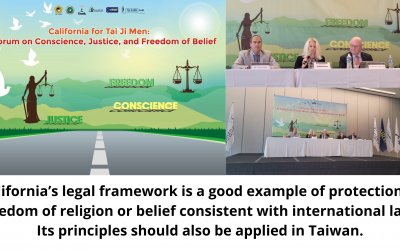
California for Tai Ji Men: Conscience, Justice and Freedom of Belief

California for Tai Ji Men: Conscience, Justice and Freedom of Belief

California, the Golden State, is known for its stunning landscapes, thriving entertainment industry, and diverse culture. Beneath the surface of this multifaceted state lies another remarkable aspect of its diversity: religious pluralism. From the Spanish missions of the 18th century to the bustling metropolises of the 21st century, California’s religious landscape has evolved into a vibrant tapestry of faiths and beliefs.
read more
Ahmadi Muslims in Germany who’ve fled state  persecution are being deported back to Pakistan and  it’s putting their lives at risk

Ahmadi Muslims in Germany who’ve fled state persecution are being deported back to Pakistan and it’s putting their lives at risk

Thousands  of Ahmadi  Muslims  in  Germany who  have fled  severe  religious persecution in Pakistan are awaiting a decision on their asylum  applications. They   belong   to  a religiously  and  politically  persecuted   minority  – the Ahmadiyya Muslim  Community. It  is  recognized   around  the  world   by  human   rights  groups  that Ahmadi Muslims  are  constantly,  ruthlessly  persecuted.
read more
Turkish court rules in favor of 101 Ahmadi religion detainees

Turkish court rules in favor of 101 Ahmadi religion detainees

In a side-event of the 54th session of the Human Rights Council in Germany, director of CAP Freedom of Conscience, Thierry Valle, has delivered an oral statement emphasizing the urgent need to grant asylum/humanitarian visas to the 101 members through EU consulates in Turkey as the only way available means to safeguard their right to freedom of religion and their right to life and freedom from inhumane or degrading treatment. 

read more
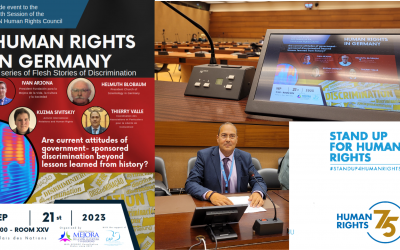
Side-event of the 54th session of the Human Rights Council UN Human Rights In Germany

Side-event of the 54th session of the Human Rights Council UN Human Rights In Germany

Since May of this year, over 100 Ahmadis from various countries where they were heavily persecuted, have been detained by the Turkish authorities in Edirne Immigration Detention Center. They want to apply for asylum in an EU country.

Those people from the Ahmadi Religion of Peace and Light do not want to stay in Turkey, another Muslim majority country, where people also consider them infidels and treat them as such.

read more
Addressing Anti-Religious Hate Crime in the OSCE Area

Addressing Anti-Religious Hate Crime in the OSCE Area

Anti-religious intolerance and hate crimes continues to be a concern across the Organization for Security and Co-operation in Europe (OSCE) region. Such manifestations of intolerance threaten both the security of individuals and societal cohesion, as discrimination and intolerant discourse often escalate into violence and wider scale conflict. At the same time, a comprehensive security regime is also needed to fully respect, protect and fulfil freedom of religion or belief, which is specifically acknowledged as one of the fundamental principles guiding mutual relations among OSCE participating States and an integral aspect of the OSCE’s concept of security. Furthermore, participating States of the OSCE have agreed on a broad range of commitments to address racism, xenophobia, anti-Semitism, discrimination and intolerance, including intolerance against Christians, Muslims, Jews and members of other religions. This side event will present the current situation in the OSCE area with regards to anti-religious hate crime, including reporting and addressing it. It will also highlight ODIHR’s recent and forthcoming tools, such as community security guides and factsheets. The discussion will also address gender-related aspects of anti-religious hate crime. The side event will be organized by the Office for Democratic Institutions and Human Rights (ODIHR) with the support of the FoRB Roundtable Brussels-EU

read more
Translate »
Share This