What is “Coordination des Associations et des Particuliers pour la Liberté de Conscience” (CAP Freedom of Conscience)?
CAP Freedom of Conscience is a secular European NGO with United Nations Consultative Status, created in 1995 and dedicated to protect the Right of Freedom of Religion and Belief.
CAP Freedom of Conscience combats all forms of discrimination based on religion or belief by alerting European and International bodies.
CAP Freedom of Conscience collects testimonies of discrimination and human rights violations affecting religious or belief communities in order to disseminate them to international bodies, and in order to raise awareness and inform them as well as to generate debate on the protection of Freedom of Religion and Belief.
CAP Freedom of Conscience also advocates for any religious or spiritual group facing discrimination to have their right to Freedom of Religion and Belief recognized.
CAP Freedom of Conscience is a member of the European Federation for Freedom of Belief (FOB), European Network Of Religion and Belief (ENORB) and participate to the Civil Society Platform of Fundamental Rights created by the EU Fundamental Rights Agency DAFOH Partners in Combating and Preventing Forced Organ Harvesting

HRC 58 side-event : Rights of vulnerable persons in the Middle East and Asia
During the 58th session of the UN Human Rights council in Geneva, United Villages organize along with Italia Che Cambia APS and CAP Liberté de Conscience we are co-hosting a side event “Indo-Mediterranean: political changes and human rights” to highlight and discuss the effect of the recent political changes in countries like Afghanistan, Pakistan, Iran, Yemen and Syria on ethnic, religious minorities and vulnerable groups such are women.

Multilateral Negotiations: Keys to Sustainable Peace
Multilateral negotiations are indispensable for resolving complex international conflicts. As António Guterres, Secretary-General of the United Nations, aptly stated, “Multilateralism is not an option but a necessity for rebuilding a better, more equal, more resilient, and more sustainable world.” This principle is particularly relevant in the context of the ongoing Russian-Ukrainian conflict, which has exposed the limitations of unilateral approaches and underscored the need for inclusive, cooperative solutions.

HRC 58 Side-event Human Rights In Pakistan
Join us for an urgent discussion on Human Rights in Pakistan, Particularly the education sector crisis. This event will highlight how ideological influences and rising intololerance threaten fundamental rights, limit access to education, and jeopardize academic freedom

HRC 58 Written statement : Sudan Crisis
At the 58th session of the Human Rights Council, UN experts and civil society have highlighted the gravity of the situation in Sudan and reiterated the urgent necessity of ensuring respect for principles of international law. As the UN High Commissioner for Human Rights, Volker Türk stated “The continued and deliberate attacks on civilians and civilian objects, as well as summary executions, sexual violence, and other violations and abuses, underscore the utter failure by both parties to respect the rules and principles of international humanitarian and human rights law”. [1]

HRC 58 : Unprecedented Human Rights Violations in Tunisia: The Persecution of Political Opponents and the Targeting of Sub-Saharan Migrants.
On 3 March 2025, during the 58th Human Rights Council, Fundacion Vida hosted a side event introduced by Thierry Valle, President of CAP Freedom of Conscience, on Unprecedented Human Rights Violations in Tunisia: The Persecution of Political Opponents and the Targeting of Sub-Saharan Migrants.[1] This side event took place following a strong statement issued by the UN High Commissioner for Human Rights Volker Türk on 18 February 2025 calling the Tunisian authorities to “bring an end to the pattern of arrests, arbitrary detentions and imprisonment of dozens of human rights defenders, lawyers, journalists, activists and politicians”, the statement also highlighted that members of civil society are often accused of illegally sheltering Sub-Saharan migrants, with individuals denouncing racism and the situation of migrants being arrested.[2] The side event was attended by the delegations of the European Union, Antigua, the United Kingdom, Belgium and Austria.

Religious Persecution in Pakistan: The Systematic Targeting of Ahmadis
CAP Liberté de Conscience and the International Human Rights Committee (IHRC) are ringing the alarm bells over the continuing erosion of religious freedom in Pakistan. In a recent joint report submitted to the United Nations Special Rapporteur on Freedom of Religion or Belief, these organizations continued to highlight the systematic and widespread violations of the rights of religious minorities with a focus on the Ahmadiyya Muslim community. The report shows that international intervention is desperately required to prevent the further persecution of Ahmadis in Pakistan, a community that has been persecuted for its beliefs for years.
CAP Freedom of Conscience involvement UNITED NATIONS
LASTEST NEWS
Adhésion CAP LC 2024
CAP Freedom of Conscience involvement in Europe
SUPPORT CAP Liberté de Conscience
IBAN BE61 9670 0987 0017
SWIFT / BIC TRWIBEB1XXX
Address
TransferWise Europe SA
Square de Meeûs 38 bte 40
Brussels
1000
Belgium

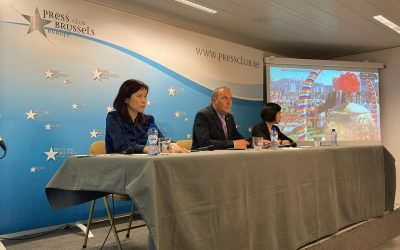
Conference at the Press Club in Brussels on 4 May, 3pm – 5pm
Tai Ji Men is a menpai (similar to school) of qigong, martial arts, and self-cultivation, and its shifu (master) and dizi (disciple) have long been committed to international cultural exchanges, spreading the concepts of love, peace, and conscience, purifying people’s hearts, and practicing world peace. It has been highly praised by Taiwanese presidents, vice presidents, and foreign ministers.
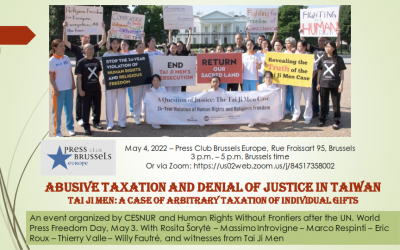
Abusive Taxation and Denial of Justice in Taiwan: The Case of Tai Ji Men A case of arbitrary taxation of individual gifts
Tai Ji Men is a menpai (similar to school) of qigong, martial arts, and self-cultivation, and its shifu (master) and dizi (disciple) have long been committed to international cultural exchanges, spreading the concepts of love, peace, and conscience, purifying people’s hearts, and practicing world peace. It has been highly praised by Taiwanese presidents, vice presidents, and foreign ministers.
Side Event to the 49th Session of the UN Human Rights Council Roundtable Discussion
Side Event to the 49th Session of the UN Human Rights Council Roundtable Discussion
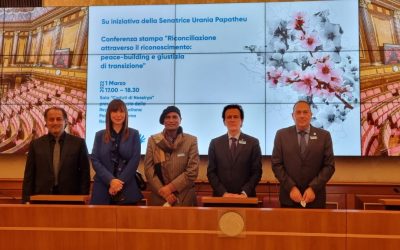
To promote reconciliation between Azerbaijan and Armenia under the motto: “Reconciliation through recognition”
This year marks the 30th anniversary of the Khojaly massacre of civilians, and over the past 30 years there have been many peace initiatives to ensure that the massacre is properly recognised. It has been described by Human Rights Watch as “the largest massacre in the conflict” in Nagorno-Karabakh.
Escalation of Human Rights Violations in the 21st century: Finding solutions to help combat crimes against humanity
We have learned that egregious crimes such as forced organ harvesting from living Falun Gong practitioners has occurred for over two decades in the People’s Republic of China. Irrefutable evidence has been gathered and led to a unanimous judgement. The international community appears to be overwhelmed in the handling of crimes against humanity to the extent that the values of our civilization are at stake. Humankind has to decide if it accepts or rejects the killing of human beings for forced organ harvesting or other exploitations.
Escalation of Human Rights Violations in the 21st century : State-sponsored Forced Organ Harvesting of Living People
Escalation of Human Rights Violations in the 21st century : State-sponsored Forced Organ Harvesting of Living People