What is “Coordination des Associations et des Particuliers pour la Liberté de Conscience” (CAP Freedom of Conscience)?

CAP Freedom of Conscience is a secular European NGO with United Nations Consultative Status, created in 1995 and dedicated to protect the Right of Freedom of Religion and Belief.

CAP Freedom of Conscience combats all forms of discrimination based on religion or belief by alerting European and International bodies.

CAP Freedom of Conscience collects testimonies of discrimination and human rights violations affecting religious or belief communities in order to disseminate them to international bodies, and in order to raise awareness and inform them as well as to generate debate on the protection of Freedom of Religion and Belief.

CAP Freedom of Conscience also advocates for any religious or spiritual group facing discrimination to have their right to Freedom of Religion and Belief recognized.

CAP Freedom of Conscience is a member of the European Federation for Freedom of Belief (FOB), European Network Of Religion and Belief (ENORB) and participate to the Civil Society Platform of Fundamental Rights created by the EU Fundamental Rights Agency DAFOH Partners in Combating and Preventing Forced Organ Harvesting
European parliament raises urgent questions on antisemitism in Eu schools following UNESCO survey

European parliament raises urgent questions on antisemitism in Eu schools following UNESCO survey

On 30 January 2026, a cross-party group of eighteen European Parliament members submitted a written question to the European Commission regarding alarming findings in a UNESCO report on antisemitism in European Union educational institutions. The initiative, led by MEPs from multiple political groups—including the European Conservatives and Reformists, Renewists, and the Patriotic Europe faction—signals growing parliamentary concern over documented prevalence of antisemitic incidents within classrooms across the bloc.

read more
The United Nations High Commissioner for Human Rights Addresses Critical Violations in Sudan: Key Findings and International Recommendations

The United Nations High Commissioner for Human Rights Addresses Critical Violations in Sudan: Key Findings and International Recommendations

The Office of the United Nations High Commissioner for Human Rights (OHCHR) published a comprehensive report (A/HRC/61/24) on 13 January 2026, presenting an assessment of the human rights situation across Sudan. The document covers the period from 16 November 2024 to 15 November 2025 and was submitted to the Human Rights Council at its sixty-first session, responding to Council resolution 57/2.

read more
HRC 61 Written Statement Ensuring Justice in the Sudan: Extending Accountability for Crimes Against Humanity

HRC 61 Written Statement Ensuring Justice in the Sudan: Extending Accountability for Crimes Against Humanity

At the 61st session of the United Nations Human Rights Council, CAP Liberté de Conscience submitted a written statement highlighting the catastrophic human rights situation in Sudan and the urgent need for extended accountability. The submission documents heinous crimes committed by the Rapid Support Forces (RSF), including summary executions, sexual violence, and mass killings in areas like El Fasher and the Zamzam camp, while noting the RSF’s systematic attempts to destroy evidence. CAP LC emphasizes the necessity of extending the UN Security Council’s ICC referral beyond Darfur to cover all regions of Sudan, ensuring justice for crimes against humanity nationwide. Additionally, the statement exposes the critical role of foreign actors, particularly the United Arab Emirates, in supplying weapons that sustain the RSF’s operations. Consequently, CAP LC calls on Member States to cease arms transfers to the RSF, condemn the UAE’s involvement, impose sanctions on perpetrators and enablers, and support international mechanisms for evidence preservation and accountability.

read more
HRC 61 Written Statement Threatened Dissolution of Shincheonji and Other Religious Organizations in the Republic of Korea

HRC 61 Written Statement Threatened Dissolution of Shincheonji and Other Religious Organizations in the Republic of Korea

At the 61st session of the United Nations Human Rights Council, CAP Liberté de Conscience submitted a written statement raising serious concerns over the threatened dissolution of the Shincheonji Church and other minority religious organizations in the Republic of Korea. The document condemns efforts by President Lee Jae Myung to disband groups labeled as “pseudo-religions,” arguing that such state actions violate Article 18 of the ICCPR by allowing the government to act as a theological arbiter. CAP LC challenges the cited Japanese precedent, noting UN Special Rapporteurs’ criticism of dissolution orders based on vague concepts of “public welfare.” The statement further refutes claims of “enormous damage,” highlighting the Supreme Court’s acquittal of Shincheonji regarding COVID-19 allegations and the lack of coercive elements in its past evangelism methods. Consequently, CAP LC urges the Korean authorities to respect freedom of religion or belief and cease discriminatory campaigns driven by religious intolerance.

read more
Interactive dialogue on the oral update of the OHCHR on the human rights situation in and around El Fasher, in the context of the ongoing conflict in the Sudan

Interactive dialogue on the oral update of the OHCHR on the human rights situation in and around El Fasher, in the context of the ongoing conflict in the Sudan

Survivors of the attacks in El Fasher report mass atrocities and killings committed by the Rapid Support Forces after a year and a half of siege under horrific conditions, with no access to basic necessities. Civilians who fled describe widespread violence, including torture, kidnappings for ransom, sexual violence, disproportionately affecting women and girls, and summary executions as they attempted to escape. More than 1,000 days into the conflict, atrocities persist, and large-scale attacks are becoming a recurring pattern. Immediate and collective action is required to cease these crimes and prevent similar atrocities in other regions of Sudan.

read more

CAP Freedom of Conscience involvement UNITED NATIONS

LASTEST NEWS

HRC 49th Session General debate on Item 5 Montenegro: Double standards in Georgii Rossi’s extradition case

We would like to draw the attention of the Council and the Subcommittee on the prevention of torture with regard to the human rights situation in Russia, a country requesting from Montenegro the extradition of a Ukrainian citizen.

HRC 49th Session General debate on Item 4 situation in Balochistan

We are deeply concerned about the situation in Balochistan which has been monitored for years by the Brussels-based NGO Human Rights Without Frontiers.

UNITED KINGDOM SUBMISSION TO THE UN UNIVERSAL PERIODIC REVIEW FOURTH CYCLE, 41ST SESSION (7 – 18 NOVEMBER 2022)

This submission outlines how Clause 9 is likely to result in an increase in citizenship deprivation orders that are incompatible with the UK’s international and domestic human rights obligations and highlights that it would allow the UK Government to retrospectively legitimise previous unlawful deprivation decisions. It recommends that Clause 9 be removed from the Bill and that the UK Government undertake not to reintroduce it in this or any other Parliamentary session.

HRC 49th Session General debate on Item 3 : Human Rights Situation in Balochistan

It has already depleted the gold, uranium, and other valuable deposits in many parts of Balochistan. Now, the Baloch coast is nearly void of marine life, which has been the backbone of their economy for centuries.

Coalition of 220 ECOSOC Accredited NGOs Call for New United Nations Human Rights Council Resolution to Protect Tamils from Genocide, to name a Special Rapporteur for North East of Sri Lanka and to Recognize Tamils Rights to self-determination

We, the undersigned organizations, with support of more than 7200 organization in the World, urge the Member States of the HRC to pass a strong resolution at the upcoming 49th Session, affirming an international commitment to protect human rights and justice in Sri Lanka, with a particular focus on Tamils victims of Genocide in Sri Lanka.

HRC 49 : Montenegro double standards in extradition cases: Georgii Rossi’s case

For many years, Montenegro has expressed its firm intention to become part of the European Union. To become an EU member state, Montenegro will have to implement multiple reforms, fight against corruption, respect human rights and eradicate double standards in the application of legal norms, including in extradition cases.

A call to the United Nations High Commissioner for Human Rights about the human rights situation in Afghanistan

The challenges from lived experiences came very early to me, the moment I decided to work as an activist for the upliftment of the vulnerable sections of the population. On the one hand, my appointment as a Mayor in Wardak province (which is among the most conservative regions in Afghanistan) was lauded as a significant step in the democratically elected government’s commitment towards women empowerment. At the same time, my mayorship was the beginning of direct confrontation with the country’s conservative forces and the Taliban. In the last two years, I survived three assassination attempts and lost my father and numerous friends, and so many loved ones to the Taliban assassins.

HRC 49 : Freedom of expression and the media muzzled in Ukraine: the case of Anatolij Sharij

This article states that ‘an act willfully committed by a citizen of Ukraine in the detriment of sovereignty, territorial integrity and inviolability, defense capability, and state, economic or information security of Ukraine: joining the enemy at the time of martial law or armed conflict, espionage, assistance in subversive activities against Ukraine provided to a foreign state, a foreign organization or their representatives, shall be punishable by imprisonment for a term of ten to fifteen years.’

ETHIOPIA: Massacres of Amhara civilians in war and non-war zones

We are deeply concerned about the mass-scale massacres of civilians in war and non-war zones in Ethiopia as recently reported by Human Rights Without Frontiers.

BHRC calls for international intervention in Balochistan

In a written statement submitted to the United Nations Human Rights Council (Forty-ninth session 28 February–1 April 2022) which was submitted through Coordination des Associations et des Particuliers pour la Liberté de Conscience, a non-governmental organization in special consultative status in the United Nations Human Rights Council, it was demanded that the gross violation of human rights in Balochistan needs immediate attention and intervention from the international community.

Corruption in the Tai Ji Men Case Denounced at the United Nations

The statement mentions that scholars have recognized that corruption is a violation of human rights. “Thirteen years ago, CAP-LC states, the Maastricht Center for Human Rights in the Netherlands organized an important conference on corruption as a human rights issue, on October 22–23, 2009. The majority position at the Maastricht conference was that there is indeed a provision in international law that makes corruption a violation of human rights. It is article 2, number 1, of the International Covenant on Economic, Social and Cultural Rights.” The provision mandates that states should remove the obstacles to the full enjoyment of human rights by their citizens, and there is little doubt that corruption is such an obstacle.

Protecting Life: Repealing the Death Penalty for Apostasy and Blasphemy

Inspire and equip policy makers to address and effectively work to repeal the death penalty for choice or expression of religion or belief.

G2122410 Summary of Stakeholders’ submissions on Thailand

JS30 expressed concern about the specially vulnerable and dire situation of Ahmadi refugees and asylum seekers regarding poor living conditions, lack of access to legal protection and exposure to arrest, detention and exploitation

CPR – International Covenant on Civil and Political Rights 133 Session : Freedom of expression under threat in Ukraine the case of Anatoliy Sharij

Recently, Anatoliy Sharij, a Ukrainian blogger living in EU countries for almost a decade, was accused by the Security Service of Ukraine (SSU) on “High Treason” under the controversial Article 111 of the Criminal Code of Ukraine (https://bit.ly/3CXMvaR). This article states that ‘an act willfully committed by a citizen of Ukraine in the detriment of sovereignty, territorial integrity and inviolability, defense capability, and state, economic or information security of Ukraine: joining the enemy at the time of martial law or armed conflict, espionage, assistance in subversive activities against Ukraine provided to a foreign state, a foreign organization or their representatives, shall be punishable by imprisonment for a term of ten to fifteen years.’

Hungary: inappropriately using tax legislation and data protection to harass a well-established minority religion

Hungary: inappropriately using tax legislation and data
protection to harass a well-established minority religion

CPR – International Covenant on Civil and Political Rights 133 Session : Germany violates its Constitution by discriminating against a peaceful religious minority

Since nearly 30 years, and still today in 2021, German citizens are in general life contexts required to
sign declarations that they did not and will not participate in any Scientology related activity before
obtaining some public and private jobs, or before getting a municipal grant to get an eBike and so
contribute to the city’s efforts on protecting the environment, as it has been happening with the City of
Munich.

HRC 48th session human rights situation in Balochistan

We would like to draw the Council’s attention to arbitrary arrests and enforced disappearances of Baloch political activists, leaders, students, doctors, intellectuals, writers, and human rights defenders. They are being picked up by security forces or their proxy death squads and kept incommunicado for years. As a result of this practice, thousands of Baloch remain missing.  Tortured bodies of thousands have been found.

HRC 48 General Debate on item 3 human rights situation of Sindh

We are profoundly grateful to UN working group on Enforced and Involuntary disappearances for comprehensively raising the issue of forced abduction of Sindhis through a joint communication in March this year. Despite this, disappearances of Sindhi political and human rights activists by Pakistani secret agencies continue unabated. In the month of August alone more than 10 prominent political workers and human rights activists including Insaf Dayo, Ayoub Kandhro, Suhail Raza Bhatti, Zakir Sahito, Kashif Tagar have been abducted. 

Coalition of 192 ECOSOC Accredited NGOs Calls for New United Nations Human Rights Council Resolution to Protect Tamils from Genocide, to name a Special Rapporteur for Sri Lanka and to Recognize Tamils’ Right to self-determination

The Tamils have been fighting for over seventy years for self Determination. We are a nation of people living in the merged North and East in the island of Ceylon. We have our right to determine our own destiny.  Successive Sri Lankan Sinhala – Buddhist Governments have continually suppressed Tamils right to self-determination and govern Tamils employing brutal military force to annihilate, which amounts to Genocide.

The worsening Human Rights situation in Balochistan

The human rights violations in Balochistan by Pakistan have many aspects. These include enforced disappearances, kill and dump, illegal detentions, torture of political and human rights activists. Human rights violations also include social, cultural, and economic aspects.

Evacuation of Religious Minorities of Afghanistan

We are a NGO that specializes in the freedom of religious minorities. This statement reports to the UN on the urgent need to evacuate the religious minorities of Afghanistan – namely the Sikhs and Hindus of Afghanistan, who face religious persecution and an immediate threat to their lives, following the takeover by the Taliban. We make this statement jointly with UNITED SIKHS, an international humanitarian and advocacy NGO that has been associated with the Department of Public Office of the United Nations, since 2007, and the Gurdwara Guru Nanak Darbar, London, UK, which serves the largest Afghan Sikh congregation in the world.

A written submission exposed a growing international problem, quoting the Tai Ji Men case in Taiwan

The ECOSOC-accredited NGO CAP-LC (Coordination des Associations et des Particuliers pour la Liberté de Conscience) filed a written submission for the 48th session of the United Nations Human Rights Council, which starts in Geneva on September 13. The document is published on the Web site of the United Nations. CAP-LC expressed its concern for “the use of real estate seizures as a weapon to discriminate against religious and spiritual minorities.”

International community must pay attention to the statesponsored persecution of Ahmadi Muslims in Pakistan and worldwide

human rights experts have expressed their deep concern over the lack of attention to the serious human rights violations perpetrated against the Ahmadiyya Muslim Community around the world and called on the international community to step up efforts in bringing an end to the ongoing persecution of Ahmadi Muslims as follows:

High Commissioner to Human Rights Council: Fighting Continues Unabated in the Tigray Region of Ethiopia but a Solution Can Only be Found through a Political Process and Dialogue

Also taking the floor were the following non-governmental organizations: East and Horn of Africa Human Rights Defenders Project, Society for Threatened Peoples, Centre for Human Rights, Christian Solidarity Worldwide, Centre for Global Nonkilling, Coordination des Associations et des Particuliers pour la Liberté de Conscience, Amnesty International, Human Rights Watch, International Bar Association and CIVICUS.

Item 2: Enhanced interactive dialogue on the oral update by the High Commissioner on the situation of human rights in the Tigray region of Ethiopia

There is a war in Ethiopia. It started with TPLF attacking the Ethiopian Defense Force of the government of Abiy Ahmed.

In this conflict, Amhara women and children are being killed and their villages are looted both by TPLF and governmental forces.

CAP Freedom of Conscience involvement in Europe

“1,5 million jailed for their faith”: Religious persecution in China denounced at the European Parliament

Bitter Winter (28.06.2018) - https://bit.ly/2II2Sfq - The situation of religious liberty in China...

Freedom of religion or belief and the rights of asylum : The case of China

The Coordination of the Associations and the People for Freedom of Conscience is a european NGO...

Faith and Freedom Summit 2018

Mr Jan Zahradil, MEP, is sending this invitation to the "Faith and Freedom Summit: Practicing what...

Freedom of Religion or Belief and the Right to Asylum: The Case of China

Freedom of Religion or Belief and the Right to Asylum: The Case of China European Parliament ASP...

ANTI-SECT MOVEMENTS AND LAICITE: THE FRENCH-RUSSIAN CONNECTION

Since the beginning of the century, religious matters have emerged as a critical issue in national and international political agendas. However, starting in the 1980-1990s, a question started preoccupying certain European States: the emergence of new religious and spiritual groups coming from abroad, from Northern America or the East, or the spontaneous appearance of new spiritual movements, besides traditional Churches and worldviews well integrated in society.

Anti sect movements and laicite

Human Dimension Implementation Meeting (HDIM) Working Session 6: Freedom of thought, conscience,...

Supplementary Human Dimension Meeting (SHDM) I: Freedom of Religion or Belief: Issues, Opportunities, and the Specific Challenges of Combatting Anti-Semitism and Intolerance and Discrimination against Christians, Muslims, and Members of Other Religions

FECRIS claims in its by-laws that its activities do not enter « the religious field » and declares to be neutral in this matter. Why is it then that the Vice-President of FECRIS, an organization registered in secular France and massively financed by the French State, is Alexander Dvorkin, a Russian citizen blessed, financed and missioned by the Russian Orthodox Church Patriarch to combat religious minorities perceived as competitors?

Freedom of religion prevails again at Council of Europe

Today in the Parlementary Assembly of the Council of Europe (PACE), Rapporteur Valeriu Ghiletchi...

Synthesis of the 2016 Spiritual Human Rights Conference

Friday, 9th of December Soteria International hosted the Spiritual Human Rights conference in...

SUPPORT CAP Liberté de Conscience

IBAN BE61 9670 0987 0017

SWIFT / BIC TRWIBEB1XXX

Address
TransferWise Europe SA
Square de Meeûs 38 bte 40
Brussels
1000
Belgium

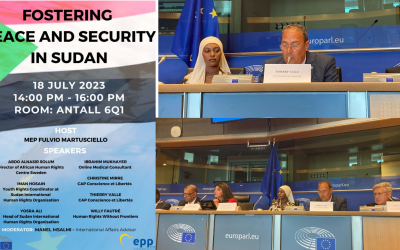
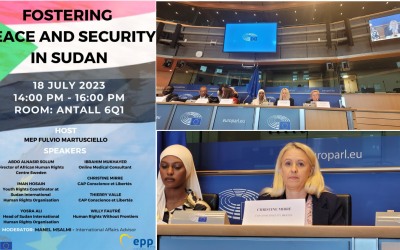
The various peace and security proposals put forward by the United Nations UN Security Council on the conflict in Sudan.

The various peace and security proposals put forward by the United Nations UN Security Council on the conflict in Sudan.

The United Nations Security Council convened on 2nd June 2023, to discuss the ongoing situation in Sudan.

The members of the Security Council recalled the previous Press Statement issued on 15 April 2023, expressing deep concern regarding the continued military clashes between the Sudanese Armed Forces and Rapid Support Forces.

I will summarize the key points and outcomes of the Security Council’s deliberations.
read more
The devastating impact on women of the ongoing conflict in Sudan and the crucial role they can play in the peace process

The devastating impact on women of the ongoing conflict in Sudan and the crucial role they can play in the peace process

As we all know, women, along with children, are the most vulnerable targets in wartime.

Gender-based violence and crime, such as rape and the destruction of property and lives, are the greatest threats to women, and these crimes are often overlooked and committed with impunity.

According to UN estimates, even before the fighting broke out on April 15, more than 3 million women and girls in Sudan were at risk of gender-based violence. This figure has since risen to 4.2 million.
read more
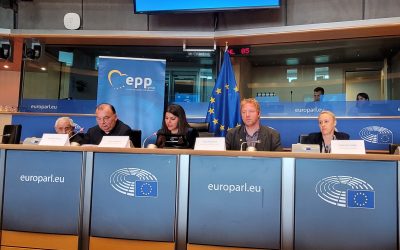
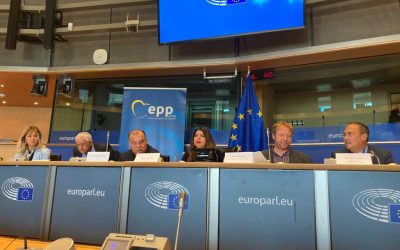
Conference EU Parliament : oppression of minorities in Iran and women rights

Conference EU Parliament : oppression of minorities in Iran and women rights

They have also encountered restrictions on their language and cultural rights. For instance, the Azeri language, which is widely spoken in Iran, has faced limitations in official settings, education, and media. Iranian law imposes certain restrictions on women, such as compulsory hijab and gender-based segregation in public spaces. It is important to emphasize that these issues are not unique to women of ethnic minority backgrounds in Iran. Women across the country, regardless of their ethnicity, face legal and social challenges that limit their rights and freedoms. I’d like to illustrate the situation of ethnic minority women in Iran with an emblematic case of persecution.
read more
Conference EU Parliament : oppression of minorities in Iran and Religious Freedom

Conference EU Parliament : oppression of minorities in Iran and Religious Freedom

It is high time that Iran listened to the voices from around the world imploring it to comply with the universal principles of respect for human rights for all Iranians, and that the persecution, discrimination, and barbaric behavior of another age cease, so that this great country with a rich and glorious history, can once again become the magnificent Iran.

read more
Oppression of Minorities in Iran : The Azeri Community as an Example

Oppression of Minorities in Iran : The Azeri Community as an Example

Join us tomorrow in the European Parliament to speak about the situation of Minorities and mainly the Azeri community. The debate aims at supporting 30 million Southern Azerbaijanis who suffer under the Iranian rule. The rights of this ethnic group must be guaranteed by anyone who claims to be an opposition leader, whether it is cultural autonomy or independence.

read more
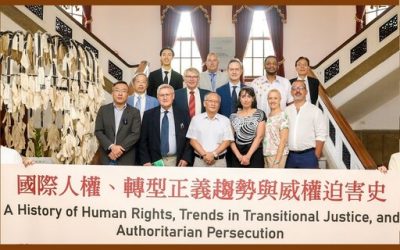
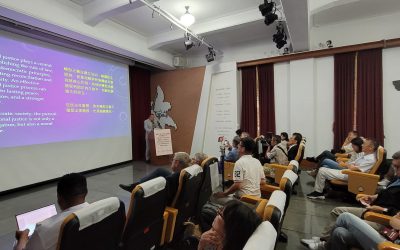
Taiwan : International Forum on Peace and Human Rights Freedom of Religion or Belief : The Case of Tai Ji Men at the United Nations

Taiwan : International Forum on Peace and Human Rights Freedom of Religion or Belief : The Case of Tai Ji Men at the United Nations

“religion and spirituality live in the hearts of the believers, but they create communities, and communities cannot exist without places where they can gather. For many religious and spiritual groups, these gathering places do not serve a functional purpose only. Land where devotees gather becomes sacred land. Religion and spirituality live in time and space. They separate portions of time and space from the daily temporal and spatial flow, appropriate them for themselves, and invest them with spiritual meanings. Taking their spaces away from spiritual movements means cutting their deepest roots.”

read more
Translate »
Share This