What is “Coordination des Associations et des Particuliers pour la Liberté de Conscience” (CAP Freedom of Conscience)?
CAP Freedom of Conscience is a secular European NGO with United Nations Consultative Status, created in 1995 and dedicated to protect the Right of Freedom of Religion and Belief.
CAP Freedom of Conscience combats all forms of discrimination based on religion or belief by alerting European and International bodies.
CAP Freedom of Conscience collects testimonies of discrimination and human rights violations affecting religious or belief communities in order to disseminate them to international bodies, and in order to raise awareness and inform them as well as to generate debate on the protection of Freedom of Religion and Belief.
CAP Freedom of Conscience also advocates for any religious or spiritual group facing discrimination to have their right to Freedom of Religion and Belief recognized.
CAP Freedom of Conscience is a member of the European Federation for Freedom of Belief (FOB), European Network Of Religion and Belief (ENORB) and participate to the Civil Society Platform of Fundamental Rights created by the EU Fundamental Rights Agency DAFOH Partners in Combating and Preventing Forced Organ Harvesting
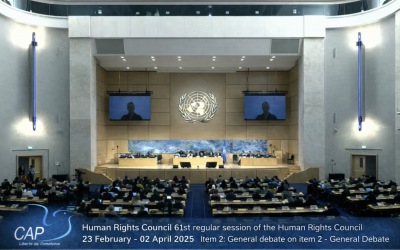
HRC 61 oral statement Item 2 Sudan
Sudan conflict: civilians face executions, torture, sexual violence. UAE supports RSF forces enabling atrocities. States must end support, investigate crimes, prevent prolonged suffering

Conference 228 Incident : 228, the Tai Ji Men Case and the Unfinished Work of Justice
The 228 Incident warns against unchecked authority. Taiwan’s Tai Ji Men case reflects similar concerns: administrative actions contradicting court rulings undermine rule of law and religious freedom protections under international human rights standards
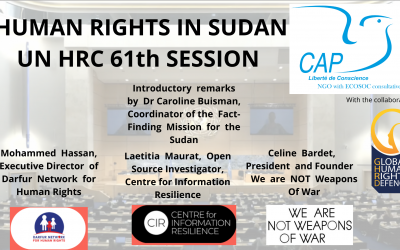
HRC 61 Side event : 1000 days of conflict. 1000 days of civilians suffering the first-hand consequences of the conflict
Sudan faces a humanitarian crisis with mass killings, sexual violence, and displacement. The UN documented genocide indicators in El Fasher and identified external support fueling RSF atrocities. Accountability remains largely absent despite ongoing investigations.
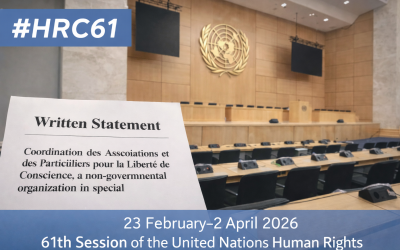
HRC 61 Written Statement : Arbitrary Detention, Enforced Disappearance, Torture, Prolonged Pre-Trial Detention, and Religious Coercion of Members of the Ahmadi Religion of Peace and Light in Egypt
Human Right Without Frontiers, International Support for Human Rights and CAP Liberté de Conscience has submitted a joint written statement to the Human Rights Council at its sixty-first session addressing the grave and systematic violations of freedom of religion or belief perpetrated against members of the Ahmadi Religion of Peace and Light (AROPL) in Egypt. Since March 2025, Egyptian authorities have detained numerous peaceful adherents of this religious minority solely for expressing their beliefs and possessing religious materials, subjecting them to arbitrary arrest, enforced disappearance lasting over a month, torture, and prolonged pre-trial detention exceeding ten months without trial. The statement documents severe violations including electric shocks, beatings, denial of legal counsel, inhumane prison conditions, and crucially, organized religious coercion through visits by Al-Azhar-affiliated sheikhs explicitly aimed at forcing detainees to renounce their faith. CAP Liberté de Conscience calls upon the Egyptian Government to immediately and unconditionally release all detained AROPL members, investigate torture and enforced disappearances by security forces, end the misuse of pre-trial detention, guarantee fair-trial rights and access to legal representation, and cease all forms of religious coercion in violation of Egypt’s international human rights obligations.

European Parliament Resolution on Systemic Oppression in Iran: A Call for International Accountability
On 12 February 2026, the European Parliament adopted Resolution P10_TA(2026)0046 addressing systemic oppression, inhumane conditions and arbitrary detentions by the Iranian regime. This text represents the institution’s continued engagement with human rights violations in Iran, building upon multiple prior parliamentary resolutions on the country. The resolution was adopted under emergency procedures (Rule 150(5) and 136(4)), underscoring the urgency with which the Parliament views the situation.

European parliament raises urgent questions on antisemitism in Eu schools following UNESCO survey
On 30 January 2026, a cross-party group of eighteen European Parliament members submitted a written question to the European Commission regarding alarming findings in a UNESCO report on antisemitism in European Union educational institutions. The initiative, led by MEPs from multiple political groups—including the European Conservatives and Reformists, Renewists, and the Patriotic Europe faction—signals growing parliamentary concern over documented prevalence of antisemitic incidents within classrooms across the bloc.
CAP Freedom of Conscience involvement UNITED NATIONS
LASTEST NEWS
Adhésion CAP LC 2024
CAP Freedom of Conscience involvement in Europe
SUPPORT CAP Liberté de Conscience
IBAN BE61 9670 0987 0017
SWIFT / BIC TRWIBEB1XXX
Address
TransferWise Europe SA
Square de Meeûs 38 bte 40
Brussels
1000
Belgium

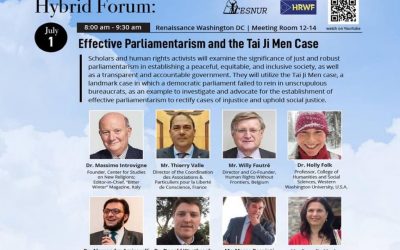
Seminar Effective Parliamentarism and the Tai Ji Men Case
Hybrid forum where scholars and Tai Ji Men members will discuss the importance of robust parliamentarism in building peaceful, equitable, and inclusive societies as well as transparent and accountable institutions. They will explore the Tai Ji Men case, and iconic case where a democratic Parliament failed to keep rouge bureaucrats in check, while calling for effective parliamentarism to clarify the injustices vested on the spiritual movement and others.
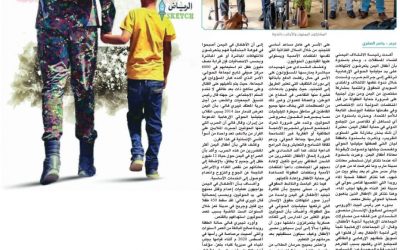
Side-event : Violations of Houthis militias against children in Yemen
Violations of Houthis militias against children in Yemen
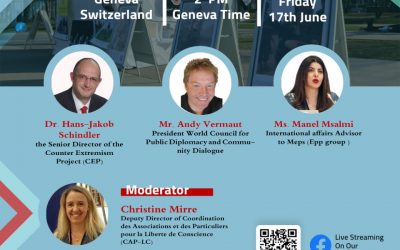
Side event Human Rights In Yemen
The eminent experts here present, that I will introduce to you, will address several issues related to human rights violations in Yemen perpetrated by the Houtis. The purpose is to enlighten us and more important, to alert international bodies on the unbearable humanitarian disaster that has been taking place since 2014 in Yemen, and which makes this country and its people one of the most damaged of the century.
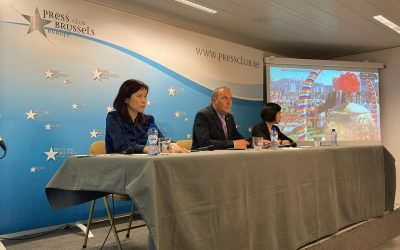
Conference at the Press Club in Brussels on 4 May, 3pm – 5pm
Tai Ji Men is a menpai (similar to school) of qigong, martial arts, and self-cultivation, and its shifu (master) and dizi (disciple) have long been committed to international cultural exchanges, spreading the concepts of love, peace, and conscience, purifying people’s hearts, and practicing world peace. It has been highly praised by Taiwanese presidents, vice presidents, and foreign ministers.
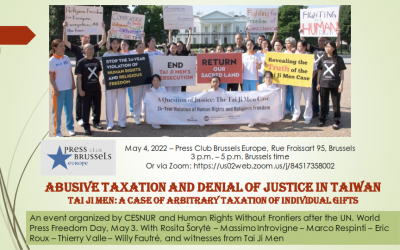
Abusive Taxation and Denial of Justice in Taiwan: The Case of Tai Ji Men A case of arbitrary taxation of individual gifts
Tai Ji Men is a menpai (similar to school) of qigong, martial arts, and self-cultivation, and its shifu (master) and dizi (disciple) have long been committed to international cultural exchanges, spreading the concepts of love, peace, and conscience, purifying people’s hearts, and practicing world peace. It has been highly praised by Taiwanese presidents, vice presidents, and foreign ministers.
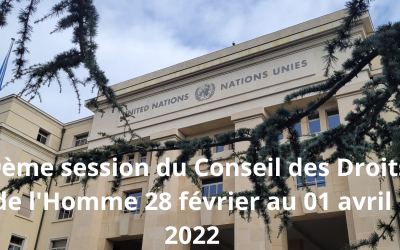
Side Event to the 49th Session of the UN Human Rights Council Roundtable Discussion
Side Event to the 49th Session of the UN Human Rights Council Roundtable Discussion